
The right choice depends on more than capacity or the word infrared: your sample matrix, required moisture definition, heating behaviour, sample mass, and reference method determine whether a moisture balance will produce defensible results. By the end, you can match the instrument to your materials, define a workable method, and create a Mumbai-specific purchase and validation checklist.
Key takeaways
- Sample mass determines useful moisture percentage resolution.
- Repeat sample preparation, heating, timing, and endpoint settings.
- Match infrared heating to the material’s drying behaviour.
- Validate the balance against a reference method before release testing.
What an infrared moisture balance actually measures
A 1.000 g sample that loses 1 mg has lost 0.1% of its starting mass. That calculation shows why sample mass matters: finer balance readability cannot create useful percentage resolution from an undersized or unrepresentative sample.
An infrared moisture balance tares the sample pan, weighs the loaded sample, heats it with infrared energy, and repeatedly weighs it as mass falls until the endpoint. It can report moisture percentage, dry-weight percentage, solids percentage, residual weight, or loss-on-drying percentage. Specify the reporting basis before comparing results: wet-basis and dry-basis values are not interchangeable.
This is a thermogravimetric measurement, not a chemically specific water test. Lost solvent, oil, decomposition products, or other volatile material can be counted as moisture, so use Karl Fischer titration when the specification requires chemically specific water content.
Before selecting a moisture balance instrument, confirm:
- Heater type, wavelength or temperature-control specification, maximum temperature, and heating uniformity
- Pan dimensions, safe sample capacity, and display resolution
- The drying programme, endpoint calculation, and reporting options
- Whether the method defines moisture as loss on drying
A moisture analyzer balance and a moisture balance usually describe the same integrated instrument class. An ordinary analytical, precision, or semi-micro balance cannot replace one because it lacks the integrated heater, drying programme, endpoint calculation, and moisture result.
How to run a repeatable moisture test
Repeatability starts with sample preparation, not the display resolution of a moisture determination balance. Mix the batch, then grind or break particles only as far as the method permits; coarse or heterogeneous material dries unevenly. Record the preparation. In Mumbai’s humidity, open the container shortly before weighing because hygroscopic powders can gain mass during transfer.
- Tare a clean, dry pan.
- Load enough material for a representative result without exceeding the moisture balance’s safe load.
- Spread the sample in a thin, even layer. A deep pile traps moisture and can form a crust, producing a slow or falsely low result.
- Select the stored programme for sample mass, temperature, heating profile, drying time, and endpoint.
- Start the run without opening the lid or changing the programme.
- Repeat the test without changing preparation or loading technique.
Endpoint choice affects comparability.
| Option | How it stops | Main risk |
|---|---|---|
| Fixed temperature and time | Runs for a defined duration at a defined temperature | May stop before slow-release moisture leaves |
| Automatic endpoint | Stops when mass change stays below a defined rate for a set time window | Can stop early after crust formation or staged drying |
Keep a fixed-time method for comparison and validation. Do not accept the first stable-looking reading; check replicates at the actual working sample mass, not only the headline readability. Record initial mass, final mass, temperature, endpoint, run time, result, and replicate variation.
Also record container-opening time and sample preparation so a humidity-driven mass change is not mistaken for product variation.
Match the heating method to the material
Infrared drying suits powders, granules, pastes, food, pharmaceuticals, plastics, textiles, soil, and wastewater solids only after you confirm that heating removes water rather than other volatile material.
| Material | Main risk | Starting decision |
|---|---|---|
| Powders and granules | Uneven drying or crusting | Spread a thin layer and screen temperature |
| Pastes and food | Skin formation, splattering, or boiling | Use a lower ramp and observe the first runs |
| Pharmaceuticals | Decomposition or solvent loss | Match the validated compendial method |
| Plastics and textiles | Additives or polymers releasing volatiles | Stay below softening or decomposition temperatures |
| Soil and wastewater solids | Bound water and heterogeneous particles | Compare with the applicable oven method |
Set the temperature below the point where the matrix chars, oxidises, decomposes, loses non-water volatiles, or forms an impermeable crust. A higher setpoint shortens a run but creates positive bias; a lower one leaves bound or slow-release water unmeasured.
Validate temperature, ramp behaviour, sample mass, layer thickness, and endpoint against the laboratory’s oven loss-on-drying method. Oven LOD uses more time and space, while an infrared moisture balance improves single-sample turnaround without becoming automatically equivalent. For soil, compare with ASTM D2216; use ASTM D2974 for peat and organic soils before reporting faster results.
If solvents or other volatiles make mass loss ambiguous, use Karl Fischer titration for chemically specific water. Treat splattering, violent boiling, flammable vapours, and decomposition as a safety review.
A moisture determination balance or moisture balance instrument is not automatically suitable for hazardous areas; require written confirmation of ventilation, over-temperature protection, gas group, temperature class, area classification, and Indian site compatibility.
Specify the instrument for Mumbai conditions and laboratory work
At a 2–5 g working mass, compare repeatability and pan handling before maximum capacity or readability. A moisture analyzer balance with a large capacity still fails if low-density material spills, splashes, forms a deep pile, or produces a nonrepresentative sample.
| Option | Specify | Why it matters |
|---|---|---|
| Heating | Heater type, temperature range, accuracy, control, pan material, dimensions and replacement cost | “Infrared” may mean a halogen emitter; setpoint bias changes moisture results |
| Methods | Stored methods, fixed-time and rate-of-change endpoints, automatic shut-off behaviour | Early stopping can miss staged drying or crusted samples |
| Data | Raw mass and temperature export, date/time stamps, audit trail, method locking and reporting format | A printed moisture percentage alone is weak release evidence |
| Site | 230 V, 50 Hz compatibility, grounding, voltage variation, interruption recovery, heat discharge, ventilation, bench space, temperature and humidity limits | Mumbai humidity and unstable supply affect loading and operation |
Request the technical datasheet and user manual, then confirm installation away from windows, exhaust outlets and air-conditioner discharge. Ask for:
- Local service response, spare pans and heaters, preventive maintenance, operator training, calibration support, warranty, lead time and total ownership cost.
- Calibration certificates and procedures for traceable mass standards and temperature verification at every working setpoint; a weight check does not verify the heater.
When comparing a CAL Series configuration or an alternative from CONTECH INSTRUMENTS LTD., obtain model-specific data for temperature range, throughput, reporting functions and sample applications. Confirm these details rather than assuming every configuration matches.
Related product
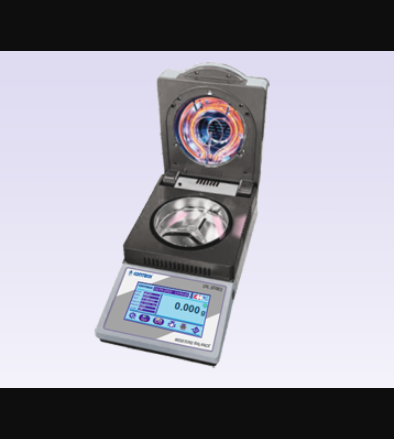 | Moisture Balances Moisture Balances (CAL Series) (0.001 g to 180 g) Moisture Balances (CAL Series) (0.001 g to 180 g) The CONTECH CAL Series Moisture Balances are advanced moisture analyzers designed for fast,... View product → |
Prove the choice before using results for release
Release a moisture balance instrument only after it agrees with the laboratory’s governing method on real samples. Test representative low-, medium-, and high-moisture material in replicates against the existing oven, compendial method, customer specification, or another approved reference. Distilled water and a supplier’s standard do not prove suitability for a complex matrix.
1. Set acceptance limits before testing for bias, repeatability, analysis time, failed-endpoint rate, and traceability. Include method-development time for screening temperature, heating profile, sample mass, particle size, endpoint, and preparation.
Select a temperature below decomposition, charring, crust formation, or loss of non-water volatiles; a high setting can create positive bias, while a low setting can leave bound moisture unmeasured.
2. Compare complete operator time and run duration with the oven workflow to determine how many samples per day justify the moisture determination balance. Do not use nominal drying speed alone. Define cleaning after sticky, oily, sugary, corrosive, or splashing samples; inspect the heater and pan, prevent carryover, and replace damaged pans.
3. Record sample identity, batch number, preparation, initial mass, programme version, temperature, endpoint, run time, final mass, moisture basis, result, replicate variation, and analyst. Use routine mass checks, temperature verification, control samples, and documented calibration intervals. Approve the moisture balance only when its result represents the intended moisture definition and meets the specification.
Frequently asked questions
What does an infrared moisture balance actually measure?
It measures mass loss during controlled heating and reports that loss as moisture only when the material’s volatile loss represents water.
How do you run a repeatable moisture test?
Control sample mass, particle size, distribution, heating settings, endpoint, and cooling or handling steps, then repeat the same method.
How do you match the heating method to the material?
Choose the temperature profile and endpoint based on how the material releases moisture without scorching, crusting, or losing other volatile compounds.
What should you specify for a moisture balance used in Mumbai?
Specify the required readability, sample capacity, heating range, repeatability, operating environment, calibration support, and laboratory workflow.
How do you prove the choice before using results for release?
Compare the moisture balance with an established reference method using representative samples, document agreement, and set acceptance limits before release testing.