
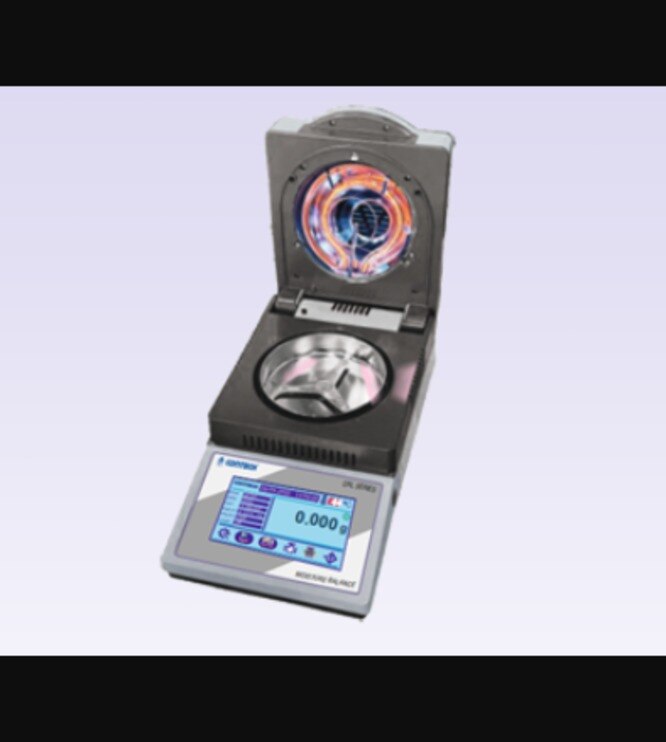
Moisture testing in a jewellery plant usually concerns investment powder, casting residues, polishing compounds, wax-related materials, plating chemicals, slurries, desiccants, and packaging—not finished gold or silver. By the end, you will know how to prepare a representative sample, build a defensible loss-on-drying method, interpret the result, and specify equipment for an Ahmedabad laboratory.
Key takeaways
- Test process materials, not finished jewellery, unless moisture affects a coating or package.
- Take increments from multiple locations and combine them before testing.
- Set drying conditions from the material’s thermal behaviour and production process.
- Record sample identity, mass, temperature, time, endpoint, and final moisture result.
Which jewellery manufacturing materials need moisture checks?
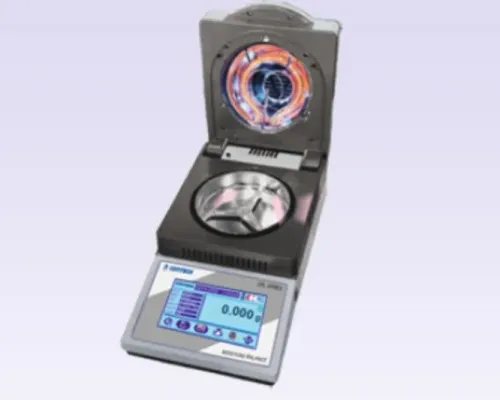
Moisture checks belong mainly on process materials, not finished jewellery. A laboratory moisture balance for jewellery manufacturing in Ahmedabad can help monitor investment powder, casting slurries, ceramic and refractory materials, polishing compounds, wax-related materials, plating chemicals, desiccants, and packaging.
| Material | Why moisture matters | Quality risk |
|---|---|---|
| Investment powder or slurry | Changes mixing, setting, drying, and burnout behaviour | Porosity, cracks, or other casting defects |
| Ceramic or refractory material | Alters storage stability and thermal preparation | Weak moulds or inconsistent casting results |
| Polishing compound | Changes hardness, flow, and application consistency | Uneven finishing or wasted compound |
| Wax-related material | Affects storage, handling, and burnout consistency | Surface defects or residue |
| Plating chemicals | Changes concentration and chemical performance | Uneven deposition or unstable baths |
| Desiccants and packaging | Shows whether moisture protection is still working | Damp materials during storage or transport |
Use a laboratory moisture balance to measure mass loss or moisture under a defined method; the acceptable limit must come from the supplier’s specification or a validated casting process. Drying can also remove solvents or other volatile components, so loss on drying is not automatically water content.
Use Karl Fischer titration when the acceptance criterion is specifically water.
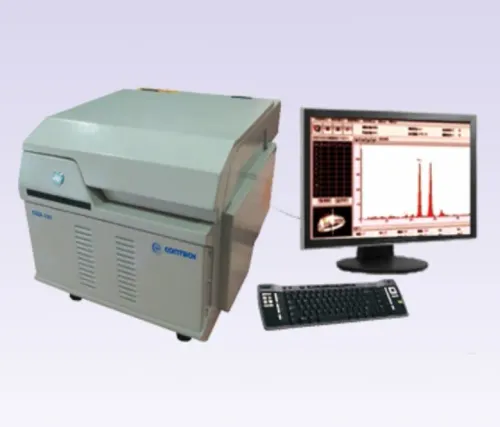
Finished gold and silver jewellery usually needs alloy or fineness analysis instead. X-ray fluorescence measures characteristic elemental radiation to screen composition and precious-metal fineness; it does not replace moisture analysis, and a moisture balance cannot answer the XRF question.
How to take and test a representative sample
Take increments from the top, middle, and bottom of the lot, or from several containers within it. Use enough material to cover the prescribed test mass after mixing; a tiny scoop can exaggerate sampling error, while excessive loading creates a thick layer that dries unevenly.
1. For powders, sample several locations, combine the increments, and mix gently. If coarse particles affect representativeness, reduce particle size using the validated preparation method. Do not grind if grinding changes the material or releases volatiles.
2. Transfer the mixed sample immediately into a clean, airtight container. During Ahmedabad’s humid monsoon, an opened hygroscopic investment or ceramic powder can change mass on the bench before moisture content analysis begins.
3. Weigh a clean, dry pan, place it on the balance, and tare it. Add the prescribed sample mass, record it, then spread the material across the pan in a thin, even layer. Use the same pan size, surface area, sample mass, and loading pattern for every test.
4. Homogenise a slurry immediately before sampling; otherwise, solids settle and the result represents only the liquid or sediment. Break a surface skin only when the method permits, and seal the container between tests.
5. Keep waxes below their melting point during sampling and use a method that prevents migration. For splattering materials, reduce the load or use a suitable cover; stop and repeat any test that loses material from the pan.
Start testing promptly, allow the programmed result to stabilise, and record the lot, preparation, mass, programme, endpoint, duration, replicate results, analyst, and instrument identification.
How to set temperature, drying time, and the endpoint
Do not treat a default programme as universal: develop a material-specific moisture determination method. Test the same homogenised sample at several temperatures and with different layer thicknesses, then plot mass loss against time. Choose the lowest temperature that reaches a repeatable plateau without scorching, oxidising, decomposing, or driving off useful components.
A thin layer dries faster, but an overloaded pan can form a crust and trap moisture.
| Temperature and endpoint | Best use | Main risk |
|---|---|---|
| Lower temperature, longer timed run | Heat-sensitive waxes, binders, or compounds | Premature endpoint or residual moisture |
| Moderate temperature to stable mass | Routine powders and investment materials | Volatile solvents can inflate the result |
| Higher temperature, carefully monitored | Thermally stable materials needing faster drying | Scorching, oxidation, or decomposition |
| Karl Fischer titration | Acceptance limits for water itself | Requires extraction or dissolution, reagents, and chemical controls |
A laboratory moisture balance reports loss on drying, not automatically water content. Solvents, residual binders, subliming substances, and decomposition products also reduce mass. Use Karl Fischer when water alone determines acceptance. Record temperature programme, sample thickness, endpoint, duration, and replicate results.
Before heating, confirm:
- Flammable or solvent-containing material is permitted for the instrument and ventilation system.
- Corrosive vapours or hazardous fumes have suitable containment and exhaust.
- The maximum temperature cannot ignite, explode, or decompose the sample.
How to use the result in jewellery quality control
Release a lot only when its moisture result meets an internal limit set from the material supplier’s specification or a validated casting process. Compare each moisture analysis result with a retained reference sample, and investigate a rising batch trend before it becomes a casting or setting defect.
| Observation | Risk to the result | Action |
|---|---|---|
| Drafts or unstable room conditions | Cooling and balance fluctuations | Close the chamber and control the room |
| Damp or dirty pan | False mass and moisture carryover | Use a clean, dry pan |
| Balance drift | Incorrect starting or final mass | Verify with traceable weights |
| Uneven heating or an overloaded pan | Incomplete, uneven drying | Reduce the load and spread it thinly |
| Crust formation or a premature endpoint | Trapped moisture remains | Break the crust and validate the endpoint |
| Splashing or spillage | Lost sample produces a false result | Reject the run and repeat |
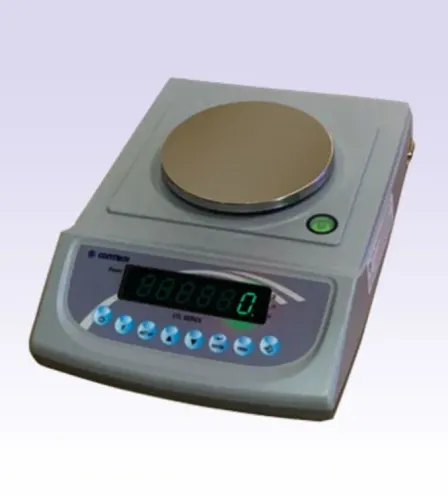
A readable display is not proof of moisture-result accuracy. A balance readable to 0.001 g cannot justify moisture accuracy of 0.001%; sample homogeneity, heating control, endpoint detection, repeatability, and reference-method uncertainty also limit moisture content analysis.
Correlate the instrument with a reference oven or validated method before using it for release. Halogen heating can disagree with an oven when drying kinetics or decomposition differ.
Record the lot, sample mass, preparation, temperature programme, endpoint, duration, replicates, analyst, and instrument. Use the same method for trend comparisons.
What to specify when selecting a moisture balance in Ahmedabad
Specify the material before you specify the instrument. For a laboratory moisture balance for jewellery manufacturing in Ahmedabad, give the supplier each sample type, expected moisture range, required turnaround time, and maximum permitted sample temperature. A display resolution of 0.001 g does not prove moisture-result accuracy.
1. State whether you will test investment powder, casting residue, polishing compound, wax-related material, plating chemical, desiccant, packaging, powder, or slurry. Record the acceptance range and required sample mass for each; one default programme is not a universal moisture analysis method.
2. Define heating and endpoint controls. Require an adjustable temperature range, controlled heating profile, repeatable sample loading, and an endpoint based on stable mass or a validated time. Exclude samples that ignite, explode, release corrosive vapours, or generate hazardous fumes unless the instrument and ventilation controls are rated for them.
3. Require electronic data export in a usable format, an audit trail showing changes and user identity, calibration certificates, stored programmes, and operator training. Ask for local service response times in Ahmedabad, spare-parts availability, and documented escalation for failed tests.
4. Put verification into the purchase specification: check the balance with suitable traceable weights, verify or calibrate the heating-system temperature, and compare results periodically with a reference oven or another validated method. Use ISO/IEC 17025 when the laboratory needs technically valid, traceable results for release or customer reporting.
5. Evaluate suppliers such as CONTECH INSTRUMENTS LTD. against these documents and demonstrations, not labels such as “halogen” or “fast.” Require repeatability data on your materials before treating a high-resolution display as evidence of suitability.
Related product
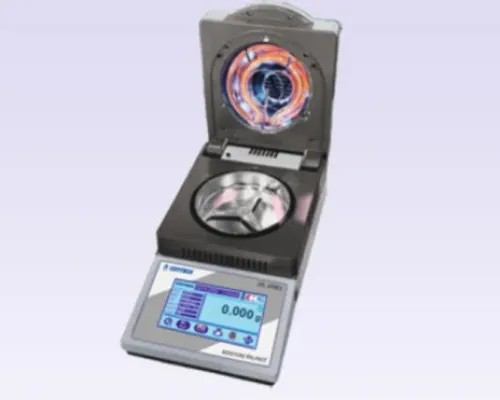
 | Moisture Balances Moisture Balances (CAL Series) (0.001 g to 180 g) Moisture Balances (CAL Series) (0.001 g to 180 g) The CONTECH CAL Series Moisture Balances are advanced moisture analyzers designed for fast,... View product → |
Frequently asked questions
Which jewellery manufacturing materials need moisture checks?
Check investment powder, casting slurries, ceramic and refractory materials, polishing compounds, wax-related materials, plating chemicals, desiccants, and packaging when moisture can affect processing or storage.
How do you take a representative sample for moisture analysis?
Take small increments from several locations in the material, combine them, mix the composite sample, and test promptly in a sealed container to limit moisture exchange.
How do you set temperature, drying time, and the endpoint?
Choose a temperature that removes moisture without decomposing or curing the sample, set drying time from repeat tests, and define the endpoint as a stable mass or a specified change between readings.
How should moisture determination results support jewellery quality control?
Record the material lot, sample mass, drying settings, endpoint, result, operator, and time, then compare the result with an approved process limit or historical control range.
What should you specify when selecting a moisture balance in Ahmedabad?
Specify weighing resolution, maximum sample mass, heating range, temperature control, endpoint modes, data export, calibration support, pan size, and local service response.