
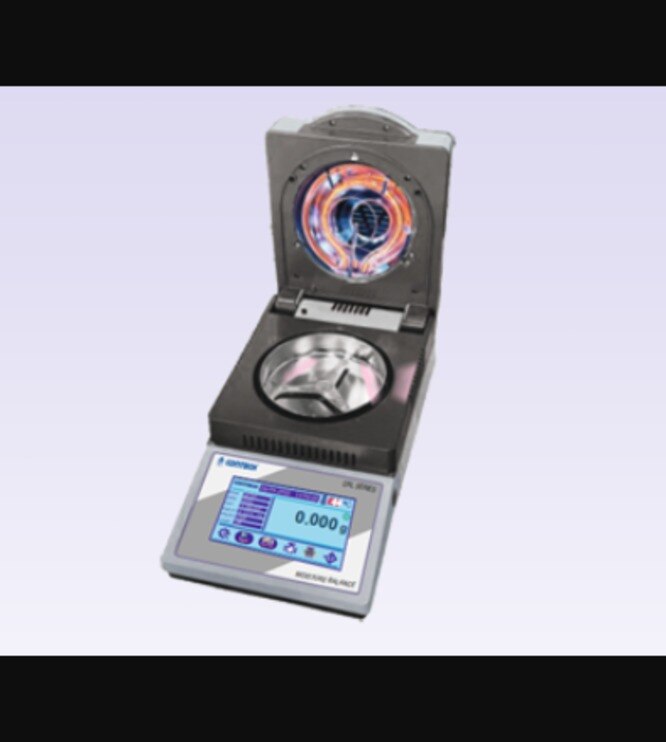
A heating test can reveal whether a spice, tablet granule, chemical powder, textile material or soil sample has reached its required drying level, but the result is not automatically a measurement of water alone. By the end, you will know how infrared heating and weighing produce a result, how to prepare and validate a method, when to use another technique, and what to compare when selecting equipment in Ahmedabad.
Key takeaways
- Spread a representative sample evenly to prevent surface drying from masking internal moisture.
- Set temperature from the material’s heat tolerance, not from a generic default.
- Use loss on drying when volatile mass loss represents moisture for your process.
- Compare repeatability, endpoint controls, sample capacity, calibration and service support before buying.
How infrared heating turns sample weight loss into a result
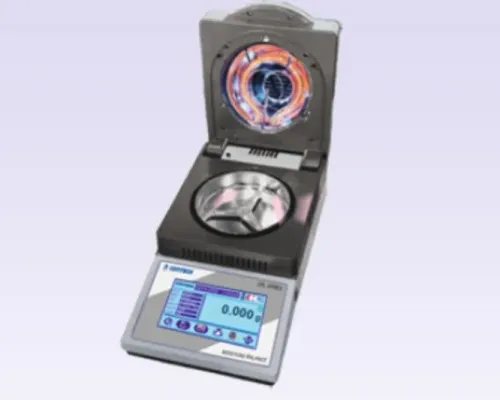
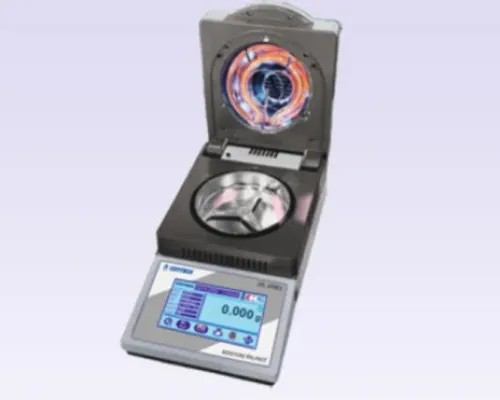
An infrared moisture analyzer heats a prepared sample while its balance tracks mass loss, turning drying behaviour into a rapid moisture detection result.
For an infrared moisture analyzer in Ahmedabad, treat the CAL Series as infrared only when the manufacturer documents an infrared lamp or infrared heating specification; otherwise, confirm that detail before selecting it for infrared moisture measurement.
1. Place a representative, prepared sample in a clean, dry pan and record its initial mass. Spread powders, pastes or slurries in a thin, even layer so the surface does not dry while moisture remains underneath.
2. Apply controlled infrared radiation. Wavelength and lamp power determine how quickly energy enters the sample, while sample colour and reflectivity change how much radiation it absorbs. A dark material can heat differently from a pale one.
3. Weigh continuously during drying. Keep the pan clean and undamaged; residue, warping or a reflective coating changes heat transfer and can distort repeatability.
4. Stop at the defined endpoint: a fixed time, a specified mass-loss rate over an interval, or constant mass. The chosen endpoint is a method setting, not proof that all water has left.
5. Calculate the reported drying loss: moisture percentage = (initial sample mass − final dry mass) ÷ initial sample mass × 100.
This result includes every substance lost under the selected temperature, radiation and time. It is therefore loss on drying, not automatically a water-specific measurement; solvents and other volatile compounds can also lower the final mass.
How to prepare a representative sample and calculate loss on drying
Repeatability starts with the sample, not the infrared moisture analyzer. A poor increment, uneven layer or changing sample mass can produce different results from the same batch.
1. Take increments from different locations in the batch, then mix them thoroughly. Break lumps and grind the material when grinding does not alter its composition. This creates a representative portion for the moisture analysis method.
2. Place the portion on a clean pan in a thin, even layer. Spread pastes, powders, slurries and heterogeneous industrial materials across the pan instead of forming a mound. A mound can develop a dry surface while moisture remains underneath.
3. Establish the sample mass during method validation. A larger sample is not automatically better: overloading lengthens drying and can bias the endpoint, while an excessively small portion may not represent the batch or may exceed the balance’s practical resolution. Use the validated mass consistently.
4. For hygroscopic samples, limit exposure between sampling and weighing. Define how you handle the pan, the cooling or weighing conditions, and the permitted exposure time; prevent re-absorption before the final reading.
5. Record the initial mass before heating and the final dry mass at the selected endpoint. Wet-basis reporting expresses moisture as a percentage of the original sample mass:
Moisture percentage = (initial mass − final dry mass) ÷ initial mass × 100
This moisture measurement is loss on drying, so it includes any volatile material removed under the chosen heating conditions, not automatically water alone.
How to set temperature, heating profile and endpoint for Ahmedabad materials
Do not assign settings by product name alone. A moisture analysis method for Ahmedabad materials must specify drying temperature, ramp or step heating profile, sample mass, layer thickness, endpoint and maximum test duration. Validate those settings against the product-specific reference method across the expected moisture range; copying an oven temperature can produce a misleading result.
| Endpoint | How it works | Main consequence |
|---|---|---|
| Fixed time | Stop after a defined duration | A slow-drying sample can retain moisture; an overheated sample can lose non-water volatiles |
| Mass-loss rate | Stop when loss stays below a stated rate over a stated interval | The result depends on the chosen rate and interval |
| Constant mass | Continue until successive readings meet a defined mass-change limit | Takes longer but targets drying completion under that method |
Changing the endpoint can change the reported percentage. Excessive heat can scorch food or spices, form a surface skin on slurries, decompose pharmaceuticals or chemicals, or drive off solvents and other non-water volatiles.
Use results for release and storage decisions in spice and food processing; powders and granules in pharmaceutical and chemical plants; fibres or process materials in textile operations; incoming grain lots; ceramic bodies and slurries; and solids in soil or wastewater laboratories.
A rapid result matters when it changes a dryer setting, batch release, incoming-material decision or process endpoint. Confirm moisture detection performance with representative samples at low, medium and high moisture levels, not one convenient batch.
When infrared loss on drying is useful—and when another method is safer
Infrared loss on drying is useful when your specification accepts mass lost during a defined heating programme, not water alone. It is not a stand-alone water test for samples containing volatile solvents, fragrances, plasticizers, decomposition products or other non-water volatiles.
| Method | What it measures | Main difference |
|---|---|---|
| Infrared LOD | Mass loss during infrared heating | Rapid heating, controlled ramp and endpoint; heat transfer depends on sample colour, reflectivity and layer |
| Conventional oven drying | Mass loss after oven exposure | Reference procedure for some materials, but tests can take tens of minutes or hours |
| Halogen heating | Mass loss during rapid gravimetric heating | Another fast LOD approach, not proof that its result equals an infrared result |
| Karl Fischer titration | Water content by chemical reaction | Stronger comparison when the specification concerns water specifically; validate the matrix |
Treat thermally decomposing or oxidising materials as unsuitable for heated LOD until a safe, validated method demonstrates otherwise. Karl Fischer also requires matrix-specific validation.
Transfer a method from an oven to an analyzer only after you have:
- Tested representative samples across the expected moisture range.
- Set acceptance limits before comparison.
- Checked repeatability and bias against the product-specific reference method.
- Confirmed the temperature profile, ramp rate and endpoint, not just the final mass.
A calibrated weight checks the balance function; it does not prove that the heating profile or moisture measurement method is accurate. Changing the endpoint can change the reported result.
What to compare before selecting an infrared moisture analyzer in Ahmedabad
Choose an infrared moisture analyzer in Ahmedabad by its validated result, not its maximum temperature or nominal readability. Compare repeatability at the intended sample mass, temperature-program capability, ramp control, endpoint options, pan size, maximum temperature, data export, audit-trail features, service response, calibration support and documented instrument-performance checks.
Use this purchasing checklist:
- Ask for repeatability data at your actual sample mass, not a lighter test portion.
- Confirm fixed-time, mass-loss-rate and constant-mass endpoints, plus programmable ramps or steps.
- Check that the pan accommodates your layer thickness and that maximum temperature suits the material.
- Request sample exports, user access controls and an audit trail showing method, result, changes and operator.
- Ask for service response times, local calibration arrangements and records for performance checks.
- Require evidence that the balance was checked with a traceable test weight, and that temperature or heating performance was checked separately.
Compare methods before accepting a supplier’s claim that two analyzers agree.
| Method comparison | What to compare | Decision evidence |
|---|---|---|
| Oven drying | Same representative samples across the expected moisture range | Predefined bias and repeatability limits |
| Karl Fischer titration | Water-specific result against the analyzer’s drying loss | Correlation demonstrated for the actual matrix |
| Infrared LOD | Temperature, ramp, mass and endpoint against the reference method | Accepted bias, repeatability and documented method |
For equipment from CONTECH INSTRUMENTS LTD., ask which CAL Series configuration uses infrared heating, whether your material has a validated temperature and endpoint method, and how local calibration and service are documented. The useful decision is whether moisture measurement supports release, drying control or incoming inspection in your Ahmedabad operation.
Related product
 | Moisture Balances Moisture Balances (CAL Series) (0.001 g to 180 g) Moisture Balances (CAL Series) (0.001 g to 180 g) The CONTECH CAL Series Moisture Balances are advanced moisture analyzers designed for fast,... View product → |
Frequently asked questions
How does an infrared moisture analyzer produce a moisture result?
Infrared radiation heats the sample while an integrated balance records weight loss. The instrument reports loss on drying as moisture when the lost mass represents water.
How should you prepare a sample for infrared moisture measurement?
Collect a representative portion, mix it, remove large lumps without changing its moisture, and spread a thin, even layer across the pan. Record sample mass and test conditions.
How do you set temperature and endpoint for Ahmedabad materials?
Start below the material’s decomposition or scorching temperature, then adjust the heating profile using repeat tests against a reference method. Select an endpoint based on stable mass rather than an arbitrary drying time.
When is infrared loss on drying the wrong moisture analysis method?
Use another method when the sample contains solvents or volatile compounds, decomposes during heating, or requires a specific water measurement. Karl Fischer titration can distinguish water from other volatile losses.