
Ahmedabad’s humid air does not automatically disqualify a heated moisture analyzer, but it can change the sample before testing and destabilize results when temperature, airflow, or condensation is uncontrolled. You will be able to set up the instrument, handle samples, select a defensible drying method, and verify performance against an appropriate reference procedure.
Key takeaways
- Control sample exposure before loading the analyzer.
- Set temperature and endpoint from the product method, not guesswork.
- Validate results against an oven or Karl Fischer reference.
- Use a hygrometer or data logger to track room humidity.
When Ahmedabad humidity affects the analyzer—and when it affects the sample
Yes, an electronic moisture analyzer can operate reliably in Ahmedabad, but humidity affects the hygroscopic sample more directly than the electronic balance or heater. The instrument measures mass lost during heating; it does not measure room relative humidity. An electronic moisture analyzer for humidity in Ahmedabad therefore does not replace a hygrometer or data logger.
1. Check the exact model’s environmental limits before installation. Do not assume an 80% RH rating applies universally; the limit may depend on room temperature and may require non-condensing conditions. Keep the room stable within the manufacturer’s stated temperature and humidity range, without sudden airflow or temperature changes.
2. Place the analyzer on a stable, level, enclosed bench away from doors, windows, sunlight, ovens, vibration, and direct air-conditioning flow. Drafts can disturb the weighing signal, while nearby heat or fluctuating airflow can change drying conditions. A hygroscopic sample can gain or lose moisture before testing, even when the analyzer itself remains functional.
3. Prevent condensation after transport or storage. Let a cold analyzer, pan, sample container, or specimen reach room temperature before switching on or testing. Condensation can destabilise weighing, contaminate the pan, and create an electrical-safety risk.
4. Record ambient temperature and RH during testing, then interpret unusual results separately. Sample moisture change points to handling or exposure; unstable readings point to drafts, condensation, balance drift, or temperature disturbance. A model-specific warm-up period and stable room conditions are more useful than finer display resolution alone.
How to prepare and load a sample without changing its moisture
A reliable moisture analysis starts by controlling the sample before it reaches the pan, not by correcting the result afterward.
1. Keep the specimen in a sealed, labelled container during transport and storage. Record sample identity and collection time, then let the closed analyzer, container, and sample reach laboratory temperature before opening.
2. Define a documented equilibration rule from the temperature change and material. A cold, hygroscopic powder needs different conditioning from a stable granule; use the selected conditioning time for every test instead of inventing one universal waiting period.
3. Inspect the empty pan, place it correctly, and confirm that it is clean and undamaged. For liquids, use a validated disposable pad, place it flat, and tare the pan and pad together. Handle pans by their edges to prevent fingerprints from adding mass.
4. Open the container only when you are ready to load. Homogenize the specimen quickly with minimal exposure, breaking lumps without grinding, heating, or drying the material.
5. Load the validated mass in a thin, even layer across the pan. A deep central pile, excessive mass, or uneven surface creates temperature and diffusion gradients, so the top can dry while the centre remains wet. Loading geometry must come from the method, not the balance capacity.
6. Record the sample identity, mass, conditioning time, and loading time. After the run, remove residue and clean the pan area using the approved procedure.
A changing result during loading indicates moisture gain or loss. A drifting display with no sample change points instead to drafts, vibration, or balance instability. Both require investigation in moisture content analysis.
How to choose temperature, endpoint, and the right moisture method
One drying temperature or fixed run time cannot suit powders, granules, liquids, polymers, food materials, and heat-sensitive chemicals. A liquid can boil and spit; a powder can form a skin or crust; a polymer or chemical can decompose before its water leaves.
Use a staged program or lower initial temperature to control boiling, spitting, skin formation, and crusting. Higher heat shortens drying, but it can decompose the specimen or release volatile substances that are not water. Revalidate every changed method.
An automatic endpoint means only that mass has stabilised under the chosen conditions. It does not prove that all water has left: slow diffusion, surface crusting, and reabsorption can stop the test prematurely.
Treat an electronic moisture analyzer, or moisture balance instrument, as a Loss on Drying system until a reference method confirms its moisture content analysis.
| Option | What it measures | When it is wrong |
|---|---|---|
| Halogen or infrared thermal Loss on Drying | Total mass lost during heating | Decomposition or non-water volatiles affect mass loss |
| Oven drying | Mass loss after a longer heated cycle | The material is unstable or heat-sensitive, or speed matters |
| Karl Fischer titration | Chemically specific water | You need broad volatile-loss measurement; it is not a substitute |
| Moisture probe | An indirect signal through a sensor | Matrix, calibration, contact, or sampling geometry is not validated |
Report the result on a declared wet basis or dry basis. Wet basis divides water by original mass; dry basis divides water by dry-solids mass, so the percentages are not interchangeable.
How to validate results against an oven or Karl Fischer reference
Start by defining the measurand and acceptance limit. Compare wet-basis moisture with wet-basis moisture, or dry-basis with dry-basis; never mix the two percentages. Use the same representative matrix, homogenization step, sample mass, storage interval, and stated laboratory standard or internal specification for every comparison.
Run replicate specimens to establish repeatability, plus an empty-pan or blank check. Record the temperature, ramp, sample mass, pan or disposable pad, endpoint rule, and run time. The automatic endpoint proves only that mass loss has stabilised, not that all water has left.
| Method | What it measures | Main limitation |
|---|---|---|
| Electronic moisture analyzer | Thermal loss on drying | Residual solvents, decomposition, crusting, or incomplete drying can bias the result |
| Reference oven | Loss on drying under its specified temperature and time | Slow drying and reabsorption can affect agreement |
| Karl Fischer | Chemically specific water | It does not measure every volatile component lost during heating |
Compare results only after selecting the applicable oven procedure or Karl Fischer procedure. Do not demand numerical agreement between methods that measure different quantities. Investigate bias from residual solvents, decomposition, reabsorption, crusting, incomplete drying, and sample heterogeneity.
- Check balance calibration with a traceable mass; this does not verify heater temperature.
- Verify heater temperature separately, then repeat both checks after installation, relocation, service, or a major environmental change.
- Treat 1 mg readability as a display specification, not moisture-result accuracy; loading, temperature uniformity, endpoint selection, preparation repeatability, and reabsorption also contribute uncertainty.
A defensible moisture content analysis therefore validates the complete electronic moisture analyzer method on the actual sample matrix, not merely its balance.
What to ask before approving an analyzer for Ahmedabad use
Approve a moisture balance instrument only after its environmental limits and method performance are documented for your site and materials.
1. Ask for the exact model’s operating temperature and relative-humidity limits, including its non-condensing qualification and warm-up guidance after transport or a large temperature change. Request the heater-temperature verification procedure, balance calibration procedure, sample-mass limits, pan geometry, endpoint options, and stored method records.
2. Request repeatability data and comparison results for the materials you will test in Ahmedabad. Balance readability does not prove moisture accuracy; require evidence from the actual matrix, sample preparation, temperature program, endpoint rule, and reference method.
3. Require a site trial before acceptance. Test a normal sample, a high-moisture or liquid sample, a slow-drying sample, and a heat-sensitive sample where relevant. Record sample mass, pan or pad, drying temperature, ramp, endpoint, run time, replicate results, and comparison with an oven or Karl Fischer procedure.
4. Ask CONTECH INSTRUMENTS LTD., an Ahmedabad manufacturer, for model-specific environmental specifications and application discussion, then judge the instrument by documented results rather than brand familiarity. Reject approval if the supplier cannot explain how heater temperature and balance calibration are verified.
Humidity alone is not a pass/fail criterion; an electronic moisture analyzer for humidity in Ahmedabad is suitable when the room, sample handling, drying program, endpoint, and reference comparison are validated together.
Related product
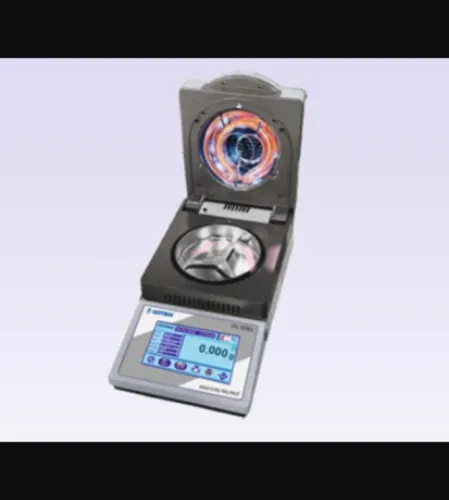
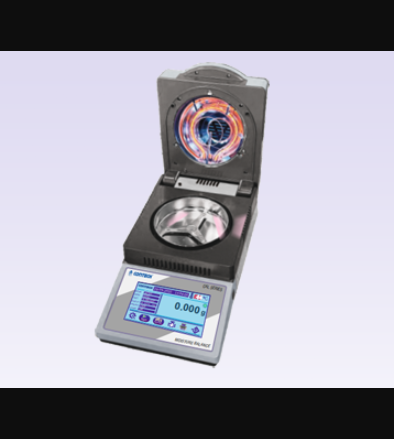 | Moisture Balances Moisture Balances (CAL Series) (0.001 g to 180 g) Moisture Balances (CAL Series) (0.001 g to 180 g) The CONTECH CAL Series Moisture Balances are advanced moisture analyzers designed for fast,... View product → |
Frequently asked questions
Does Ahmedabad humidity affect the analyzer or the sample more?
Humidity affects hygroscopic samples more directly than the analyzer. The analyzer measures mass lost during heating and does not measure room relative humidity, so use a hygrometer or data logger separately.
How should you prepare and load a sample in humid conditions?
Keep the sample container closed until preparation, minimise exposure time, mix consistently, and load the specified sample mass quickly. Record the time between opening, weighing, and starting the test.
How do you choose the temperature and endpoint for moisture analysis?
Use a temperature and endpoint validated for the product. A high temperature can evaporate volatile components or degrade the sample, while an endpoint that is too early leaves residual moisture.
How do you validate an electronic moisture analyzer result?
Test representative samples with the analyzer and compare them with a validated oven method or Karl Fischer reference. Define an acceptance difference, repeatability limit, sample preparation procedure, and routine check schedule before approval.