
Chemical powders, salts, granules and finished products can gain or lose moisture between sampling, weighing and drying, making a displayed result difficult to trust without a controlled method. By the end, you will know which production materials and sampling points suit a moisture balance analyzer, how to run moisture content determination, and when Karl Fischer or an oven method is the better choice.
Key takeaways
- Sample across the lot and seal containers immediately to prevent moisture change.
- Record sample mass, temperature, drying time and endpoint for every test.
- Increase sample mass only when the matrix remains uniform and dries evenly.
- Confirm moisture-balance results with oven drying or Karl Fischer when specificity matters.
Which Ahmedabad chemical-production materials need moisture analysis?
Powders, granules, crystals, salts, pigments, fertilizers, polymers, resins, intermediates and finished products all warrant moisture analysis when water changes a release decision or processing result.
| Material | Moisture-related decision | Sampling or control point |
|---|---|---|
| Powders and pigments | Prevent poor flow, caking and dosing errors | Incoming bags, drums and final lots |
| Granules, crystals and salts | Control dissolution, crystallisation and storage stability | Tanker or drum receipt and dryer discharge |
| Fertilizers and polymers | Protect concentration, reaction yield and downstream processing | Reactor, dryer and in-process release |
| Resins, intermediates and finished products | Confirm specification, stability and packaging weight | Production lot and final-batch quality control |
At receipt, test raw materials from tankers, drums or bags before they enter production. During reaction and drying, moisture results help decide whether to extend drying, adjust concentration or release material to the next stage. Final testing catches water that could cause caking, altered dissolution, unstable storage or incorrect packed weight.
A moisture balance analyzer is most defensible for rapid screening when the material’s drying curve has been correlated with an approved reference method. Validate repeatability, intermediate precision, working range, agreement with that method, selectivity against volatile components and robustness to sample mass and temperature changes.
Without that correlation, the result is loss on drying: solvents, residual monomers or decomposition products can count as “moisture,” so low-level water specifications may require a specific method such as Karl Fischer titration.
How to collect a representative sample without changing its moisture
1. Sample the entire lot, not just its surface. From drums and bags, take increments from the top, middle and bottom; from tankers and reactors, sample separate depths through the approved port; from dryers, take increments across the discharge period. Combine increments from the same lot only after recording each location.
2. Mix and reduce the combined sample in a clean, dry container without frictional heating. Use a moisture-tight, wide-mouth glass or chemically compatible screw-cap container with a liner. Divide it with a sample splitter or by repeated quartering; do not leave hygroscopic powder exposed on paper.
3. Record the lot number, source vessel or bag range, sampling point, date, room temperature, relative humidity, and sampling start and finish times. Ahmedabad’s monsoon air can increase uptake rapidly, while air-conditioned rooms can dry exposed surfaces and dehumidified areas create a different uptake history.
4. Seal the container immediately and transfer it to the analyzer within 15 minutes. Keep it closed in a desiccator during any unavoidable delay, and record the actual exposure time. Conduct moisture analysis in the validated room-condition range, with the pan and sample protected from drafts.
5. Test the material as received unless the approved moisture content determination permits particle-size reduction. Grind only with a clean, dry mill when validation allows it; grinding can release heat and expose fresh hygroscopic surfaces. Record the sieve or grinding condition, sample mass, pan-loading method and replicate number.
These controls determine whether results from different production lots are comparable.
How to run a moisture balance and interpret the LOD result
Run the electronic moisture balance as a controlled drying test, not as an automatic water assay.
- Clean and dry the pan, place it correctly, then verify zero and tare with the empty pan.
- Weigh the prescribed sample mass and record the initial mass.
- Spread the sample in a thin, even layer. Break permitted lumps without changing the particle-size treatment specified in the method.
- Select the validated heating program, including temperature, ramp and endpoint. Do not substitute a preset because it gives a faster result.
- Close the chamber and allow the moisture balance analyzer to heat and weigh without interruption.
- Review the initial mass, final mass, mass-loss curve and endpoint. Record the displayed result, program, sample mass and replicate number.
For moisture content determination, state the reporting basis. Wet-basis moisture equals mass loss divided by initial mass, multiplied by 100. Dry-basis moisture equals mass loss divided by dry solids mass, multiplied by 100. The same sample therefore produces different percentages when the basis changes.
Loss on Drying (LOD) measures mass lost during the selected heating program, not chemically specific water. Solvents, residual monomers, sublimation and decomposition products can also reduce mass. A stable curve only shows that the measured mass has stopped changing; it does not prove that only water evaporated.
Confirm specificity for a new chemical matrix by comparing the program with Karl Fischer, oven LOD or thermogravimetric data. Report the method basis explicitly, or results from different batches and laboratories cannot be compared reliably.
How to set temperature, time and sample mass for difficult chemical matrices
Start at the lowest temperature that removes moisture without changing the matrix. A stepped ramp is safer for salts, pigments, polymers, fertilizers, crystals and intermediates that melt, spatter, oxidise, decompose or form a surface crust.
| Matrix behaviour | Program choice | Main control |
|---|---|---|
| Conductive or ionic salt | Low initial heat and smaller mass | Prevent spatter and trapped moisture |
| Melting or crusting solid | Stepped ramp | Expose moisture without sealing the surface |
| Polymer or volatile intermediate | Lower temperature and longer time | Avoid decomposition and non-water loss |
| Stable powder or granule | Validated constant temperature | Confirm agreement with the reference method |
Reduce sample mass for conductive or ionic materials, but do not overload the pan. Spread a thin, even layer; an uneven bed dries at different rates and produces poor repeatability. Use clean, dry pans, remove contamination, shield the instrument from drafts, and transfer hygroscopic powders quickly.
Do not accept a preset such as “less than 1 mg change in 30 seconds” without validation. Keep the chamber closed until the result is stable; opening it early introduces drafts and moisture exchange, while a crust can make the surface appear stable before the interior dries.
Validate the method for:
- Repeatability, intermediate precision and working range
- Recovery or agreement with an approved reference method
- Selectivity against solvents and other volatile components
- Robustness to sample mass, grinding and temperature changes
- Balance calibration status, weighing repeatability, zero/tare behaviour and heater performance
Record the temperature program, time or validated endpoint, sample mass, pan condition, exposure controls and wet- or dry-basis reporting rule. A moisture analysis method becomes defensible only when its moisture content determination matches the product specification, not a generic instrument preset.
Which moisture method fits production speed, specificity and throughput?
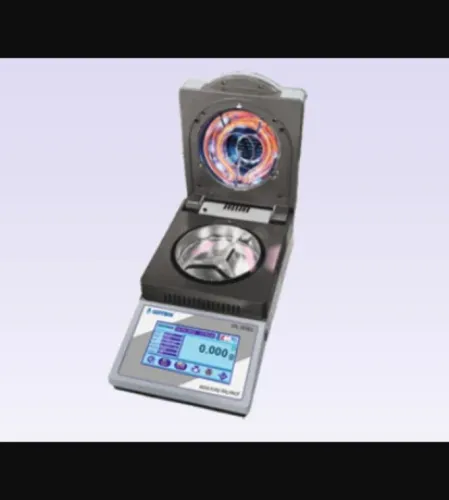
An electronic moisture balance integrates weighing and heating, so it supports rapid in-process screening without transferring a sample between instruments. Infrared or halogen describes the heating source, not a separate measurement principle; both report mass loss unless validated as specific water measurement.
| Option | Speed and throughput | Main limitation |
|---|---|---|
| Electronic moisture balance with infrared or halogen heating | Fast screening, automated endpoint, low operator workload; useful for frequent powder, salt, pigment or resin checks | Volatile solvents, residual monomers, sublimation or decomposition inflate LOD; temperature programming needs validation |
| Oven-based gravimetric LOD | Useful reference method with established temperature control | Slower equilibration, separate balance weighing, more handling and lower batch throughput |
| Volumetric Karl Fischer | Specific water analysis for higher water levels and routine batch testing | Solvent compatibility and reactive matrices can interfere; titration adds preparation |
| Coulometric Karl Fischer | Specific water analysis for very small quantities | Small water capacity and matrix or solvent reactions can compromise results |
| Laboratory balance plus drying oven | Flexible reference setup for LOD development | Highest operator workload and poorest in-process speed; weighing and heating remain separate |
Choose the method against the product specification, not the display resolution. Validate repeatability, intermediate precision, working range, agreement with Karl Fischer or oven LOD, selectivity, and robustness to sample mass, grinding and temperature.
Before purchase, ask CONTECH INSTRUMENTS LTD. for application trials, calibration records, heater and balance checks, service response, and method-development support. A specification sheet proves instrument capability, not suitability for your chemical matrix.
Related product
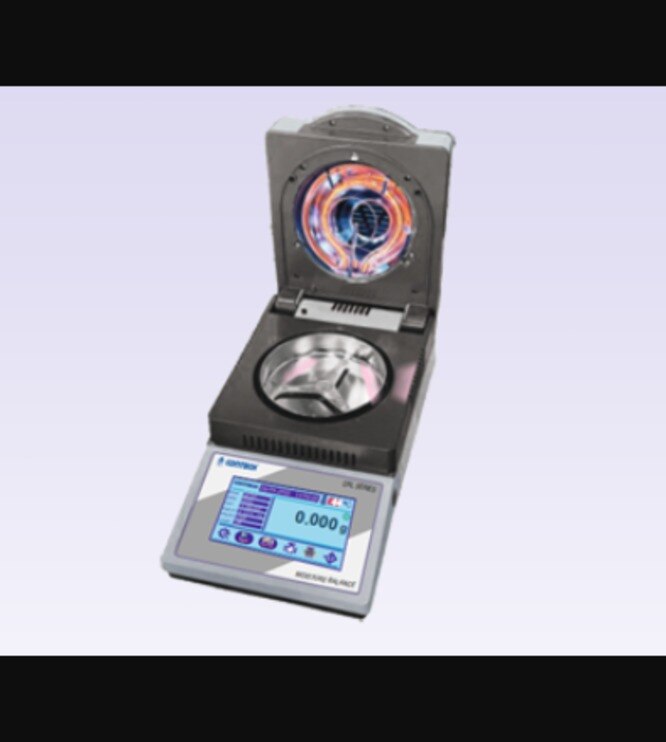
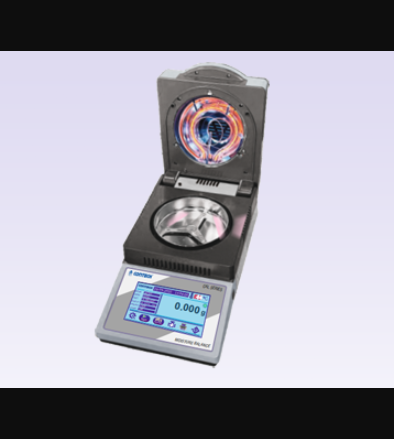 | Moisture Balances Moisture Balances (CAL Series) (0.001 g to 180 g) Moisture Balances (CAL Series) (0.001 g to 180 g) The CONTECH CAL Series Moisture Balances are advanced moisture analyzers designed for fast,... View product → |
Frequently asked questions
Which Ahmedabad chemical-production materials need moisture analysis?
Test powders, granules, crystals, salts, pigments, fertilizers, polymers, resins, intermediates and finished products when water affects release, handling, stability or processing.
How do you collect a representative chemical sample without changing its moisture?
Take increments from different locations in the lot, combine them when appropriate, minimize exposure to room air, and seal the sample container immediately.
How do you run a moisture balance and interpret the LOD result?
Weigh the prepared sample, heat it under a defined program, record the mass loss, and report loss on drying as a percentage while checking that the endpoint is stable.
How should you set temperature, time and sample mass for difficult chemical matrices?
Start with a temperature that removes water without decomposing or volatilizing the matrix, spread a consistent sample layer, and confirm the endpoint through repeat tests.
Which moisture method fits production speed, specificity and throughput?
Use an electronic moisture balance for rapid routine screening, oven drying for established gravimetric methods, and Karl Fischer titration when water-specific measurement is required.