
An IR moisture test is not simply a sample placed under a lamp: the result depends on preparation, mass tracking, heating conditions, and the endpoint chosen. By following each stage, you can understand what the instrument measures directly, calculate the result correctly, and decide whether the method is suitable for your material.
Key takeaways
- Mix and reduce the sample without heating or drying it before testing.
- Record the initial mass before infrared heating begins.
- Validate drying temperature, time, and endpoint settings for each material.
- Check the analyzer and document the final moisture result with sample details.
1. Prepare the Sample and Record the Starting Mass
1. Mix the batch before sampling so the portion reflects the whole material rather than a wet or dry pocket. Reduce particle size only enough to improve uniformity, using a method that does not warm, dry, or otherwise alter the sample. Transfer it gently and consistently to prevent segregation by particle size or density.
2. Control exposure during preparation. Hygroscopic samples can gain water from ambient air; warm or finely divided samples can lose water quickly. Keep the material in a sealed container, equilibrate it to a defined temperature and humidity when the method requires it, and weigh it promptly.
Use the same mixing, grinding, equilibration, and transfer procedure for every replicate.
3. Place a clean, dry pan on the balance, close the chamber or shield the pan from drafts, and tare the balance to zero. Add the prepared sample, spread it evenly without pressing it into a compact layer, and record the sample identity and initial mass before heating.
This controlled sequence is the foundation of a reliable moisture analysis method and moisture measurement.
4. Specify both the target sample mass and maximum layer thickness. Too little sample magnifies tare error, balance noise, and sample heterogeneity; too much dries slowly and can leave a wet centre.
The method must balance signal strength against even drying, because a thick layer can produce a falsely low result even when the displayed mass appears stable.
2. How Infrared Heating Removes Moisture During the Test
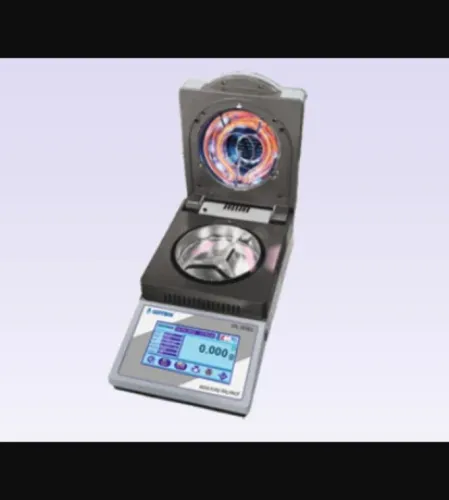
After the initial mass is recorded, the moisture analyzer applies its programmed infrared lamp or heater profile. The radiation transfers energy directly to the sample, while the balance continuously records decreasing mass. Software plots or evaluates the mass-versus-time curve as drying proceeds.
- The IR heater raises the sample temperature according to the selected profile.
- Moisture and other volatile material leave the sample as vapour.
- The balance measures each change in mass during heating.
- The instrument continues until its programmed time or endpoint condition is reached.
IR energy can heat the exposed surface faster than the centre, especially in a thick, compact, or poorly mixed specimen. A thin, even layer improves heat transfer and repeatability; excessive grinding, however, can cause evaporation or alter the material before the run begins.
| Heating method | How energy reaches the sample | What the instrument measures |
|---|---|---|
| IR moisture analyzer | Radiation applies energy directly to the sample surface | Mass change during the same run |
| Conventional drying oven | Heated air and chamber surroundings warm the sample | Mass before and after separate drying and weighing |
An IR moisture analyzer does not selectively detect H2O. In moisture content analysis, solvents and other volatile components lost under the selected programme also appear as “moisture.” Watch for crust formation, bubbling, splattering, oxidation, caramelisation, and decomposition; each can stop internal drying or remove non-water material, making the reported result misleading.
3. How the Analyzer Detects the Endpoint and Calculates the Result
The endpoint is the rule that tells the analyzer when to stop heating. Common approaches are:
- Fixed drying time: the run ends after a programmed duration, whether or not the mass has stabilised.
- Mass-loss rate below a specified threshold over a specified interval: the analyzer stops when the mass change falls below the limit for that interval.
- Rate limit combined with a maximum run time: the rate rule ends a stable run, while the time limit prevents endless heating when stability is not reached.
An automatic endpoint is not automatically valid. A surface crust can stop visible mass loss while moisture remains inside the sample. Excessive heating creates the opposite error by removing non-water volatiles and reporting them as moisture.
For moisture content determination, initial mass means the sample mass after taring, and final dry mass means the mass measured at the endpoint. Mass loss is initial mass minus final dry mass. The wet-basis formula is:
moisture content (%) = (initial mass − final dry mass) ÷ initial mass × 100
Moisture measurement must state its basis because the same loss produces different percentages:
| Basis | Denominator | Result |
|---|---|---|
| Wet basis | Initial mass | Moisture loss ÷ initial mass × 100 |
| Dry basis | Final dry mass | Moisture loss ÷ final dry mass × 100 |
Total solids (%) = final dry mass ÷ initial mass × 100. Confirm the basis required by the specification before comparing results; wet-basis moisture, dry-basis moisture, and total solids are not interchangeable.
4. Build and Validate a Drying Programme for Each Material
Do not use one drying programme for every product: set each method through trials on the specific matrix. Define a target sample mass, maximum layer thickness, drying temperature, heating profile, and time limit.
Keep the layer thin and even; excessive mass or thickness can leave a wet centre and produce a falsely low moisture content determination.
A high temperature shortens the run but can cause decomposition, oxidation, skin formation, caramelisation, or loss of volatile compounds. A low temperature can leave internal or bound moisture behind. Adjust one setting at a time and record the endpoint rule, temperature, sample mass, repeatability, bias, and allowable matrix variation.
Compare replicate IR results with an accepted reference procedure for that material. Use an oven loss-on-drying method described by ASTM E1131, ISO 712 for cereals and cereal products, or the applicable sector standard.
Where water selectivity matters, compare the moisture analysis method with Karl Fischer titration, while accounting for reagent handling, extraction limits, and chemical interference.
| Reference or comparison | Strength | Limitation |
|---|---|---|
| Oven loss-on-drying | Direct matrix-specific comparison | Slower and can also lose non-water volatiles |
| Karl Fischer titration | More selective for water | Requires reagents and can face extraction or chemical interference |
| IR analysis | Fast routine testing | Requires correlation with the accepted method |
For release or certification testing, demonstrate equivalence to the prescribed standard; do not replace it solely because IR testing is faster. A validated programme must show that its endpoint, temperature, target mass, and allowable product variation produce results consistent with that standard.
5. Check the Measurement System and Document the Reported Value
Verify the moisture analyzer as two linked systems before trusting its moisture measurement: check the balance with traceable mass standards, then check the heating system with a suitable temperature or performance test.
The balance records mass before and during heating; the reported value is inferred from mass loss attributed to water and other volatile material under the selected conditions. A correct balance calibration cannot repair a weak lamp, faulty temperature sensor, unsuitable pan, uneven sample layer, or poor handling.
| System | Verification | Failure it cannot hide |
|---|---|---|
| Balance | Test with traceable mass standards across the working range | Heating faults or sample-preparation errors |
| Heating | Confirm temperature or performance against the method | Correct weighing with incomplete or excessive drying |
Record every condition that gives the percentage meaning:
- Sample identification and initial sample mass
- Wet-basis or dry-basis convention
- Preparation and homogenisation method
- Drying temperature or programmed profile
- Endpoint rule and final time
- Replicate results and any deviations
For wet-basis reporting, calculate moisture (%) = (initial mass − final dry mass) ÷ initial mass × 100. Dry-basis moisture uses final dry mass as the denominator, so never compare the values without confirming the basis.
When comparing equipment from CONTECH INSTRUMENTS LTD., assess balance performance, heating control, endpoint settings, calibration support, and method-recording features together; resolution alone cannot prove a suitable method. The instrument is useful only after its complete method has been demonstrated for your material.
Related product
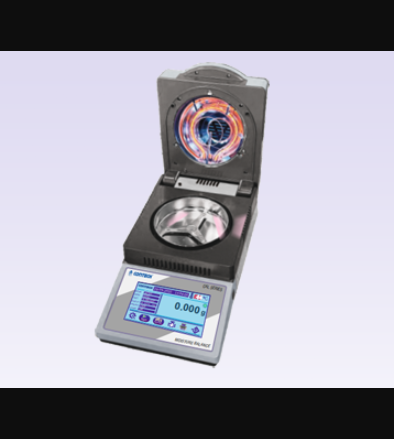 | Moisture Balances Moisture Balances (CAL Series) (0.001 g to 180 g) Moisture Balances (CAL Series) (0.001 g to 180 g) The CONTECH CAL Series Moisture Balances are advanced moisture analyzers designed for fast,... View product → |
Frequently asked questions
How should you prepare a sample for moisture content determination?
Mix the batch, reduce particle size only when needed, avoid changing the sample during preparation, and transfer it consistently to prevent segregation.
How does infrared heating remove moisture during analysis?
Infrared radiation heats the sample and evaporates moisture while the analyzer tracks mass loss over the drying cycle.
How does an IR moisture analyzer calculate moisture content?
It compares the starting mass with the mass remaining after drying, then reports the mass loss as moisture content according to the selected endpoint.
How do you validate a drying programme for a material?
Test suitable temperature, time, and endpoint settings against a trusted reference method, then confirm repeatable results before routine use.
What should a moisture analysis report include?
Record the sample identity, starting and final masses, drying programme, endpoint, reported moisture value, date, operator, and instrument check results.