
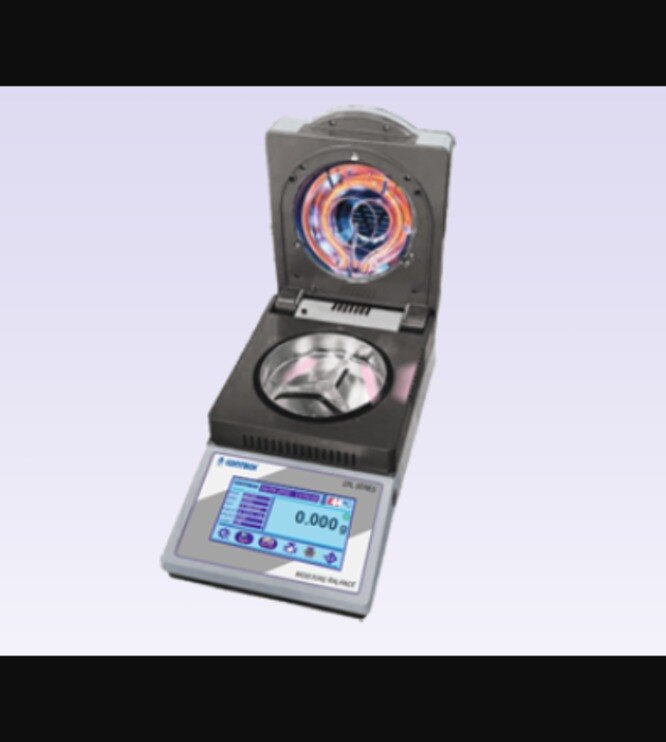
A moisture balance can show how much mass a heated sample loses, but that loss is not automatically water and it says nothing by itself about gold fineness or alloy composition. By the end, you will be able to match Loss on Drying with the right sample types, prepare and validate the method, and specify the India-based support needed for a defensible purchase.
Key takeaways
- Use Loss on Drying for moisture and volatile matter, not precious-metal purity.
- Choose sample mass after checking homogeneity, expected moisture, and the instrument’s weighing range.
- Validate repeatability, accuracy, drying endpoint, and temperature performance before routine use.
- Compare calibration records, temperature control, data export, service, and spare-part support before buying.
What does a moisture balance measure in a precious-metal laboratory?
A moisture balance measures mass lost during heating, not precious-metal purity. In Loss on Drying, the instrument records the initial sample mass, heats the material, removes water and other volatile matter, then stabilizes or cools the residue before calculating mass loss as a percentage. The result can also be reported as residual dry mass.
That distinction matters in a gold, silver, platinum, or jewellery testing laboratory. Moisture content is not fineness, karat, alloy composition, or the presence and thickness of surface plating.
A sample can lose moisture while its precious-metal content remains completely unknown; Loss on Drying is not automatically a water-specific measurement because solvents, oils, plasticizers, or decomposition products can also evaporate.
A moisture balance for india precious metal testing laboratories has a legitimate supporting role when drying an assay sample, preparing a powder, or applying a dry-mass correction. The procedure must prevent oxidation, decomposition, spattering, particle loss, pan reaction, and moisture reabsorption during cooling.
It cannot replace these assay methods:
- Cupellation, which determines precious-metal content through a fire-assay process.
- Gravimetry, which uses a controlled chemical separation and weighing step.
- X-ray fluorescence, which estimates elemental composition from characteristic X-rays.
- Another validated chemical or instrumental assay suited to the material.
Use moisture analysis to describe volatile mass loss; use a precious-metal assay to establish what the sample contains.
When is Loss on Drying suitable, and when is it the wrong test?
Loss on drying (LOD) is suitable when heating removes the material’s volatile content without changing the solid itself. A laboratory moisture analyzer records initial mass, heats the sample, and calculates total mass loss at the selected temperature and time. That loss is not water selectively: it can include water, solvents, oils, plasticizers, or decomposition products.
Suitable applications include:
- Assay samples where drying does not alter the analyte or cause oxidation
- Fluxes and powders with a stable, reproducible drying profile
- Ores and polishing compounds that do not spatter, melt, or form a sealed crust
- Binders and other materials whose volatile loss has been defined by a validated method
Reject LOD when heating causes oxidation, melting, spattering, crust formation, reaction with the pan, or decomposition. A rapid halogen or infrared cycle can overshoot the target, trap vapour beneath a skin, or destroy part of the sample; the fastest cycle is not automatically the most accurate.
| Method | What it measures | Use it when |
|---|---|---|
| Karl Fischer titration | Water selectively | Water content must be separated from other volatiles |
| Conventional oven drying | Mass loss under slower, controlled heating | The existing reference method uses an oven |
| Halogen or infrared drying | Mass loss with faster radiant heating | The sample tolerates the validated heating profile |
| Thermogravimetric analysis | Mass change across a programmed temperature range | Different volatile-loss or decomposition stages must be identified |
| Other validated procedure | A defined property under specified conditions | LOD does not represent the required result |
Compare LOD with Karl Fischer or the laboratory’s reference procedure when chemistry matters.
How should you prepare the sample and choose its mass?
A repeatable moisture measurement starts with a representative portion, not the first scoop from a container. Homogenize the material, reduce particle size when it permits, and use a clean pan made from a material compatible with the sample and temperature. Record handling details so another analyst can reproduce the result.
- Weigh a suitable amount for the method, not simply the instrument’s capacity. Too little sample produces a small mass change and an unstable percentage; too much lengthens drying and encourages wet interiors, crusts, or spattering.
- Spread the sample as a thin, even layer across the pan. Break agglomerates, but do not grind a material that heats, oxidizes, or loses volatile matter during preparation.
- Set the validated heating profile: temperature, ramp or step pattern, and endpoint. Fast infrared or halogen heating can overshoot, form a surface skin, or eject particles before the interior dries.
- Prevent contamination and loss. Keep the pan covered until loading, avoid drafts, and stop splashing or spattering from changing the sample mass.
- Cool for the specified time under controlled conditions. Use a desiccator when the dry residue reabsorbs water; otherwise cooling in humid air changes the result before the final weighing.
- Report whether the value is as received or on a dry basis, and state the endpoint and sample mass.
Sample choice affects the result more than a display figure suggests.
| Sample choice | Main effect | Risk |
|---|---|---|
| Too little | Small detectable mass loss | Noisy percentage |
| Suitable | Balanced drying and repeatability | Requires validation |
| Too much | Longer drying and uneven heat transfer | False low or high result |
A nominal 1 mg readability does not prove moisture-result accuracy or define the minimum usable mass. Verify repeatability, temperature uniformity, and method precision with the actual material.
What evidence proves that the method is fit for laboratory use?
Evidence of fitness is a documented comparison between the laboratory moisture analyzer and the existing oven or another suitable reference procedure. A transferred drying program is not proof that both methods produce equivalent moisture measurement.
1. Test representative materials at more than one moisture level, including low-moisture samples near the reporting limit. Use enough replicates to establish repeatability and expose bias hidden by testing one convenient sample.
2. Compare results with the reference procedure under defined sample mass, spreading, heating profile, temperature, and endpoint conditions. Record temperature uniformity and investigate incomplete drying; a stable display can still represent trapped moisture.
3. Challenge the method with different compositions. Check whether oils, binders, salts, metals, or other matrix components change drying behaviour, and measure reabsorption during cooling by controlling cooling time, desiccation, and weighing conditions.
4. Before reporting results, document method validation or verification, calibration or performance checks, maintenance records, and ongoing control samples. For ISO/IEC 17025 work, retain raw data, acceptance criteria, deviations, and corrective actions; a supplier’s factory certificate alone does not validate the method for your samples.
Analytical fitness is separate from Indian legal-metrology approval. If the instrument supports regulated commercial weighing rather than internal testing, confirm whether verification, stamping, and use-specific documentation are required by the applicable jurisdiction. An analyzer fit for ISO/IEC 17025 testing is not automatically approved for trade.
What should you check before buying a moisture balance in India?
A moisture balance India purchase is usable only when its installation, service, and method requirements are documented before payment. Ask for the electrical requirement, permitted voltage variation, operating temperature and humidity limits, temperature-control range and stability, pan compatibility, spare heating-element or lamp availability, and the expected service response in your location.
| Check | Evidence to request | What failure can cause |
|---|---|---|
| Electrical and environment | Installation sheet listing power, voltage, humidity, and temperature limits | Shutdowns, unstable readings, or premature component failure |
| Measurement performance | Readability, temperature range, repeatability, minimum sample mass, and temperature-uniformity data | Precise-looking percentages that are not reliable |
| Service pathway | Local calibration, repair, spare-part availability, response time, and maintenance terms | Extended downtime after a lamp, sensor, or balance fault |
| Data and validation | Export format, audit trail, application notes, and demonstration records | Manual transcription errors or an undocumented method |
Do not infer moisture performance from capacity or drying speed. For a moisture balance for India precious metal testing laboratories, run an application demonstration using the actual matrix and compare it with your reference method. Test crusting, spattering, volatile loss, and agreement at low moisture levels.
Confirm that software exports the fields your records require, then document calibration or verification, maintenance, and ongoing checks for ISO/IEC 17025 work. CONTECH INSTRUMENTS LTD. belongs in the comparison when it supplies this evidence and supports validation; also obtain legal-metrology documentation if the instrument will perform regulated commercial weighing.
Related product
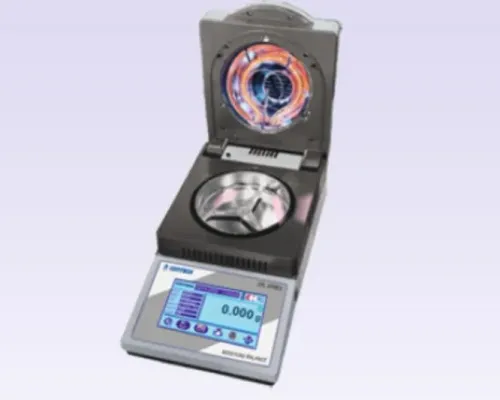
 | Moisture Balances Moisture Balances (CAL Series) (0.001 g to 180 g) Moisture Balances (CAL Series) (0.001 g to 180 g) The CONTECH CAL Series Moisture Balances are advanced moisture analyzers designed for fast,... View product → |
Frequently asked questions
What does a moisture balance measure in a precious-metal laboratory?
It measures mass lost during controlled heating and reports Loss on Drying as a percentage or residual dry mass. It does not determine precious-metal purity.
When is Loss on Drying suitable for laboratory testing?
Use Loss on Drying when heating removes water or defined volatile matter without decomposing the sample or changing its target composition. Choose another method when bound water, oxidation, decomposition, or heat-sensitive components affect the result.
How should you prepare a sample for moisture analysis?
Homogenize the material, use a clean and dry pan, spread the sample in a thin even layer, and record the sample identity and starting mass. Select a mass that fits the balance range and gives a measurable loss without overloading the pan.
What evidence proves that a moisture balance method is fit for laboratory use?
Document accuracy, repeatability, drying temperature, endpoint performance, reference-material or comparison results, sample preparation, and acceptance limits. Keep calibration and verification records for routine testing.
What should you check before buying a moisture balance in India?
Check weighing capacity and readability, temperature range and control, heating technology, endpoint settings, calibration options, method storage, data export, user records, installation, service coverage, and spare-part availability.