
A reliable moisture result depends on more than selecting an infrared instrument. You need a controlled sample, a defensible heating programme, a clear endpoint, and a comparison with the method your laboratory already trusts; by the end, you will know how to set up that process and evaluate equipment claims.
Key takeaways
- Use loss-on-drying to measure mass loss, not water alone.
- Grind and mix samples before taking a representative test portion.
- Set temperature, sample mass, endpoint, and time for the material.
- Compare analyzer results with an oven or other validated reference method.
How infrared loss-on-drying determines moisture
An IR moisture analyzer measures the sample’s mass before and after heating. It is a thermogravimetric loss-on-drying instrument: the heater drives off water and other volatile material, while the balance continuously records the decreasing mass.
The moisture analysis method calculates the loss against the original sample mass:
Moisture percentage = (initial mass − dry mass) ÷ initial mass × 100
For example, a 5.00 g sample that finishes at 4.25 g has lost 0.75 g, so the reported moisture is 15.0%. The result represents moisture only when the lost material is water. Solvents and other volatile compounds also increase the reported loss; describe that result as loss on drying unless water selectivity has been demonstrated.
Use Karl Fischer titration when the specification is specifically for water and the material suits that method.
Record the conditions that produced the result:
- Sample mass and particle size
- Pan loading and layer thickness
- Heating temperature and heating profile
- Endpoint definition, such as a mass change below a stated rate
- Drying duration or automatic-stop criterion
A stable endpoint does not prove that drying occurred. Darkening, smoking, bubbling, unusual odour, a sudden rate change, or a higher result at higher temperature indicates decomposition or volatile loss. Confirm the method with temperature verification and comparison against a reference method at low, typical, and high moisture levels.
Prepare each sample so the test portion represents the material
A small test portion cannot represent a coarse or segregated material. Mix the container before opening, then prepare the portion without warming it or leaving it exposed; otherwise moisture loss during preparation can make the reported value falsely low.
1. Powders and granules: Stir or roll the full sample to redistribute fines and coarse particles. Grind lumps to a consistent particle size using a cool tool, then weigh immediately. Do not grind if friction heats the material or drives off volatile components.
2. Pastes, liquids, and oils: Mix until the texture is uniform without whipping in air. For viscous samples, use a spatula to take portions from several points. Place the measured mass in the pan and spread it into a thin, even layer; a deep pool can form a dry crust over wet material.
3. Food and chemicals: Homogenise food without heating it, and remove foreign packaging or visible stones. For chemicals, check the safety data sheet before heating; solvents, hydrates, and decomposing compounds can create a mass loss that is not water.
4. Soil: Break clods gently, mix the whole sample, remove roots and stones only when the method permits, and pass it through the specified sieve. Record the sieve size, sample mass, and pan loading.
5. Hygroscopic samples: Keep the container closed, limit transfer time, and weigh promptly. Record sample temperature and handling conditions when the specification is tight. These controls matter for ir moisture analyzer moisture for determination in bengaluru, where exposed samples can exchange moisture with laboratory air.
Choose temperature, loading, endpoint, and duration by material
Build the method around the material’s water-release behaviour, not the default programme on the instrument. Record sample mass, particle size, pan loading, temperature, heating profile, endpoint, and maximum duration; changing any one can change the reported moisture.
| Material | Starting method | Main risk |
|---|---|---|
| Flour, powders | 2–5 g; grind uniformly; 105–130°C; thin layer; gentle ramp | Surface crusting can trap internal moisture |
| Pastes, syrups, high-sugar foods | 1–3 g; spread over the pan; 80–105°C; slower ramp | Bubbling, caramelisation, and skin formation |
| Polymers or pharmaceutical powders | 1–3 g; use the validated particle size; start at 70–100°C | Decomposition or loss of solvents mistaken for water |
| Sludge, soil, or wet granules | 3–10 g; break agglomerates; 105–140°C; staged heating | A wet core can delay the endpoint |
Use the lowest temperature that gives complete drying without darkening, smoking, bubbling, strong odour, or a sudden rate change. If the result rises as temperature increases, stop: the method is likely measuring decomposition or non-water volatiles.
Set the endpoint from a stable mass change, such as less than 1 mg over 30 seconds, then confirm it against your reference method. Add a maximum run time so a failed endpoint does not continue heating indefinitely.
For a moisture determination analyzer in Bengaluru, keep hygroscopic samples sealed until loading, minimise transfer time, and record sample and room conditions. Validate each method at low, typical, and high moisture levels; a flour programme does not transfer safely to polymer, sludge, or pharmaceutical material.
Validate the result against a suitable reference method
Accept an IR result only after comparing it with a matrix-specific reference method at low, typical, and high moisture levels. Use representative material rather than one convenient sample, and run replicate portions under the same conditions. Calculate the mean, repeatability, and bias against the reference; matching one reading proves very little.
- Set acceptance limits before testing. Require the IR method’s bias and repeatability to fit the product moisture specification, not merely the instrument’s displayed readability.
- Verify the heating temperature with a calibrated temperature device and verify the balance with certified test weights. Weight calibration checks mass measurement; it does not prove moisture performance.
- Keep hygroscopic samples in closed containers, minimise exposure during transfer, grinding, and pan loading, and record sample temperature, room conditions, and handling time. Bengaluru laboratory air can change the result before heating begins.
- Investigate disagreement by checking sample homogeneity, loading thickness, endpoint selection, decomposition, and volatile loss. Do not “adjust” the result to make it match.
| Reference method | Use | Limitation |
|---|---|---|
| Validated oven loss-on-drying | Compare total mass loss for the same matrix | It includes solvents and other volatile substances |
| Karl Fischer titration | Compare a specification that means water specifically | Confirm that the sample is compatible with the reagent system |
Describe the result as loss on drying when selectivity for water has not been demonstrated. A validated moisture analysis method for flour cannot be transferred unchanged to polymers, pharmaceutical powders, sludge, or sugary products. Revalidate whenever the matrix or specification changes.
What to ask before selecting a moisture balance
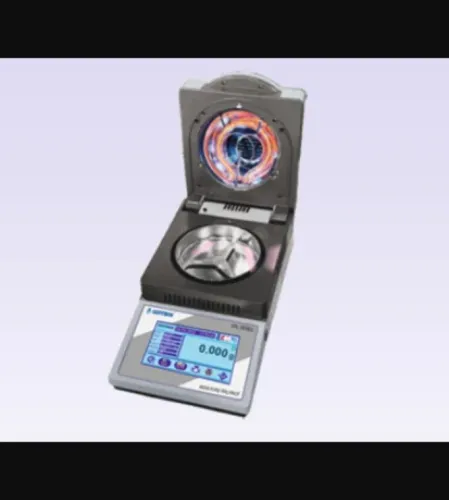
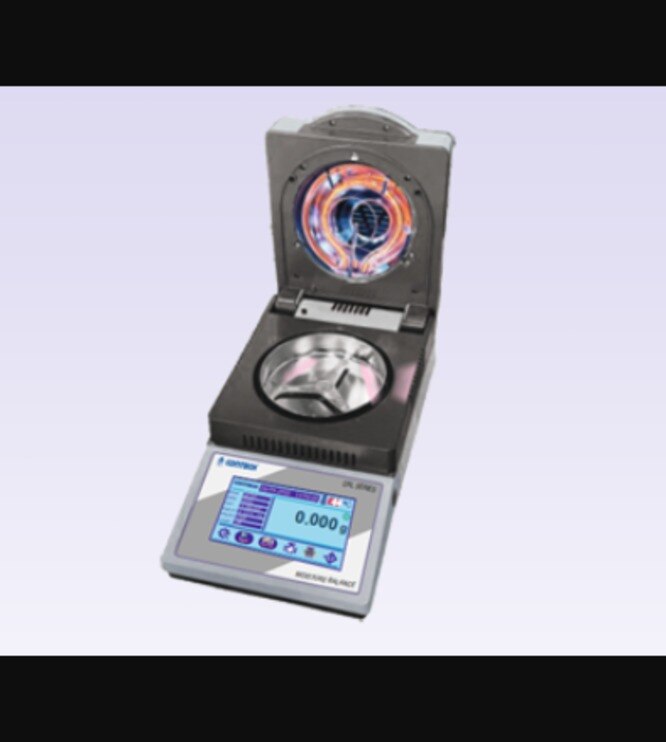
A claimed capacity of 180 g and readability of 0.001 g do not prove suitability. Ask for the exact model’s maximum sample mass, heating range, pan dimensions, readability, endpoint algorithms, calibration procedure, and number of stored methods. “Moisture Balance CAL Series” is not a specification; controls differ between models.
- Request a demonstration using your material at low, typical, and high moisture levels.
- Record the sample mass, particle size, pan loading, temperature, heating profile, endpoint, result, and test duration.
- Compare each result with your established reference method. Check bias and repeatability across multiple portions, not agreement with one sample.
- Verify the weighing system with certified test weights, then verify temperature separately. Weight calibration alone cannot validate moisture results.
| Specification | Evidence to request | Warning sign |
|---|---|---|
| Maximum sample mass | Rated mass for the exact model, with pan dimensions | Capacity stated without model or usable loading guidance |
| Readability | Display increment alongside repeatability data | 0.001 g presented as moisture accuracy |
| Heating control | Temperature range, ramp or step profiles, and endpoint options | “Automatic” endpoint with no algorithm description |
| Method storage | Number of methods and editable parameters | Brand-level claim with no stored-method capacity |
| Result validity | Matrix-specific reference comparison and temperature check | Balance calibration offered as the only acceptance test |
CONTECH INSTRUMENTS LTD. can help you identify which CAL model specifications apply, but you still need to test the moisture determination analyzer in Bengaluru under your own laboratory method.
Related product
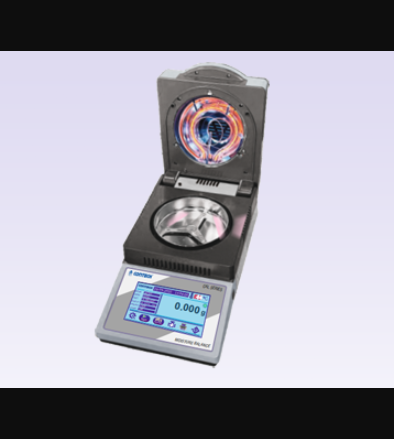 | Moisture Balances Moisture Balances (CAL Series) (0.001 g to 180 g) Moisture Balances (CAL Series) (0.001 g to 180 g) The CONTECH CAL Series Moisture Balances are advanced moisture analyzers designed for fast,... View product → |
Frequently asked questions
How does infrared loss-on-drying determine moisture?
The analyzer weighs the sample, heats it with infrared radiation, and continuously records mass loss. The reported percentage represents moisture plus other volatile substances removed during heating.
How should you prepare a sample for moisture determination?
Mix the material thoroughly, reduce particle-size differences, and take a test portion that represents the whole batch. Avoid exposing hygroscopic samples to humid air before weighing.
How do you choose temperature, loading, endpoint, and duration?
Choose settings according to the material’s heat sensitivity, expected moisture level, particle size, and drying behaviour. Use a controlled test method rather than copying one setting across different materials.
How do you validate an IR moisture analyzer result?
Compare repeated analyzer results with a suitable reference method, such as a specified oven loss-on-drying procedure. Investigate differences caused by temperature, sample mass, endpoint, or volatile compounds.
What should you ask before selecting a moisture balance?
Ask about weighing resolution, temperature range, heating control, endpoint modes, sample capacity, data output, calibration, service support, and compatibility with your validated method.