
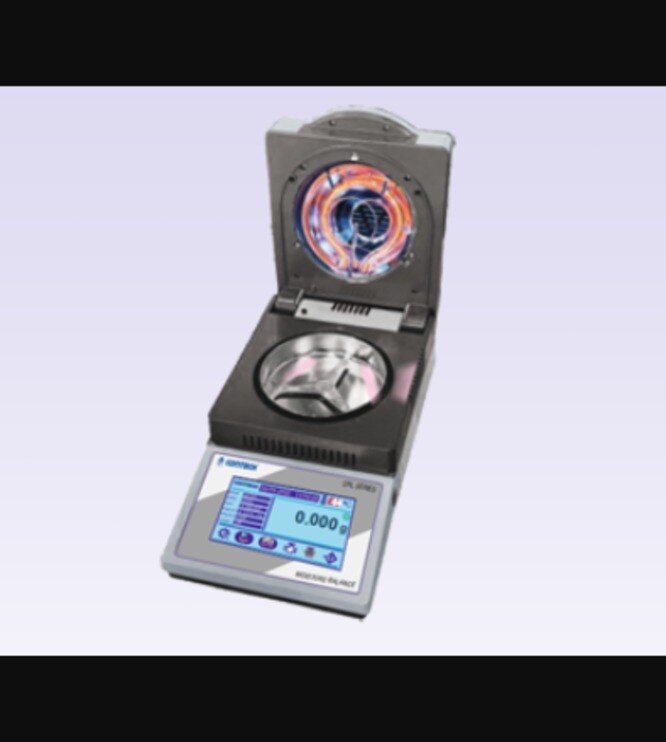
A moisture analyzer can produce a precise mass-loss result without proving that the lost material was water. By matching the method to the sample, controlling Bengaluru’s humidity-related handling risks, and validating the drying program, you can decide when LOD is fit for purpose and when a water-specific reference method is necessary.
Key takeaways
- Use LOD when heating removes moisture without decomposing the sample.
- Select drying temperature, endpoint, and sample mass for each material.
- Mix and seal samples before testing to prevent humidity-driven errors.
- Verify repeatability, temperature control, calibration, and service support before purchase.
How a laboratory moisture balance turns mass loss into a result
A laboratory moisture balance converts loss on drying (LOD) into a moisture measurement by comparing sample mass before and after a controlled heating program. The result is useful only when the test portion represents the material and the endpoint removes the intended volatile fraction without changing the sample.
- Weigh a representative sample into the pan and record its original mass.
- Heat it at the selected temperature, profile, and endpoint condition.
- Remove volatile material until the program stops, then record the dried residue mass.
- Calculate the lost mass and express it as moisture percentage.
Free moisture is readily mobile water within the sample; surface moisture is water held on particle or product surfaces. Bound water is associated with a crystal structure, protein, polymer, or other matrix.
Residual solvent is non-water liquid left from processing, while total water content is the complete amount of water, including free, surface, and bound water.
LOD does not identify water specifically. Volatile oils, solvents, decomposition products, oxidation-related losses, or splattering can all appear as “moisture.” On a wet basis, moisture % = lost mass ÷ original sample mass × 100. On a dry basis, moisture % = lost mass ÷ dried-solid mass × 100.
A repeatable result can still be wrong if the portion is unrepresentative or the endpoint stops before bound or slow-release moisture leaves, or continues into decomposition.
When LOD is suitable—and when you need a reference method
Choose LOD only when mass loss represents water for your specific matrix. For water-specific moisture analysis, Karl Fischer is preferable, especially when volatile non-aqueous components are present or heating decomposes the sample.
| Option | What it measures | When it applies |
|---|---|---|
| LOD moisture balance | Total mass lost during a heating program | Fast screening after matrix-specific validation |
| Constant-temperature hot-air oven | Mass loss after defined atmospheric drying | Reference work, including ISO 712 for cereal and grain moisture |
| Vacuum oven | Mass loss at reduced pressure and lower thermal stress | Heat-sensitive solids; still not water-specific |
| Karl Fischer titration | Chemically measured water | Water-specific moisture determination across varied matrices |
| Coulometric Karl Fischer | Water consumed electrochemically, suited to small water quantities | Low-moisture samples and small test portions |
| Thermogravimetric analysis | Mass change against temperature, time, or atmosphere | Separating drying from decomposition using a mass-temperature profile |
Oven procedures remain useful references: ASTM E871 covers particulate wood fuels, while ISO 712 covers cereal and grain moisture. Do not transfer either procedure unchanged to food, pharmaceutical, soil, polymer, or chemical samples.
Reject unqualified LOD when the sample contains:
- Solvents, oils, multiple volatile components, or bound water
- Heat-sensitive compounds, foaming, crust formation, browning, curing, or decomposition
A repeatable LOD result can still measure more than water. Compare LOD with Karl Fischer or the named oven reference before treating results as interchangeable; that comparison is essential for defensible moisture measurement.
Set the drying temperature, endpoint, and sample mass by material
Choose the drying program from the material’s behaviour, not habit. A laboratory moisture balance can use constant-temperature, stepwise-heating, or ramp heating; each can produce a different moisture measurement for the same sample.
| Program | Strength | Main risk |
|---|---|---|
| Constant temperature | Simple, repeatable comparison | Surface crusting can trap moisture |
| Stepwise heating | Removes surface moisture gently before stronger heating | A later step can cause decomposition |
| Ramp heating | Reveals where mass loss occurs | Continuous heating can trigger overlapping evaporation and chemical change |
Set the temperature high enough to remove target moisture, but below the point of browning, oxidation, caramelisation, protein denaturation, polymer curing, or loss of other volatile constituents. Inspect the residue: darkening, melting, bubbling, a hard skin, or a changed odour indicates that the result may represent chemical change rather than moisture analysis.
Load a representative mass in a thin, even layer. Keep particle size and pan loading consistent, and record whether the pan is covered or uncovered; an uncovered pan improves evaporation, while a cover can reduce splashing and volatile loss.
A 1 mg change equals 0.1 percentage point for a 1 g sample but 0.01 percentage point for a 10 g sample.
Automatic endpoints stop when the mass-change rate falls below a criterion. They can stop early in slow-drying samples or interpret decomposition as drying. Run duplicates or triplicates, compare with a reference method, and document repeatability, intermediate precision, accuracy or recovery, working range, selectivity, and robustness under ICH Q2(R2).
Prevent sampling and humidity errors before the pan is heated
A representative test portion protects moisture measurement better than finer balance readability. Homogenise the batch before subsampling: grind powders, granules, soil, and chemical formulations to a consistent particle size; cut plant materials evenly; and mix pastes, slurries, food products, and pharmaceutical suspensions thoroughly.
- Seal each sample in a moisture-tight container. Record the container ID, batch number or field location, collection time, opening time, transport duration, and sample temperature.
- For hygroscopic powders that gain water from Bengaluru’s monsoon air or air-conditioned rooms, open the container only at the controlled weighing point. Transfer rapidly, use a defined equilibration procedure when the method requires it, and keep exposure duration as short as possible.
- For warm or exposed samples that lose surface moisture during transport, cool them in a sealed container to the defined weighing temperature before opening. Do not leave soil, plant material, food, paste, or granules uncovered while waiting.
- Mix again immediately before taking the test portion. Weigh it immediately after opening, spread it in a thin, even layer, and do not overload the pan; a deep pile dries unevenly and can form a crust.
- Run duplicate or triplicate subsamples when the batch is heterogeneous, then report moisture determination on a stated wet basis or dry basis.
A moisture determination analyzer can be highly repeatable on a non-representative portion: every run measures the same biased slice, not the batch. For moisture determination analyzer research laboratories in Bengaluru, controlled weighing conditions, rapid transfer, sealed containers, and complete handling records prevent sampling error from overwhelming the instrument result.
Specify and verify a moisture analyzer for Bengaluru research work
Specify a laboratory moisture balance around your documented method, not its headline readability or nominal moisture range. For Bengaluru moisture determination, record these procurement requirements before comparing instruments:
| Item | Specify | Verify |
|---|---|---|
| Matrix and range | Sample type and expected moisture interval | Results across the working range |
| Capacity and loading | Samples per hour, sample mass, and pan design | Repeatability at actual loading |
| Heating | Maximum sample temperature and constant, stepwise, or ramp profile | Temperature-system performance |
| Endpoint | Manual, timed, or mass-change-rate criterion | Endpoint behaviour on slow- and fast-drying samples |
| Records | CSV, PDF, LIMS-compatible export, audit trail | Correct values, units, timestamps, and method version |
| Quality control | Balance calibration, temperature checks, and moisture reference or control material | Traceable results against acceptance limits |
Mass calibration alone cannot establish moisture accuracy: it does not test the heater, sensor, endpoint algorithm, or sample method. For pharmaceutical research, define selectivity, repeatability, intermediate precision, working range, accuracy or recovery, and robustness under ICH Q2(R2).
Review the method before buying for corrosive, solvent-rich, foaming, thermally unstable, or crust-forming samples. CONTECH INSTRUMENTS LTD. can be considered alongside other suppliers only after evaluation against that method, not by nominal range or readability alone.
Close commissioning with a record containing the sample preparation procedure, drying program, endpoint criterion, replicate results, reference-method comparison, operator, date, and acceptance limits.
Related product
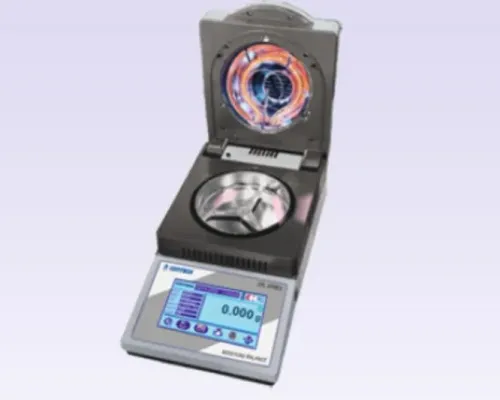
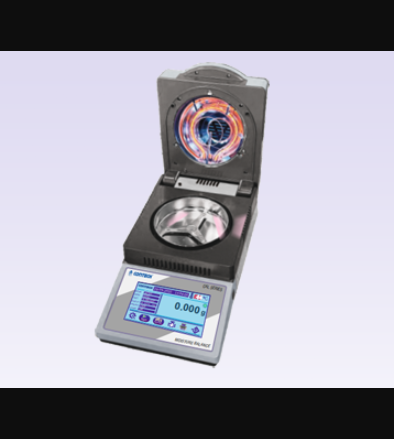 | Moisture Balances Moisture Balances (CAL Series) (0.001 g to 180 g) Moisture Balances (CAL Series) (0.001 g to 180 g) The CONTECH CAL Series Moisture Balances are advanced moisture analyzers designed for fast,... View product → |
Frequently asked questions
How does a laboratory moisture balance calculate moisture?
It measures initial sample mass, heats the sample under a controlled program, and calculates mass loss as moisture content.
When is loss on drying suitable for moisture determination?
Use LOD when the intended volatile fraction leaves during heating without decomposition or loss of other sample components.
When should you use a reference moisture method?
Use a reference method when heat changes the sample, multiple volatile compounds are present, or the result must match a validated standard.
How can you prevent sampling and humidity errors?
Take a representative test portion, minimise exposure to ambient air, mix consistently, and seal samples before weighing.