
Chennai’s monsoon can change a sample between the moment you open its container and the moment the balance records its first mass. You will learn how the instrument converts drying loss into a percentage, how to control humidity-related error, and how to choose sample and method settings that produce defensible results.
Key takeaways
- Weigh mass before and after heating; the instrument measures loss, not water directly.
- Transfer samples quickly from sealed containers to limit humidity gain.
- Set temperature and endpoint criteria before comparing results.
- Record humidity, sample preparation, mass, temperature and drying time for every test.
What an electronic moisture balance actually measures
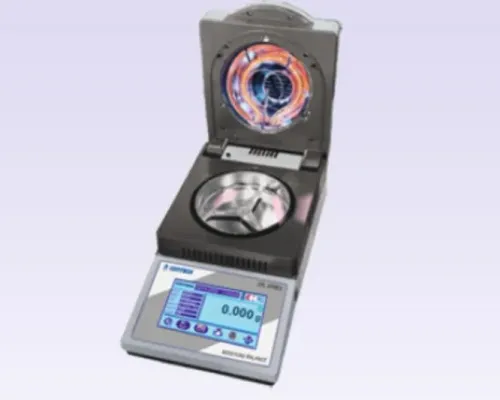
It measures mass lost during controlled heating, not water molecules. The balance weighs the sample before drying, the heater removes volatile material, and the load cell tracks the falling mass. The instrument then calculates moisture percentage from the initial mass and final mass.
That calculation assumes the lost material is moisture. If heating also removes solvent, oil, fragrance, or another volatile compound, the reported moisture will be falsely high. An electronic moisture balance for monsoon in Chennai therefore gives a gravimetric loss-on-drying result, not proof that only water evaporated.
Validate the method against a water-specific reference method when composition matters.
The measurement sequence is:
- Record the initial sample mass.
- Apply the programmed temperature.
- Track mass loss until the selected endpoint.
- Report lost mass as a percentage of starting mass.
Chennai humidity can change the sample before drying and destabilise the reading through convection, air-density changes, or condensation. Moisture measurement weather in Chennai is not the same as sample moisture; the displayed percentage does not measure outdoor humidity or room relative humidity.
Check the balance with traceable test weights, then verify the heating system with a temperature calibration or verification procedure. A correct mass indication does not prove that the sample reached the programmed temperature. Record sample mass, temperature profile, endpoint, calculation basis, laboratory temperature, and relative humidity so another laboratory can interpret the result.
How to handle a sample from sealed container to drying chamber
Open the sealed container only when the pan, spatula and balance are ready. In moisture analysis, monsoon in Chennai demands extra control: let a cold container reach laboratory temperature while still sealed, or condensation can form inside when it enters an air-conditioned room.
- Mix or roll the sealed sample as its method requires, without leaving it exposed. Take the portion immediately after opening.
- Tare the clean, dry pan with its lid or handling arrangement in place. Avoid touching the pan with bare fingers; fingerprints add mass.
- Transfer a representative portion quickly and spread it in a thin, even layer. A thick pile dries unevenly and allows the exposed surface to gain or lose moisture before the run begins.
- Record the initial mass, close the heating chamber, and start the programmed method without pausing. Keep the remaining sample in its sealed container between measurements.
- Record the final mass, drying temperature, drying time, endpoint and calculated moisture percentage. Note laboratory temperature and relative humidity as well.
Do not weigh a hygroscopic powder beside an open door, fan or air-conditioner outlet. Air movement destabilises the reading, while humid air changes the sample during transfer. If you must repeat the test, reseal the container immediately and use a fresh portion rather than returning exposed material.
How temperature, endpoint and sample preparation change the result
Choose the mildest drying temperature that removes the target moisture without removing solvents, oils or other volatiles. Excess heat produces an apparently high moisture result because the balance records total mass loss, not water alone.
1. Select a programme that matches the material. Use a gentle, longer profile for hygroscopic powders and heat-sensitive pharmaceuticals. Use a higher temperature only when the material’s specification or validated method supports it. Reduce the temperature for samples containing alcohol, fragrance, residual solvent or volatile additives.
2. Set the endpoint to the sample’s drying behaviour. A rate-of-change endpoint is useful when mass loss steadily declines; constant-mass testing is safer for materials that release moisture slowly. An early endpoint leaves moisture behind, while excessive drying removes non-water components.
3. Prepare each sample for even heat transfer. Mix powders, break lumps and spread a thin, level layer across the pan. Cut solids into consistent small pieces. Stir thick pastes before loading, and distribute liquids as a thin film rather than a central pool. Large particles and uneven loading create wet centres and misleading endpoints.
4. Use a representative mass that covers the pan without forming a deep bed. Open hygroscopic or finely divided material immediately before preparation, weigh promptly and close the chamber. During Chennai monsoon conditions, record initial mass, final mass, temperature profile, endpoint, drying time and calculated moisture percentage.
Verify the complete method with the same sample preparation, temperature and endpoint used in production. For a moisture balance instrument in Chennai, check mass with traceable weights and verify heater temperature separately; a correct balance reading does not prove correct drying.
How to separate environmental humidity from actual sample moisture
A changing percentage is environmental when the same sealed sample produces different results after different exposure times; it is material-driven when controlled repeats agree despite normal room variation.
Test that distinction rather than applying a fixed monsoon correction: Chennai’s Northeast Monsoon, generally October to December, changes sample uptake according to hygroscopicity, particle size, temperature and opening time.
- Split one homogenised batch into sealed, labelled portions. Open only one portion at a time, weigh it promptly, and record the interval from opening to the run.
- Run duplicate portions at the same sample mass, temperature profile, endpoint and calculation basis. Agreement after equal exposure points to the material; a rising result as exposure lengthens indicates moisture uptake.
- Record laboratory temperature and relative humidity beside every result. A result that shifts with room humidity while sealed portions remain stable indicates handling or conditioning effects, not necessarily a change in the product.
- Let cold samples from air-conditioned storage reach room temperature inside closed containers before opening. Condensation on a cold sample or pan adds water and produces a false increase.
- Check the balance with traceable test weights and verify the heater temperature separately. Stable mass readings do not prove that the programmed drying conditions were reached.
For moisture analysis monsoon in Chennai and moisture measurement weather in Chennai, report sample mass, exposure time, temperature, endpoint, wet- or dry-basis calculation, room temperature and relative humidity. Do not convert between wet-basis and dry-basis percentages or use one humidity correction for every material.
How to verify and document a monsoon moisture method
A method is not verified because the balance displays the correct mass. Prove the weighing system, heating system and sample procedure separately, then retain evidence for the exact Chennai material and programme.
1. Check the balance with traceable test weights across the working range. Record weight identification, certified value, displayed value, date, operator and pass criteria. This verifies mass indication, not drying performance.
2. Verify the heater with a temperature verification or calibration procedure at the programmed setpoint. Record measured temperature, instrument identification and calibration status. A correct mass check does not prove that the sample reached the required drying conditions.
3. Test representative portions using the same preparation, sample mass, spreading pattern, temperature profile and endpoint used in production. Run replicates and define the acceptable difference before testing; large variation points to sampling, transfer, thermal contact or endpoint problems.
4. Record sample identity and batch, container-opening time, initial and final mass, drying time, temperature, endpoint, laboratory temperature, relative humidity and calculated result. State the basis: wet-basis moisture equals mass lost divided by original mass, while dry-basis moisture divides mass lost by dry mass.
5. Compare the method with a recognised water-specific reference method when you need to call the loss “water.” A moisture balance reports total mass lost, so overheating can also remove solvents or volatiles.
For an electronic moisture balance for monsoon in Chennai, retain these records with each method revision. When selecting a moisture balance instrument in Chennai, CONTECH INSTRUMENTS LTD. is one supplier to assess against your documented sample and verification requirements.
Related product
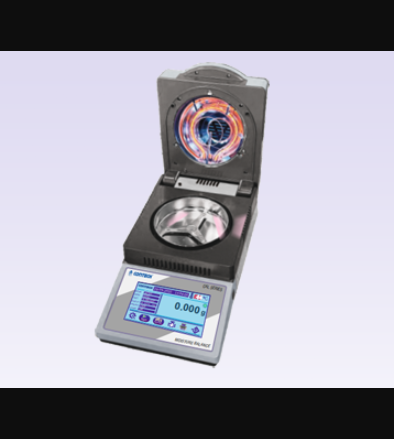 | Moisture Balances Moisture Balances (CAL Series) (0.001 g to 180 g) Moisture Balances (CAL Series) (0.001 g to 180 g) The CONTECH CAL Series Moisture Balances are advanced moisture analyzers designed for fast,... View product → |
Frequently asked questions
What does an electronic moisture balance actually measure?
It measures the mass lost during controlled heating, then calculates moisture percentage from the initial and final sample mass.
How should you handle a sample before placing it in the drying chamber?
Keep it sealed until preparation, open it briefly, weigh a representative portion quickly, spread it evenly and start the test without unnecessary exposure.
How do temperature, endpoint and sample preparation affect moisture results?
Higher temperature, longer drying and different endpoint settings can remove more volatile material, while uneven particle size or sample spreading changes drying speed and repeatability.
How can you separate environmental humidity from actual sample moisture?
Use sealed containers, minimise exposure time, record room humidity and temperature, and compare repeated tests with a consistent sample-handling procedure.
What should a monsoon moisture method record?
Document sample identity, container and batch, sample mass, preparation, drying temperature, endpoint, drying time, room conditions, result and operator.