
A halogen moisture analyzer does not detect water molecules directly. It weighs a test portion, heats it, tracks the mass that leaves, and converts that change into a moisture result—provided the method distinguishes water loss from other volatile or decomposing material. By the end, you will know how to run a sample, control the variables that affect repeatability, and decide when the result needs comparison with an oven method or Karl Fischer titration.
Key takeaways
- Treat mass loss as volatile loss, not automatically as water.
- Tare the empty pan, spread the sample evenly, and record the endpoint.
- Control sample size, temperature, and Chennai room conditions before comparing results.
- Validate the method against a reference method before routine release testing.
What the analyzer measures during a drying run
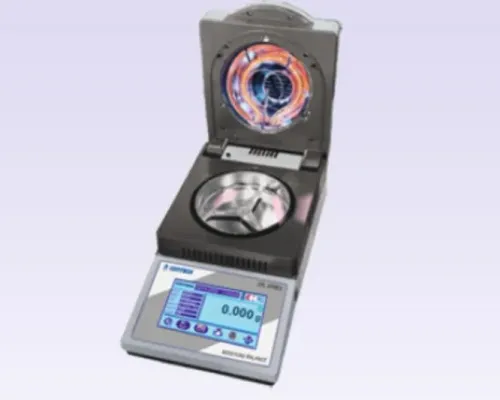
A halogen moisture analyzer combines a precision balance with a halogen-heated chamber. It records the sample’s starting mass, heats the sample, and continuously measures the mass remaining as volatile material leaves. The instrument treats that reduction as moisture loss, so this is a thermogravimetric moisture measurement—not a direct measurement of water molecules.
For a wet-basis result, the calculation is:
Moisture percentage = ((starting mass − final dry mass) ÷ starting mass) × 100
For example, a 5.00 g sample ending at 4.40 g has lost 0.60 g, giving a moisture result of 12.0%. The analyzer applies this calculation throughout the drying run and displays the value when drying reaches its programmed endpoint.
The endpoint can be an automatic mass-loss-rate threshold, such as a specified reduction over a set interval, or a fixed drying time. A fixed-time run can stop while moisture remains if the sample layer is thick or the material dries slowly.
Automatic stopping does not prove that only water was lost: solvents, oils, or decomposition products can also reduce mass during heating. That distinction matters during moisture determination. Karl Fischer titration measures water chemically, while halogen drying reports total heat-driven mass loss unless the sample and method establish that the loss represents water.
How to run a sample from taring to recorded result
Use a validated method file before placing the sample on a halogen moisture analyzer in Chennai laboratories. Confirm the balance and heater calibration status, then choose the temperature, drying mode, endpoint, and moisture basis specified for that material.
- Identify the sample, batch, and method version in the instrument record or worksheet.
- Place a clean, dry sample pan on the balance and close the chamber. Press Tare, then confirm that the display reads zero.
- Add the prescribed test portion without spilling material onto the pan rim. Record the initial mass shown by the analyzer.
- Spread the sample into a thin, even layer. Break lumps only as the validated method permits; an uneven bed can dry at different rates.
- Close the heating chamber and select the approved temperature program, endpoint criterion, or drying time. Do not change these settings to force a faster result.
- Start the run. The analyzer heats and records mass until the endpoint is reached, then displays the moisture result.
- Check the curve and final reading for an interrupted run, unstable mass, scorching, or an implausible value. Repeat the test when the method requires replicates.
- Record sample identity, test portion, initial mass, temperature program, endpoint or drying time, moisture basis, final result, replicate results, and any deviation.
For defensible moisture content analysis, save the instrument printout or electronic record with the operator, date, method version, and result units. A displayed “8.2%” without these details cannot be reliably reproduced or compared.
How sample preparation and Chennai room conditions change the result
An 8.2% result is not repeatable if a hygroscopic powder absorbs Chennai’s humid air before weighing. Keep such samples in sealed containers, open one portion at a time, and transfer it quickly. Record room temperature and relative humidity because moisture measurement depends on the mass present at the moment of taring and loading.
Prepare the test portion according to its physical form:
- Homogenize powders gently, breaking agglomerates without grinding that heats or dries them.
- Mix pastes and slurries thoroughly, then load a thin, even layer to prevent a wet centre and dry crust.
- Stir liquids before taking the portion; use enough sample to cover the pan without splashing.
- Cut large solids into smaller, uniform pieces, and avoid exposing volatile samples while preparing them.
- Weigh promptly after opening the container, then close the chamber immediately.
Use a clean, dry pan and keep the analyzer away from air-conditioner outlets, open windows, direct sun, and vibration. Do not handle the pan or sample with wet gloves. For heat-sensitive or volatile materials, compare the result with Karl Fischer or the applicable oven method before treating gravimetric loss as water.
For each moisture content analysis, record sample identity, test portion, initial mass, temperature program, endpoint or drying time, moisture basis, final result, replicate behavior, and method version. Without those details, you cannot distinguish a sample difference from a transfer, loading, or room-condition error.
How to choose heat, endpoint, and the right comparison method
Choose a temperature that removes water without changing the sample. Excess heat can crust, caramelise, oxidise, or burn the surface and trap moisture underneath; insufficient heat leaves water behind and understates moisture determination.
- Start with a conservative temperature from the material’s validated procedure, then increase it only when drying remains complete and the residue is unchanged.
- Stop and lower the temperature if the sample darkens, bubbles, smokes, forms a hard skin, or shows an unusually rapid mass drop.
- Use an automatic endpoint based on mass-loss rate when validated. A fixed drying time can give an incomplete result after sample mass, layer thickness, or room conditions change.
| Method | Measures | Choose it when | Main limitation |
|---|---|---|---|
| Halogen drying | Mass loss under programmed heat | You need fast routine gravimetric moisture analysis | Reports total heat-driven volatile loss, not water alone |
| Oven drying | Mass loss after controlled oven exposure | Your specification names an oven method or requires larger portions | Slow heating and cooling increase turnaround time |
| Infrared balance | Mass loss using infrared heating and weighing | An existing infrared method has proven equivalence | Similar-looking settings do not prove equivalent results |
| Microwave method | Mass loss after microwave heating | A validated microwave procedure suits the material | Uneven heating can scorch or leave wet zones |
| Karl Fischer titration | Chemical titration of water | You need water-specific measurement or the sample decomposes during heating | Requires reagents, handling, and chemical interference checks |
Compare methods using matched samples and acceptance limits. Select halogen drying when its result agrees with the required moisture analysis method; select Karl Fischer when volatile non-water components would distort gravimetric loss.
How to validate and document a moisture method before routine release testing
Release a moisture result only after the moisture analysis method has shown agreement with an applicable reference method across its intended matrix and operating range. A halogen moisture analyzer in Chennai measures heat-driven mass loss, not water molecules; solvents, decomposition, or thermally generated water can therefore create bias.
1. Define the method before testing: sample matrix, acceptable test-portion mass, preparation, temperature program, endpoint or drying time, moisture basis, and operating range. State the acceptance criteria for repeatability and allowable bias.
2. Compare representative lots with the applicable standard oven method or another justified reference. Record replicate results, repeatability, recovery or bias, and evidence that the method remains stable across normal production or purchasing lots. Do not treat an oven result as equivalent unless temperature, time, sample mass, cooling, and weighing conditions have been correlated.
3. Approve the method version and retain its change history, raw run files, balance checks, reference results, deviations, and analyst training record. For equipment supplied by CONTECH INSTRUMENTS LTD., request this method-transfer evidence before adding a program to routine use.
Every report should identify the sample, lot or purchase batch, test portion, initial mass, temperature profile, endpoint or elapsed drying time, moisture basis, final result, replicate behavior, analyst, date, instrument identity, and method version.
If the matrix contains volatile chemicals or decomposes during heating, compare with Karl Fischer titration; it measures water chemically rather than total heat-driven mass loss.
Related product
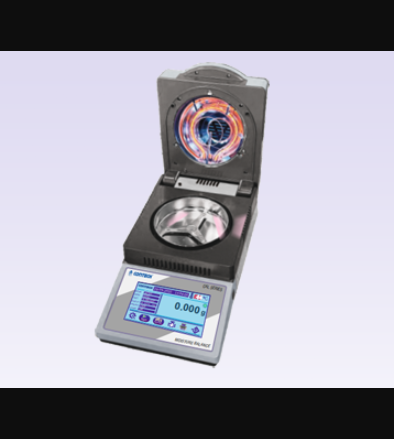 | Moisture Balances Moisture Balances (CAL Series) (0.001 g to 180 g) Moisture Balances (CAL Series) (0.001 g to 180 g) The CONTECH CAL Series Moisture Balances are advanced moisture analyzers designed for fast,... View product → |
Frequently asked questions
What does a halogen moisture analyzer measure during drying?
It measures sample mass continuously while a halogen heater removes volatile material. The reported moisture value represents mass loss, not a direct measurement of water molecules.
How do you run a sample in a halogen moisture analyzer?
Place and tare the empty pan, add and distribute the sample, close the chamber, select the validated drying method, start the run, and record the final result with its endpoint and method settings.
How can Chennai laboratory conditions affect moisture results?
Humidity, temperature, airflow, and the time a sample remains exposed before weighing can change its starting mass and drying behaviour. Control and document these conditions.
How should you choose drying temperature and endpoint?
Choose a temperature that removes the target volatile material without scorching or decomposing the sample. Set an endpoint based on stable mass loss, then compare the method with a reference procedure.
How do you validate a moisture analysis method?
Compare analyzer results with a suitable reference method, assess repeatability and agreement across representative samples, define acceptance limits, and document the approved settings before release testing.