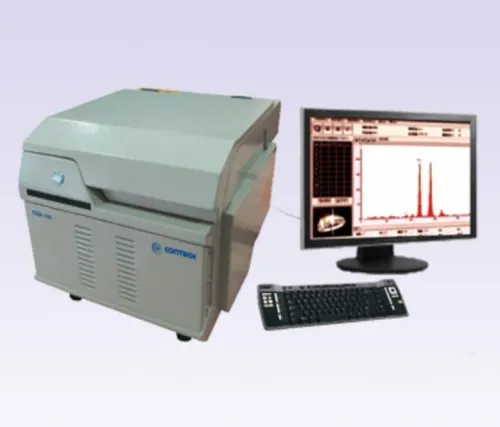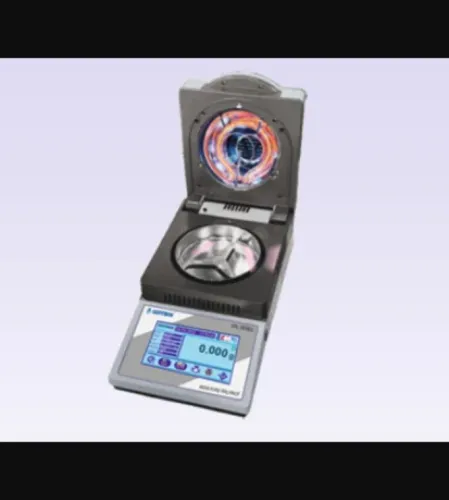

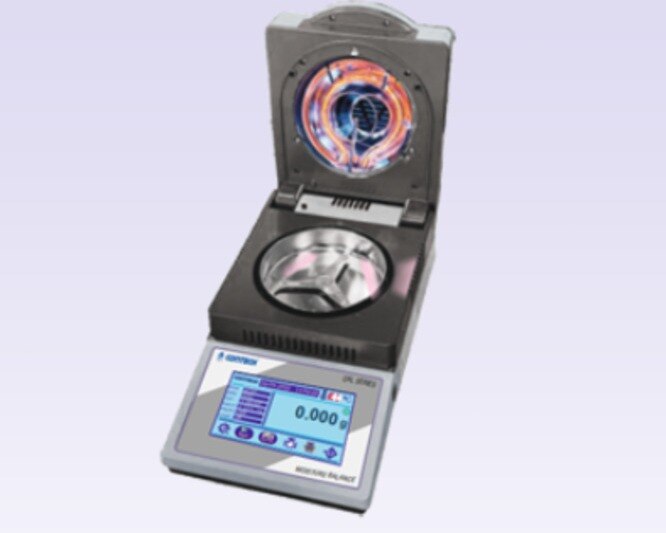
A quotation for an infrared moisture balance is incomplete if it lists only weighing capacity and readability. By the end, you will have a specification checklist, a box-content list, a sample-testing workflow, and an acceptance plan for deciding whether the instrument can produce repeatable results for your material.
Key takeaways
- Request weighing range, readability, temperature range and repeatability on the quotation.
- Compare heating profiles and endpoint criteria, not just lamp wattage.
- Confirm sample pans, calibration weights and software accessories before purchase.
- Qualify the instrument with your own samples before ordering in Hyderabad.
Which specifications must appear on the quotation?
A quotation is comparable only when it states measurable limits, not just “digital moisture balance specifications.” Ask for these figures separately:
| Specification | What the quotation must state | Why it matters |
|---|---|---|
| Maximum sample capacity | Usable mass in grams, such as 50–120 g | Overloading changes heating and weighing performance |
| Weighing readability | Mass increment in grams | It is not the same as moisture resolution |
| Moisture display resolution | 0.01% or 0.001%, with the moisture range | Finer display digits do not guarantee finer accuracy |
| Repeatability | Result variation for a defined test mass and material | Shows whether repeated tests agree |
| Temperature performance | Range, resolution, stability, and maximum temperature, such as 200 °C | Controls drying without confusing setpoint with sample temperature |
| Heating system | Infrared, halogen, ceramic, or another source; power-control steps | Heating speed and uniformity affect the result |
| Drying and endpoint controls | Time range, constant-time mode, and selectable stability criteria | Prevents one method from ending too early or too late |
| Pan and data details | Pan diameter, method storage, calibration procedure, and data output | Determines whether the method fits your workflow |
Compare repeatability and final moisture against your reference oven, Karl Fischer test, or official method at representative moisture levels. A 0.001 g balance readability does not create 0.001% moisture accuracy.
For infrared moisture balance specifications and accessories in Hyderabad, require the quotation to name:
- 230 V, 50 Hz compatibility, supplied plug, operating-environment limits, warranty, installation, response time, preventive maintenance, and calibration support.
- Availability and prices for pans, lamps, pads, temperature kits, and replacement cables.
- Safety restrictions for solvents, flammable samples, dust, fumes, and decomposition; the built-in exhaust is not a fume hood.
How do heating and endpoint controls change the result?
A moisture determination balance does not measure water selectively; it measures mass lost during heating. A volatile solvent, decomposition product, oxidation loss, or crystallisation water can therefore appear as “moisture.” Heater choice changes how quickly that loss occurs and whether the sample forms a dry crust before its interior dries.
| Heater type | Effect on drying | Main result risk |
|---|---|---|
| Infrared or halogen | Rapid radiant heating from above; dark, fine particles absorb energy faster | Surface overheating, crusting, or matrix-dependent results |
| Ceramic | More gradual heating with slower response | Longer tests, but potentially gentler treatment of heat-sensitive samples |
| Any top heater | Particle size, colour, reflectivity, layer thickness, and pan loading alter heat absorption | Identical set temperatures can produce different drying curves |
A fixed temperature is not automatically comparable across samples. A ramp or two-stage program can begin gently and finish at a higher setpoint, while excessive heat can decompose the sample or drive off compounds besides water. Compare the drying curve and final result, not just the programmed temperature.
Endpoint control determines when the instrument stops. A defined mass-loss rate over time can stop a slow sample early; a fixed drying time gives comparable timing but can leave residual moisture; a two-stage endpoint suits samples with changing drying behaviour.
Require each stored method to record temperature, heating profile, endpoint criterion, result mode, and sample identification. "Automatic endpoint" alone is not a specification.
What arrives in the box, and what is the basic operating sequence?
The box should contain the working tools needed to run a test, not just the instrument. Treat digital moisture balance specifications as separate line items, and mark every accessory as included, optional, or consumable.
| Item | Standard package | Confirm or price separately |
|---|---|---|
| Disposable aluminium pans | Starter quantity | Replacement pan packs |
| Pan handler and pan holder | One each | Spare handlers or holders |
| Spatula and sample tool | Basic sample-spreading tool | Defined tool for your material |
| Power cable and manual | Supplied for 230 V, 50 Hz | Plug type, translated manual |
| Calibration accessories | Weight kit or calibration procedure | Temperature calibration kit |
| Printer, data cable, software | Only if listed | Printer, cable, licences, export software |
Run a clean, repeatable test in this order:
- Level the balance, fit a clean pan, close the chamber, and allow the instrument to reach its operating condition.
- Tare the pan, add the agreed sample mass, and record the initial mass.
- Spread the sample into the same thin, even layer each time; excessive depth forms a dry crust, while too little sample magnifies weighing noise.
- Start the validated temperature and endpoint program without opening the chamber.
- Record moisture result, drying time, final mass, endpoint status, and any temperature warning.
- Remove the pan with the handler, clean residue, and use a fresh pan for the next preparation.
Keep balance calibration separate from heater verification; a correct weight reading does not prove correct sample temperature.
How do you choose a method for each type of sample?
Use the smallest mass that represents the sample while covering the pan in one even layer. A moisture determination balance heats from above, so a thick bed, reflective surface, or dark fine powder can produce a different drying curve at the same programmed temperature. Record the method, not just the final percentage.
| Sample type | Mass and layer | Temperature and heating profile | Endpoint |
|---|---|---|---|
| Powders | Start around 1–3 g; spread thinly without compacting | Begin at a validated reference temperature; use ramp heating if scorching or crusting occurs | Constant mass-loss rate, then confirm with a repeat |
| Granules | Use enough particles to represent the batch; keep one shallow layer | Use a longer hold or two-stage profile so the centre dries before the surface seals | Fixed mass-loss rate or extended fixed time |
| Pastes | Use a smaller portion; spread rapidly into a thin, uniform film | Start lower and ramp upward to prevent skin formation and splashing | Stable mass-loss rate after the slow tail |
| Foods | Homogenise first; use a thin layer and replicate portions | Use the recognised food method temperature, or compare curves during transfer | Fixed time only when the recipe is established; otherwise use constant rate |
| Chemicals | Use the minimum safe mass; avoid overloading | Set below decomposition or solvent-flash limits; check the safety data sheet | Stop before decomposition, oxidation, or loss of crystallisation water |
| Heat-sensitive materials | Use a small, thin portion | Low temperature, gentle ramp, and longer drying time | Conservative constant-rate endpoint; inspect for colour or odour change |
Treat “moisture” as mass loss: solvents and decomposition products count unless chemistry proves otherwise. Verify each method with drying curves and oven or reference results.
How can you qualify the instrument before purchase in Hyderabad?
Do not accept a demonstration based on one easy sample. For a moisture balance instrument in Hyderabad, make the supplier qualify the exact configuration, method storage, data handling, and site conditions before you sign.
1. Run duplicate or triplicate preparations at low, normal, and high moisture levels. Compare results with your reference method and record bias, repeatability, drying time, endpoint stability, sample-temperature behaviour, and operator-to-operator variation.
2. Verify the balance with certified weights, then check heater temperature separately at the working setpoint using the manufacturer’s temperature kit or procedure. A passing weight check does not prove that the heater is accurate.
3. Request a sample report and confirm retention or export of the result, method parameters, date and time, user identity, calibration events, and audit information in your required format. A USB socket or printer port alone does not establish electronic records compliance.
4. Document restrictions for solvent-bearing, flammable, dusty, or decomposition-prone samples. Confirm ventilation, exhaust handling, temperature limits, maximum sample size, cleaning access, and what the risk assessment prohibits; the instrument is not a fume hood.
5. Put 230 V, 50 Hz compatibility, supplied plug and power cord, operating-environment limits, installation, warranty response time, preventive maintenance, and calibration support on the purchase order.
For an electronic moisture balance in Hyderabad, confirm local stock or lead times for pans, lamps, pads, and temperature kits. Ask CONTECH INSTRUMENTS LTD. to state these service and acceptance commitments in writing rather than relying on a generic “accessories available” claim.
Related product
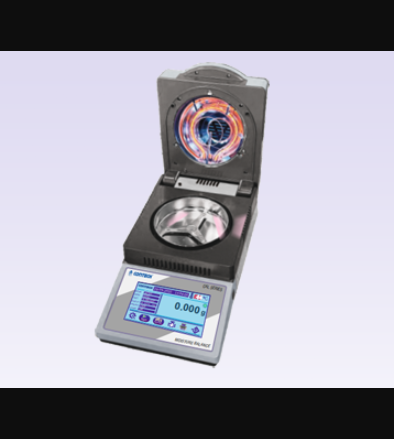 | Moisture Balances Moisture Balances (CAL Series) (0.001 g to 180 g) Moisture Balances (CAL Series) (0.001 g to 180 g) The CONTECH CAL Series Moisture Balances are advanced moisture analyzers designed for fast,... View product → |
Frequently asked questions
Which specifications must appear on an infrared moisture balance quotation?
Ask for the weighing range, readability, moisture measurement range, repeatability, temperature range, heating profile, endpoint settings, sample capacity, calibration method, dimensions, power supply and included accessories.
How do heating and endpoint controls affect moisture results?
Heating rate, temperature stability and endpoint criteria determine whether the sample dries consistently or overheats. Compare fixed-temperature, ramp and step programs, then check how the instrument defines a stable final weight.
What arrives with a moisture balance, and what is the basic operating sequence?
Confirm whether the package includes the balance, heater, sample pan holder, pans, calibration accessories, power cable, operating software and documentation. The basic sequence is tare the pan, add the sample, select the method, start heating, wait for the endpoint and record the result.
How should you choose a moisture method for different samples?
Use a lower temperature and slower program for heat-sensitive materials, and validate faster or hotter methods only when the sample does not scorch, crust or lose volatile compounds other than water. Compare results with a reference oven method during qualification.
How can you qualify an infrared moisture balance before purchase in Hyderabad?
Run representative samples at the supplier site, compare repeatability with your reference method, inspect the displayed endpoint and confirm calibration, installation, training, service response and accessory availability in Hyderabad.