
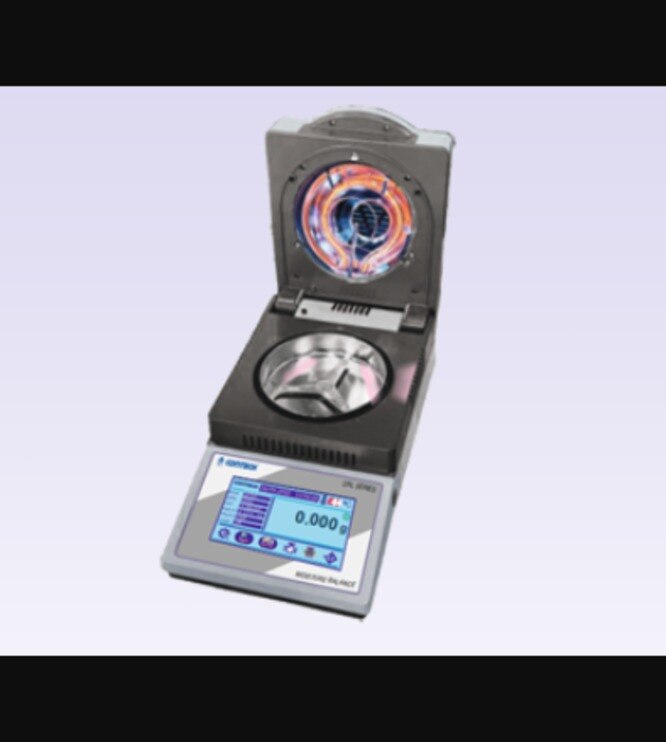
A moisture probe and a moisture balance do not measure the same thing: one infers water from a sensor response, while the other calculates mass lost during controlled heating. You will be able to decide whether a probe is suitable for your material, what validation evidence it needs, and when a balance or Karl Fischer method must remain in the workflow.
Key takeaways
- Use a moisture balance when you need direct loss-on-drying results.
- Match probe technology to the material matrix, not just the moisture range.
- Validate probe readings against balance results before replacing routine testing.
- Choose an infrared moisture meter for rapid screening, not automatic equivalence.
What a moisture probe measures versus what a moisture balance calculates
No—a moisture probe and a moisture balance are not interchangeable at a fundamental level. A probe uses electrical, dielectric, microwave, resistance, capacitance, or near-infrared response to estimate moisture through a correlation established for a specific material matrix. A moisture balance records the sample’s initial mass, heats it, records the final mass, and calculates the loss.
| Instrument | What it measures | Main limitation |
|---|---|---|
| Moisture probe | A sensor response correlated with moisture content | The correlation changes with formulation, density, temperature, and particle structure |
| Moisture balance | Mass lost during controlled heating | The loss may include water and other volatile material |
| Karl Fischer titrator | Water specifically, including water released from or dissolved in a sample | The method requires suitable reagents, sample handling, and chemical compatibility |
A probe can replace routine moisture-balance testing only after calibration against a suitable laboratory reference using representative samples. Both displays showing “percentage” proves nothing: one percentage may be predicted water content, while the other is total loss on drying.
Heating also limits the moisture balance as a reference. The sample can lose solvents, decomposition products, oxidation products, or crystallisation water; it can also form a crust, stop drying completely, or decompose before the endpoint.
For a pharmaceutical or chemical specification that concerns water rather than every volatile component, Karl Fischer titration is the more defensible reference. A probe is best treated as a replacement only when its matrix-specific calibration remains accurate across the actual product and operating range.
Which probe type fits powders, grains, soil, liquids, and polymers
A probe reading is representative only when the material is uniform, the water range is stable, and the tested location reflects the batch. A wet pocket in a drum, bag, hopper, or granule bed can make one reading misleading.
| Probe type | Best fit | Main limitation |
|---|---|---|
| Handheld soil probe | Soil and field media | Salt, compaction, and uneven contact distort readings |
| Grain probe | Bulk grain and seeds | Particle-size distribution and packing change the calibration |
| Capacitance sensor | Uniform powders, granules, or solids | Bulk density and container geometry bias the dielectric response |
| Resistance sensor | Materials with reliable electrode contact | Salt content and poor contact produce false readings |
| Microwave sensor | Bulk materials and some continuous processes | Density, temperature, and stratification affect penetration |
| Near-infrared sensor | Homogeneous surfaces or flowing product | It measures a shallow or targeted zone and needs matrix calibration |
For powders, pastes, pharmaceutical materials, polymers, and granules, do not assume a probe sees the whole sample. Polymer moisture testing is a defined method problem under ISO 15512, not a universal probe application; liquids also need a sensor designed for their conductivity, container, and mixing condition.
Use the probe consistently:
- Insert to the same depth and remove air gaps around the sensor.
- Take readings at several locations, then compare their spread.
- Control sample temperature, clean the sensor, and check it against reference material.
Bulk density, compaction, electrode contact, salt, particle size, and container shape can create a repeatable but biased moisture measurement. A calibration from one formulation or density does not transfer automatically to another.
How the balance, probe, and infrared meter are used in practice
A moisture balance needs a representative portion; a probe needs a representative location; an infrared moisture meter needs a controlled drying method.
| Option | What you do | Main result |
|---|---|---|
| Moisture balance | Tare the pan, weigh the portion, dry it, and weigh it again | Loss on drying |
| Probe | Insert or position the sensor consistently and read the material in place | Correlated moisture estimate |
| Infrared moisture meter | Heat a weighed portion with infrared radiation and monitor mass loss | Rapid loss-on-drying result |
For a balance, seal hygroscopic material until use, record the initial mass, spread the sample in a thin even layer, choose and document the drying temperature, set the endpoint, and record the final mass. Use a representative blend, not material taken from only the surface of a bag.
- Record laboratory temperature, relative humidity, sample mass, drying temperature, exposure time, and endpoint criterion.
- Keep the container closed during preparation and weigh rapidly after opening.
- Stop crust formation, incomplete drying, and rapid surface heating from distorting the result through method development and repeatability checks.
A crust traps moisture below the surface; grinding, compaction, or an uneven layer changes heat transfer. The moisture measurement then reflects preparation as much as composition.
“Infrared moisture meter” commonly means an infrared-heated loss-on-drying instrument, not a non-contact near-infrared sensor. Infrared radiation can heat the surface faster than a hot-air oven, producing a different result at the same nominal temperature. Transfer an oven or balance method only after equivalence testing.
Kolkata’s humidity makes sealed storage, minimal exposure, rapid weighing, and documented temperature and relative humidity essential.
What evidence proves that a probe can replace routine balance testing
Replacement is defensible only when the moisture probe meets the laboratory’s specification against a validated reference across representative samples. A supplier’s advertised moisture range proves only display capability, not acceptable bias or repeatability.
Evidence to collect:
- Bias against the reference method
- Repeatability by one operator and instrument
- Reproducibility across operators, instruments, days, and locations
- Working range and response time
- Sample-temperature limits
- Calibration interval and drift between checks
- Performance across the actual formulation, density, particle-size distribution, and packaging
| Evidence | What to demonstrate | Failure consequence |
|---|---|---|
| Bias | Probe result agrees with the reference within your allowed limit | Consistent readings remain wrong |
| Repeatability | Replicate readings stay within your precision limit | Routine decisions become unstable |
| Reproducibility | Results hold across operators, days, and instruments | Site-wide control cannot be trusted |
| Matrix coverage | Calibration includes each formulation, density, particle-size distribution, and package condition | One material’s calibration is transferred incorrectly |
| Sampling coverage | Multiple locations represent drums, bags, hoppers, or batches | A wet pocket is missed |
| Temperature and range | Readings remain valid across actual temperatures and moisture levels | The probe passes in the laboratory but fails in production |
Compare readings with a validated loss-on-drying method such as ASTM E871 where applicable. Use ASTM E1131 as a framework for controlled mass-change work, or use Karl Fischer when the measurand is water rather than total volatile loss.
A moisture balance tests a prepared portion; one probe location can miss stratification. Validate sampling separately, then repeat verification at the documented calibration interval and after formulation, supplier, density, particle-size, or packaging changes.
A practical purchase and operating decision for chemical laboratories in Kolkata
Choose both unless a validated comparison proves that one instrument meets your specification. For moisture probe or balance decisions in chemical laboratories in Kolkata, define the measurand before comparing prices.
| Option | Best use | Main limitation |
|---|---|---|
| Moisture probe | Screening and in-process control | Matrix-specific bias |
| Moisture balance | Routine loss-on-drying testing | Destructive, portion-based result |
| Both | Fast control plus defensible verification | Higher cost and method-management effort |
Use this decision sequence:
- Decide whether you need water specifically or loss on drying. Choose Karl Fischer for a water specification; choose a moisture balance for mass loss.
- Set allowable bias, repeatability, working range, response time, and required throughput.
- Classify the matrix: powder, liquid, paste, granule, polymer, or hygroscopic chemical.
- Decide whether a destructive test is acceptable and whether one probe location represents the batch.
- Check portability, sample-temperature limits, ambient-temperature tolerance, and cleaning requirements.
- Document the reference method, sampling plan, and calibration interval before purchase.
A moisture probe is valuable for screening when the matrix is homogeneous and stable. Retain the moisture balance or Karl Fischer method for method establishment, supplier disputes, periodic verification, and out-of-trend results.
Ask the supplier for matrix-specific validation support, calibration records, repeatability data, reference-method comparisons, and service access in Kolkata. Recheck performance after changes to formulation, supplier, particle size, density, or packaging. CONTECH INSTRUMENTS LTD. can be compared with other weighing and analytical-equipment suppliers, but documented performance against your own method must decide the purchase.
Related product
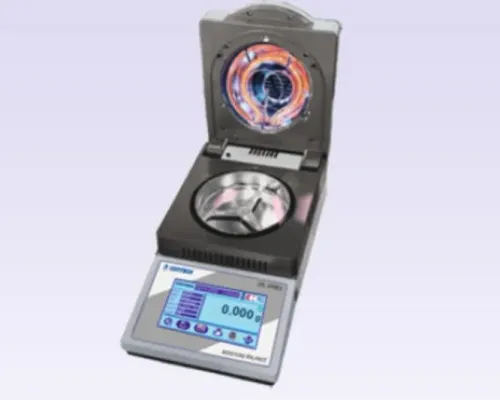
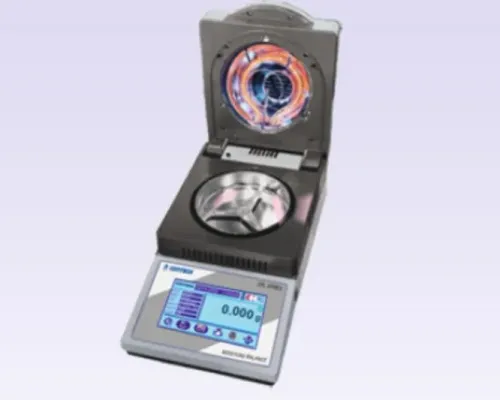
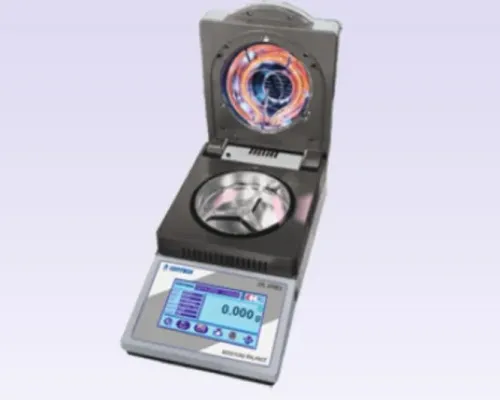
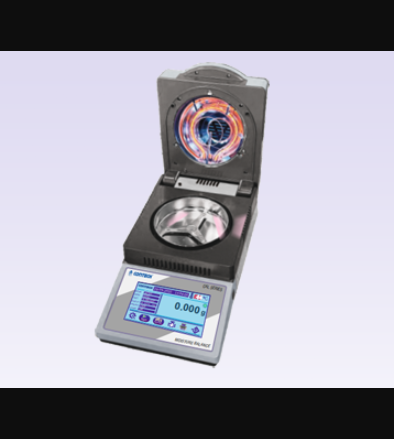 | Moisture Balances Moisture Balances (CAL Series) (0.001 g to 180 g) Moisture Balances (CAL Series) (0.001 g to 180 g) The CONTECH CAL Series Moisture Balances are advanced moisture analyzers designed for fast,... View product → |
Frequently asked questions
What is the difference between a moisture probe and a moisture balance?
A moisture probe estimates moisture from an electrical, dielectric, microwave, resistance, capacitance, or near-infrared response. A moisture balance weighs a sample, heats it, measures mass loss, and calculates moisture content.
Which moisture probe suits powders, grains, soil, liquids, and polymers?
Choose based on the material matrix: capacitance or resistance probes suit selected solids, dielectric or microwave systems suit bulk materials, and near-infrared instruments require a validated calibration for the specific product. Liquids and polymers need method-specific testing because probe response changes with composition and temperature.
How do you prove that a moisture probe can replace routine balance testing?
Compare probe readings with moisture-balance results across representative batches, moisture levels, temperatures, and operators. Set acceptance limits, document the calibration model, investigate outliers, and repeat the comparison after material or process changes.
When should a chemical laboratory in Kolkata buy a moisture balance instead of a probe?
Buy a moisture balance when you need a traceable loss-on-drying method, lack a validated probe calibration, test changing materials, or require an independent reference method. Select a probe for faster routine screening after validation.