
A changing moisture result does not prove that the analyser is failing: sample preparation, room conditions, heating behaviour, weighing accuracy, and the chosen test method can all shift the number. You will be able to separate instrument drift from genuine sample variation, investigate the cause in a defined order, and decide when to stop reporting results or change methods.
Key takeaways
- Retest a retained, homogeneous sample before blaming the instrument.
- Control room humidity, temperature, sample size, and exposure time.
- Stop reporting when retained-sample results move outside your validated tolerance.
- Test the analyser with your actual materials before purchase.
Is the instrument drifting, or is the sample changing?
For laboratories evaluating testing machines, moisture results that drift do not prove the instrument is at fault. Retain a well-mixed, homogeneous sample and test it repeatedly under the same programme. Consistent repeats from the retained sample point toward sample variation in routine material; movement in the retained sample points toward the instrument or method.
Compare the pattern with a gravimetric reference oven method. Define the sample mass, drying temperature, drying time or constant-mass rule, cooling procedure, and weighing procedure before starting. The comparison is invalid if the oven uses a different mass, cooling period, timing rule, or constant-mass criterion because method bias becomes indistinguishable from instrument error.
| Pattern | Likely source | What to check |
|---|---|---|
| Constant offset | Weighing or temperature bias | Traceable weights and temperature accuracy |
| Results worsen during one run | Heating or sensor behaviour | Temperature reference at a defined location and heater performance |
| Scattered repeats | Balance, draft, vibration, or sample presentation | Level, draft shield, pan, holder, and loading |
| Difference changes with endpoint | Method settings | Stability window, drying time, and endpoint algorithm |
A stable wrong result needs more than a zero check. Zero confirms tare; it does not prove weighing accuracy. Check the balance with suitable traceable weights at more than one load, then verify temperature with a calibrated reference using a defined procedure. A repeatable bias without an alarm still requires correction.
How room conditions and sample handling create false drift
An unchanged moisture tester can report different values because the sample and surroundings changed before heating. Hygroscopic powders gain water between opening the container, subsampling, weighing, and starting the run. Record each delay, sample temperature, laboratory temperature, and relative humidity; otherwise pre-test uptake appears as instrument drift.
- Let the instrument stabilise at its test location before use, and keep the chamber closed between tests.
- Place it level, away from air-conditioner and fume-hood drafts, and protect it from vibration.
- Do not move the instrument between tests; relocation changes its level, airflow, and thermal state.
- Avoid warm pans and wet containers, which add heat or water before measurement.
- Check mains protection and supply stability; voltage disturbances can interrupt heating or distort endpoint behaviour.
- Document room temperature, relative humidity, instrument location, sample temperature, mass, and opening-to-start delay.
Sample preparation creates another false pattern. Poor mixing, segregation, particle-size changes, or nonrepresentative subsampling mean that two portions do not contain the same moisture. Excessive mass, an uneven or thick layer, off-centre loading, splattering, or crust formation creates hot spots or traps water beneath a dry surface. Use a defined mass and consistent thin layer.
Repeating a badly prepared portion only repeats the moisture content analysis problems; it does not prove machine drift. A stable result requires controlled handling from container opening through pan loading.
When the drying programme measures more than water
A report of moisture tester inaccurate results may actually reflect genuine mass loss that is not water. Infrared or halogen heating can overheat a matrix, seal its surface, form a crust, splatter material, or leave water trapped beneath a dry layer. Sample colour, reflectivity, particle size, and layer thickness also change heat absorption.
Loss on Drying measures everything lost during heating, not water alone. Volatile solvents, plasticisers, and carbon dioxide make LOD read high; chemically bound water or an insufficient temperature makes it read low. Karl Fischer titration measures water specifically, so the two results can differ systematically without either instrument being faulty.
A short stability window can stop drying before constant mass. An overly stringent endpoint can continue heating into oxidation or decomposition. Define temperature, endpoint, time, sample mass, layer thickness, and duplicate rules for each material; do not transfer one programme universally.
| Method | Speed and throughput | Destructive testing, repeatability, and transfer | Analyst time |
|---|---|---|---|
| Moisture balance | Fast; suitable for routine batches | Destructive; repeatability depends on the heating profile; matrix-specific transfer required | Low after validation |
| Hot-air oven | Slow; limited by heating and cooling | Destructive; established reference, but less rapid and harder to transfer | High, with repeated weighing |
| Vacuum oven | Slower setup; useful for heat-sensitive materials | Destructive; reduced oxidation, but method transfer requires pressure and temperature control | High |
| Karl Fischer | Fast for many samples; moderate throughput | Consumes the sample; specific for water, with reagent and extraction effects to validate | Moderate |
Validate every moisture balance against a defined oven or Karl Fischer method before treating an endpoint as truth.
A fault-finding sequence that tells you when to stop reporting
Stop reporting when a control result exceeds its documented investigation limit. Quarantine affected batches, identify the last acceptable control result, and investigate before replacing the instrument.
- Check balance zero, level, pan condition, draft protection, and a traceable calibration-weight check at more than one load where the quality system or risk assessment requires it. A zero result alone will not reveal span, corner-load, or repeatability errors.
- Run repeatability tests, then perform span and corner-load checks. Residue, salt, sugar, oil, or polymer films on the pan can change both mass and heat transfer.
- Verify the temperature sensor with a calibrated reference at a defined location and procedure. Check heater performance, ventilation, and the drying programme against the approved method.
- Test a retained, homogeneous reference material. Agreement with one water-containing standard does not prove accuracy across matrices with different particle size, colour, water binding, or volatile content.
- Inspect for damaged sensors, blocked ventilation paths, rubbing holders, contaminated weighing chambers, electrical faults, and mechanical misalignment. Call service for persistent temperature, balance, electrical, or mechanical faults.
- Correct the cause, recalibrate, and repeat affected samples before releasing results. Record sample identity, batch, analyst, sample mass, raw and final weights, temperature, endpoint, drying time, room conditions, calibration status, and maintenance.
These controls separate moisture analysis machine errors from sample variation. If results remain outside limits after correction, keep reporting stopped and escalate the investigation rather than averaging questionable values.
How to prove a moisture analyser fits your materials before purchase
Buy only after the analyser matches your materials across the full moisture range that will support release, quality control, acceptance, process control, or inventory calculations. Test low, typical, and high-moisture samples, including difficult matrices, against your established oven or Karl Fischer method.
Define allowable bias, repeatability, duplicate agreement, endpoint behaviour, and investigation limits before testing. Use duplicate determinations, certified reference materials, control charts, and matrix-specific checks; one water standard cannot prove performance across different colours, particle sizes, water-binding properties, or volatile contents.
Reject a moisture balance when the material decomposes at the drying temperature, contains several volatile components, forms an impermeable surface, or requires chemically specific water measurement. Loss on drying is not interchangeable with Karl Fischer results.
Compare supplier documentation for these points:
- Temperature accuracy and sensor verification
- Endpoint detection and programmable stability criteria
- Repeatability, calibration, and data export
- Pan handling, sample presentation, and validation support
| Method | Main limitation | Use it when |
|---|---|---|
| Moisture balance | Measures total mass loss, including non-water volatiles | The matrix survives defined heating without misleading mass loss |
| Hot-air or vacuum oven | Slower and more labour-intensive | Your approved reference method requires controlled drying and weighing |
| Karl Fischer titration | Measures chemically determined water, not total volatiles | Water specificity matters or heating changes the sample |
Ask CONTECH INSTRUMENTS LTD. or another supplier to support a documented method transfer using your samples and acceptance limits, not specification headlines or speed claims.
Related product
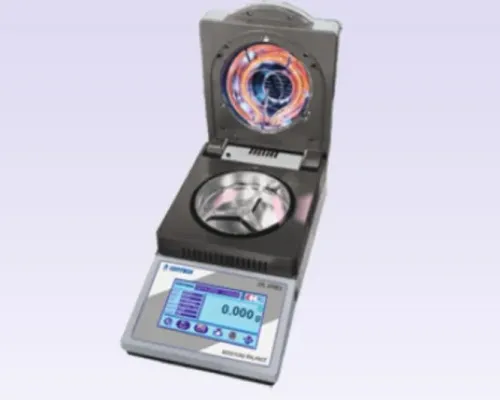
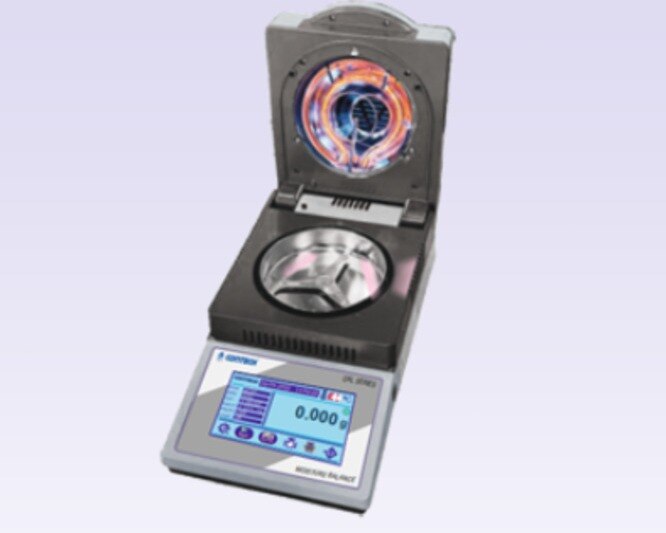
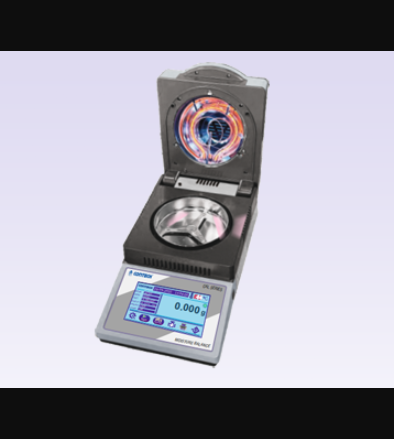 | Moisture Balances Moisture Balances (CAL Series) (0.001 g to 180 g) Moisture Balances (CAL Series) (0.001 g to 180 g) The CONTECH CAL Series Moisture Balances are advanced moisture analyzers designed for fast,... View product → |
Frequently asked questions
How can you tell whether the instrument is drifting or the sample is changing?
Test a well-mixed, homogeneous retained sample repeatedly under the same programme. Stable repeats indicate routine sample variation; changing results indicate an instrument or method problem.
Which room conditions and handling steps create false moisture drift?
Humidity, temperature, open-container exposure, inconsistent sample size, poor mixing, and delayed testing can change the sample before measurement.
Why can a drying programme measure more than water?
Heat can remove solvents and volatile compounds, or drive decomposition and oxidation. The reported loss then exceeds the material’s actual water content.
When should a laboratory stop reporting moisture results?
Stop when retained-sample checks fail the validated tolerance, controls trend beyond limits, or you cannot identify and correct a sample, method, or instrument cause.