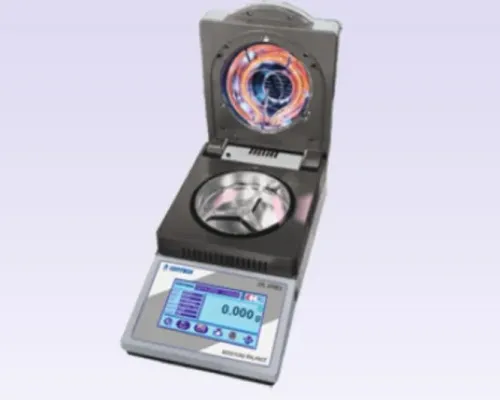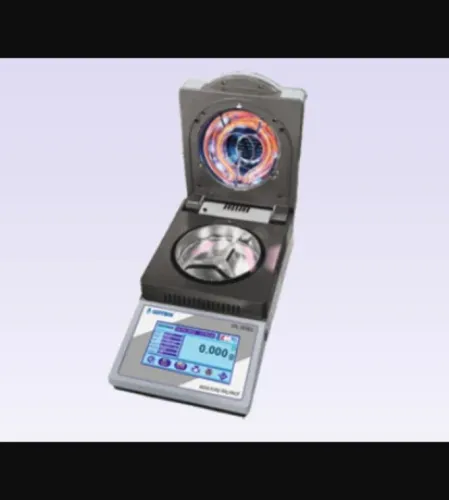

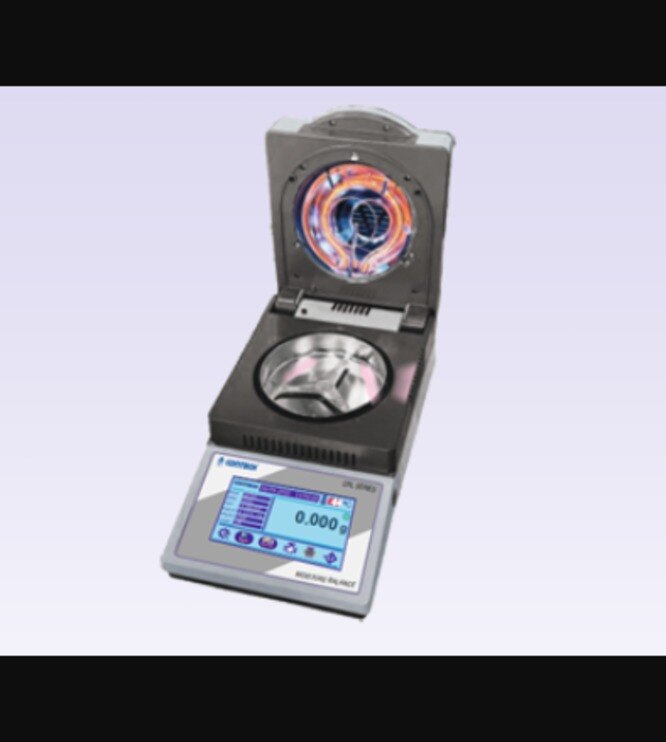
An infrared moisture balance measures mass lost during heating, but Kolkata’s humidity, air-conditioning, sample handling, and material chemistry can change that result. You will learn how to run the test, select a defensible temperature and endpoint, calculate wet- and dry-basis values, and validate the method against a reference procedure.
Key takeaways
- Control sample mass, pan handling, airflow, and room humidity before testing.
- Treat all heating losses as volatile mass until you confirm they are water.
- Report wet-basis moisture, dry-basis moisture, or dry matter with the formula shown.
- Validate the infrared method against a reference method before routine use.
How Infrared Heating Produces a Moisture Result
An infra red moisture balance for laboratory conditions in Kolkata measures mass lost from a sample during heating, then expresses that loss as moisture measurement. The weighing sensor records the sample-and-pan mass continuously; it does not identify whether the lost mass was water, solvent, oil, or another volatile component.
The heater directs infrared energy into the sample, often more intensely than a reference oven. That changes sample temperature, drying rate, and endpoint. A clean, level pan spreads heat evenly, while a dirty, warped, or overloaded pan creates hot and cool zones.
The temperature sensor and control system must reach the programmed condition; a stable mass reading alone does not prove accurate heating.
Routine performance checks should include:
- Level the balance and allow the instrument to warm up.
- Confirm zero and tare stability with an empty, clean pan.
- Check weighing response with a certified mass.
- Verify that the heater and temperature sensor reach the programmed temperature.
A constant-temperature, ramp, or step program can produce different results from the same material. Excessive heat can brown, char, oxidise, melt, form a surface skin, or release non-water volatiles, making loss on drying exceed actual water content.
The displayed readability, even at 0.001%, is not moisture accuracy; correlate the method with the laboratory’s designated oven, Karl Fischer, or other material-specific reference procedure.
A Repeatable Test Procedure for Humid Kolkata Laboratories
Keep samples and empty pans sealed while they equilibrate to the laboratory’s working temperature. A cold container moved from air conditioning into humid Kolkata air can collect condensation and invalidate the moisture measurement before testing begins.
1. Mix the sample without heating it, then grind only to the particle size specified by your method. Over-grinding creates fresh surfaces that exchange water rapidly with humid air. Record the particle size, mixing method, sample mass, and maximum delay before loading.
2. Open the container immediately before weighing. Tare a clean, dry pan, add the specified mass, and spread it as a thin, even layer. Do not touch the sample or pan with your fingers; handle the pan with forceps.
3. Close the chamber promptly and start the validated temperature program. Keep the same heater temperature, ramp or constant-temperature setting, sample mass, and pan type for every run.
4. Monitor the displayed mass and drying curve rather than stopping at a convenient time. End the run only at the defined criterion, such as a maximum mass change over a specified interval or a validated fixed time.
5. Record the result with temperature, endpoint, sample identification, start time, and operator. Moisture content analysis becomes unreliable when these conditions disappear from the record.
6. Remove the pan after cooling as required by the method, then brush away residue and clean the pan and chamber with a lint-free material. Prevent residue from changing the next sample’s mass.
Correlate this procedure with the laboratory’s designated oven reference method for each material; infrared drying can produce a different result because it heats faster and more locally.
Choosing Temperature and Separating Water from Other Mass Loss
Start with the lowest temperature that removes water at a practical rate without changing the sample. A program that works for one product cannot be transferred to another: excessive infrared heat can melt fats, form a surface crust, brown sugars, oxidise oils, or decompose solids.
Run a temperature-step trial on replicate portions and inspect the residue after each step.
| Observation | Interpretation | Action |
|---|---|---|
| Stable mass loss with unchanged residue | Consistent with water loss | Confirm with replicates and a reference method |
| Sharp early loss or solvent odour | Residual solvent or volatile additive may be leaving | Use Karl Fischer or a material-specific method |
| Glossy melt, bubbling, or oil migration | Heating has changed the sample physically | Lower the temperature or use a different method |
| Browning, smoke, crust, or continuing darkening | Scorching, oxidation, or decomposition is contributing | Reject that program; do not report the loss as water |
A moisture balance measures mass lost under its heating program, not water specifically. Moisture detection therefore becomes water-specific only after you show that other mass loss is negligible or correlate the moisture analysis method with Karl Fischer water determination or another validated reference.
Define the endpoint before testing. Use a maximum mass change over a stated interval, a validated drying-rate threshold, or a validated fixed-temperature and fixed-time procedure; changing the endpoint changes the result. Record temperature or program, sample mass, endpoint, replicate number, calculation basis, and reference method.
A thin, even layer reduces crusting and temperature gradients that conceal residual water.
Calculating Wet-Basis, Dry-Basis, and Dry-Matter Results
Let initial mass be Wi and final mass after drying be Wf. Calculate wet-basis moisture as (Wi − Wf) ÷ Wi × 100. Calculate dry-basis moisture as (Wi − Wf) ÷ Wf × 100.
For example, a 10.00 g sample ending at 8.00 g contains 20.00% moisture on a wet basis, 25.00% on a dry basis, and 80.00% dry matter on a wet basis.
Convert between bases with these equations:
- Dry-basis moisture = wet-basis moisture ÷ (100 − wet-basis moisture) × 100
- Wet-basis moisture = dry-basis moisture ÷ (100 + dry-basis moisture) × 100
- Wet-basis dry matter = 100 − wet-basis moisture
State the basis every time. “Moisture: 20%” is incomplete because it could mean wet basis, dry basis, or loss on drying.
For defensible moisture content analysis, report the sample mass, particle preparation, infrared temperature or temperature program, endpoint rule, replicate number, and reference method used for correlation. Include the maximum delay between loading and starting, especially in humid Kolkata conditions.
Treat the result as method-dependent moisture measurement. An infrared balance measures mass loss, not water specifically; solvent evaporation, scorching, or volatile additives can inflate the value. Record the endpoint, such as a permitted mass change over a stated interval, rather than reporting a convenient fixed-time result without justification.
Validating an Infrared Method Before Routine Use
Do not approve an infrared result because one run looks plausible. Validate the moisture analysis method for each material by comparing several temperatures, sample masses, and endpoint settings with the laboratory’s designated reference oven procedure.
- Demonstrate agreement with the reference method across low, middle, and high moisture samples; investigate any consistent bias.
- Run replicate portions to establish repeatability, then set an acceptance limit before routine testing.
- Specify particle size, mixing, loading pattern, sample mass, and the maximum delay before heating.
- Test the method during humid Kolkata conditions, limiting exposure during grinding, transfer, and pan loading. Keep hygroscopic samples sealed and condition containers before opening.
Compare the practical choices before selecting equipment or accepting results:
| Check | What to compare | Why it matters |
|---|---|---|
| Heating control | Constant temperature, ramp, or step programs; verified sensor accuracy | A stable mass does not prove the sample reached the programmed temperature |
| Endpoint | Fixed time versus stable-rate or stable-mass criteria | A premature endpoint leaves water; prolonged heating removes other volatiles |
| Sample handling | Pan size, thin-layer loading, capacity, and cleaning access | Uneven or overloaded samples dry unevenly and skew repeatability |
| Reference agreement | Infrared result versus the designated oven result for that material | Concentrated infrared heating changes sample temperature and drying rate |
Before every batch, check level, warm-up, zero or tare stability, pan cleanliness, and a certified-mass result. CONTECH INSTRUMENTS LTD. can help you compare a moisture balance with a separate analytical balance when independent mass checks are part of your laboratory’s validation plan.
Related product
 | Moisture Balances Moisture Balances (CAL Series) (0.001 g to 180 g) Moisture Balances (CAL Series) (0.001 g to 180 g) The CONTECH CAL Series Moisture Balances are advanced moisture analyzers designed for fast,... View product → |
Frequently asked questions
How does an infrared moisture balance produce a moisture result?
It continuously measures sample mass while infrared heating removes volatile material. The result represents mass loss, not water alone, unless the method proves other volatiles are absent.
How can you make moisture testing repeatable in a humid Kolkata laboratory?
Control sample preparation, sample mass, pan handling, heating time, endpoint criteria, airflow, and the balance environment. Record room temperature and relative humidity with each method check.
How do you choose the heating temperature for moisture analysis?
Start below the temperature that causes browning, charring, spattering, or decomposition, then confirm that the endpoint is stable. Compare the result with a reference method to separate water loss from other mass loss.
What is the difference between wet-basis and dry-basis moisture?
Wet-basis moisture divides water mass by the original sample mass. Dry-basis moisture divides water mass by dry solids mass; dry matter is the dry-solids percentage of the original sample mass.