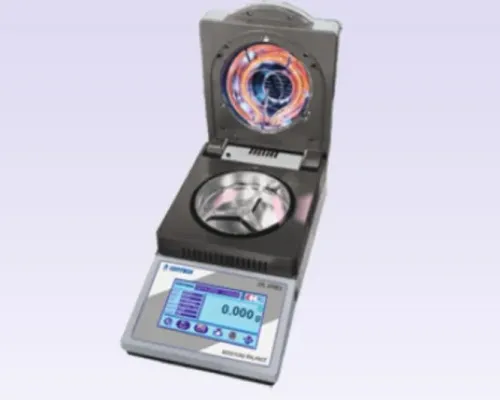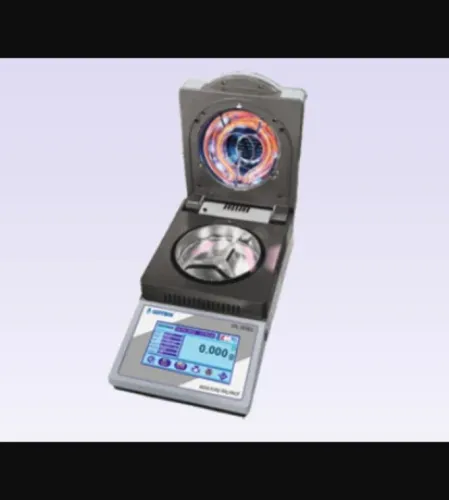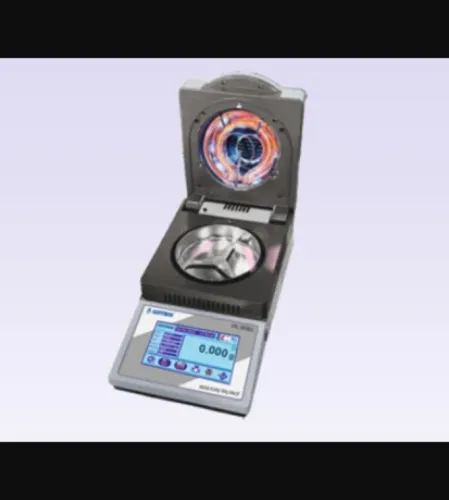

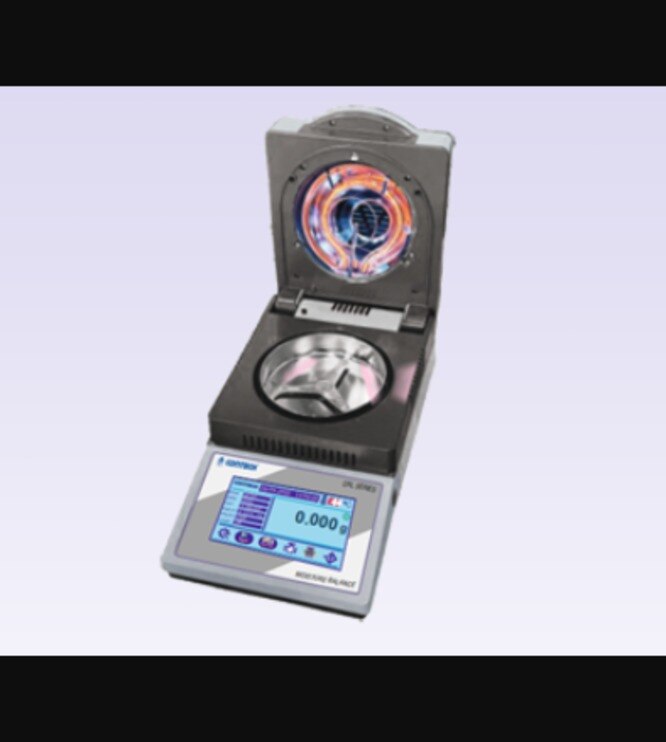
A moisture analyzer can produce a number in minutes, but that number is only useful when the sample, temperature, endpoint, and calculation are controlled. By the end, you will know how to run a repeatable test, recognise when loss on drying is misleading, compare the result with an oven or Karl Fischer method, and specify the right instrument and support for your laboratory.
Key takeaways
- Measure mass loss, not water molecules directly.
- Use consistent sample size, spreading, temperature, and endpoint settings.
- Compare analyzer results with an oven method before accepting routine measurements.
- Qualify local suppliers by checking calibration, service, training, and method support.
What a moisture balance actually measures—and what the percentage means
A laboratory moisture balance measures the reduction in sample mass during controlled heating. It weighs the sample before drying, heats it under a defined program, weighs the residue, and reports the loss as moisture content. The instrument is therefore performing gravimetric moisture analysis, not directly identifying water molecules.
The usual calculation is:
Moisture percentage = (initial mass − final dry mass) ÷ initial mass × 100
This is normally a wet-basis percentage. A result of 8.0% means that 8.0% of the original sample mass disappeared during the test, leaving 92.0% as the measured dry residue. It does not mean that the sample contained exactly 8.0% water.
The distinction matters because heating removes whatever the method allows to evaporate. Residual solvents and other volatile compounds can inflate the result, while strongly bound water or incomplete drying can reduce it. Decomposition or scorching can also create extra mass loss, making the displayed percentage look like moisture when it is not.
Treat the number as a method-defined loss on drying (LOD) result. Readability such as 0.001 g does not establish accuracy; sample uniformity, heating distribution, sample size, and the endpoint affect the result. Before using it for product release, compare it with your reference method using replicate tests at low, middle, and high moisture levels.
If the specification concerns water specifically, Karl Fischer titration provides the more direct comparison.
How to prepare and run a repeatable moisture test
For hygroscopic powders, close the sample container between every operation and load it immediately; Kolkata’s humid air can change the mass before heating begins. Use one written method for moisture content analysis, keeping temperature, heating profile, sample mass, and endpoint criterion fixed.
1. Take increments from different parts of the lot, combine them, and mix without leaving the material exposed. A scoop from the surface can misrepresent the whole sample.
2. Use the same particle-size preparation each time. Break large pieces consistently, but avoid prolonged grinding that warms the sample or drives off moisture.
3. Confirm that the pan is clean, dry, and undamaged. Place it correctly, close the chamber, and tare before opening it again.
4. Weigh the specified sample mass quickly, then spread it into a thin, even layer across the pan. A heap, thick patch, or material on the rim dries unevenly.
5. Start the laboratory moisture analyzer with the approved heating program and endpoint. Do not pause, stir, or open the chamber unless the method requires it.
6. Record the sample identity, batch, mass, program, endpoint, result, and run time. Remove the pan only after cooling instructions are met, then clean residue from the pan and heating area.
Run duplicate tests on a representative sample during method setup. Large differences usually point to sampling, particle size, uneven spreading, or delayed loading—not the displayed readability alone. Keep containers closed until the next test.
How to choose the temperature and endpoint for each material
Start below the temperature that causes visible browning, bubbling, smoking, or an unusual odour, then increase it in small steps. A high setting can evaporate fragrance, solvent, or volatile oil and report that loss as moisture; a low setting can leave water trapped beneath a dry crust.
Build the method around the material, not the heater’s maximum temperature. Keep sample mass, particle size, layer thickness, and spreading pattern fixed, then record the temperature, heating profile, endpoint rule, and final result. The same sample can produce different moisture analysis values on two instruments if those settings differ.
| Heating approach | Main risk | Suitable endpoint strategy |
|---|---|---|
| Gentle constant heat | Incomplete drying or crust formation | Continue until successive mass readings stabilise; inspect the residue |
| Stepped heating | Early surface hardening or splattering | Begin low, raise temperature only after the surface remains intact, then confirm stable mass |
| Aggressive halogen heating | Scorching, decomposition, or volatile loss | Use only after comparison with the reference method and visual checks |
Set the endpoint to a defined mass-change threshold over a defined time, rather than accepting the first apparently stable reading. If the result rises after cooling, the sample was not dry; if it darkens, foams, or smells chemically altered, the temperature or profile is too severe.
Validate every new laboratory moisture analyzer method against the applicable oven, commodity, or formal reference procedure. If the material contains water plus solvents or decomposes during heating, the instrument measures total drying loss, not water alone.
When an analyzer agrees with an oven—and when it does not
Agreement is useful only when both methods measure the same endpoint. A laboratory moisture balance reports mass lost during heating, so it can match an oven-based loss-on-drying (LOD) result while still overstating water if the sample also loses solvents or decomposes.
Compare the methods against the decision you need to make:
| Method | What it measures | When agreement is meaningful |
|---|---|---|
| Hot-air oven | Mass loss after specified temperature and time | Routine moisture content analysis when the oven procedure is your established reference |
| Formal LOD method | Mass loss under a named pharmacopoeial or product method | Release or compliance testing only when the analyzer reproduces that method’s conditions and endpoint |
| Karl Fischer titration | Water specifically, through a chemical reaction | Use when the specification concerns water rather than total volatile loss |
| ASTM D2216 oven method | Water content by mass in soil and geotechnical materials | Use the prescribed oven result for contractual or regulatory reporting; use an analyzer for screening only |
Run a documented method-transfer study before accepting analyzer results for release. Test representative samples at low, middle, and high moisture levels, with replicate measurements by both methods. Compare bias, repeatability, and failure patterns—not only the displayed percentages.
Investigate disagreement by checking sample homogeneity, particle size, sample mass, drying temperature, endpoint logic, and volatile ingredients. If Karl Fischer gives a lower result than the analyzer, the difference may be non-water material evaporating during heating. Keep the reference method for compliance unless the study proves equivalence.
How to choose and qualify a moisture analyzer in Kolkata
Specify the material and method before comparing a laboratory moisture balance. Your brief for laboratory moisture balance moisture for analysis in kolkata should state the expected moisture range, acceptable turnaround time, reference method, temperature range, endpoint options, data-export format, and sample size.
For cereals, name the applicable commodity standard, including its grinding procedure, test portion, temperature, and drying time; a generic program is not equivalent.
| Item | Request | Why it matters |
|---|---|---|
| Displayed readability | 0.001 g or 0.01% specification | Readability is not moisture-result accuracy |
| Method performance | Repeatability and recovery using your product and sample mass | Heterogeneity, heating uniformity, and endpoint choice change results |
| Support package | Calibration service, spare pans, heating elements, and response arrangements in Kolkata | A failed heater or overdue calibration can stop testing |
Ask the supplier to document these points:
- Demonstration on your actual product, with replicate results and acceptance limits
- Temperature control evidence across the intended operating range
- Exported result files containing sample identification, temperature, endpoint, time, and operator
- Installation and operational qualification records, plus a calibration certificate identifying the balance standard and date
- Local training covering hygroscopic samples, cleaning, and method changes
For powders, test the transfer time in Kolkata’s humid conditions: keep the container closed, load quickly, and compare replicate results. CONTECH INSTRUMENTS LTD. can be asked to demonstrate a method and identify spare-part and calibration arrangements before purchase.
A laboratory moisture balance is qualified only when its complete method—not its display resolution alone—produces an acceptable result.
Related product
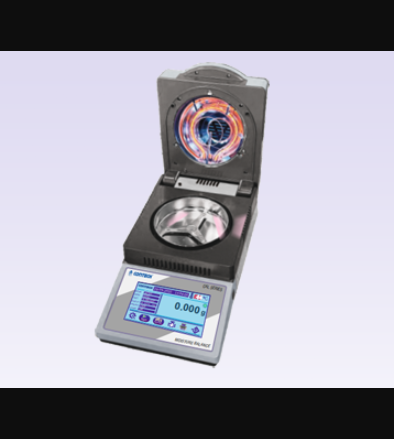 | Moisture Balances Moisture Balances (CAL Series) (0.001 g to 180 g) Moisture Balances (CAL Series) (0.001 g to 180 g) The CONTECH CAL Series Moisture Balances are advanced moisture analyzers designed for fast,... View product → |
Frequently asked questions
What does a laboratory moisture balance actually measure?
It measures the reduction in sample mass during controlled heating and reports that loss as moisture content. It performs gravimetric moisture analysis rather than directly identifying water molecules.
How do you prepare a repeatable moisture analysis test?
Use a representative sample, record its mass, spread it evenly in the pan, apply the same heating program, and repeat the method under identical conditions.
How should you choose the temperature and endpoint?
Choose a temperature that removes the target moisture without burning, decomposing, splattering, or losing volatile non-water components. Set the endpoint when successive mass readings meet your method's stability criterion.
When will a moisture analyzer disagree with an oven method?
Results can differ when heating rates, sample thickness, airflow, endpoint criteria, or volatile compounds differ. Compare both methods using the same material and a documented reference procedure.
How do you qualify a moisture analyzer in Kolkata?
Check weighing and temperature performance, calibration records, repeatability, local service response, operator training, spare parts, and support for your specific sample method.