
The choice is less about two competing measurement principles than about how the sample is heated, how mass loss is interpreted, and whether the method matches your reference procedure. By the end, you can select the heating approach, set up a defensible test, and identify when an oven or Karl Fischer method is the better comparison.
Key takeaways
- Use repeatable sample mass, thickness, and pan loading to prevent misleading results.
- Choose drying temperature from the sample’s behavior, not its name alone.
- Use a halogen analyzer for rapid routine tests; confirm methods against an oven reference.
- Select infrared or halogen heating based on accuracy, speed, and method compatibility.
What the instrument measures—and what infrared and halogen really mean
An infrared moisture balance measures the mass a sample loses during controlled heating. Before the run, the empty pan is tared, then the sample is weighed. The instrument heats it and repeatedly weighs it as drying proceeds.
It calculates the mass-loss result from the initial and final readings: moisture percentage equals initial mass minus final mass, divided by initial mass, multiplied by 100.
| Term | What it identifies | What happens physically |
|---|---|---|
| Infrared moisture balance | A moisture balance using radiant heating | The sample is heated and repeatedly weighed |
| Halogen moisture analyzer | A closely related implementation using a halogen lamp | The lamp supplies infrared radiation, often with visible radiation too |
| Halogen lamp moisture balance | Another name focused on the heating source | The measurement still depends on mass loss, not a separate halogen principle |
The result is loss on drying, not automatically water content. Residual solvents and other volatile components can evaporate, while decomposition or oxidation can also reduce mass and produce a higher result.
Karl Fischer titration is the appropriate comparison when your specification concerns water specifically. It measures water through a chemical reaction, whereas a moisture balance reports everything that leaves the sample under the selected drying conditions. Thus, infrared moisture balance and halogen moisture analyzer usually describe different implementations or labels, not fundamentally different analytical methods.
How to prepare and run a sample without changing the result
A reliable result begins before heating: prepare a representative, homogeneous sample and keep the time between preparation and heating short.
1. Mix or homogenize the material. Grind it only when smaller particles improve uniformity and diffusion. Do not grind if friction heats the sample, drives off volatile components, or exposes hygroscopic powder to air; record the preparation time and atmosphere in the method.
2. Place a clean pan on the balance, close the draft shield, and tare it. Weigh the controlled sample mass specified by your method, then spread it in a thin, even layer.
3. Avoid thick layers, large particles, and uneven distribution. They create temperature and diffusion gradients, trap moisture, and make the result depend on where moisture escapes. Watch for crust formation, bubbling, splattering, and overheating; each can seal wet material, eject sample, or cause decomposition.
4. For hygroscopic powders or volatile samples, open the container only when ready, transfer quickly, and start heating without a long bench delay. Use a covered container between preparation and weighing.
5. Record the sample identification, batch, sample mass, preparation time, pan, temperature program, endpoint, final mass, and calculated result.
An ir moisture balance remains a gravimetric instrument, but colour, reflectivity, particle size, and surface condition change radiant absorption and heating. Verify the method whenever the matrix changes; identical mass-loss calculations do not guarantee identical drying behaviour.
Choosing the drying program for powders, pastes, foods, and chemicals
Start heat-sensitive pharmaceuticals, polymers, foods, and solvent-bearing pastes at a low temperature. Use a controlled ramp or stepped profile to prevent bubbling, caramelisation, oxidation, decomposition, or surface sealing; a constant-temperature method can drive off the surface solvent too quickly and trap moisture underneath.
Heat-stable granules and dry powders may tolerate a faster constant-temperature program. Do not select the highest available setting: excessive heat can produce a deceptively low result by decomposing the sample or forming a crust before internal moisture escapes.
| Material | Suitable approach | Failure to watch |
|---|---|---|
| Powder | Constant temperature after checking flow and heat response | Crusting or uneven radiant heating |
| Granules | Faster constant temperature with adequate exposure | Moisture trapped inside large particles |
| Slurry | Low start, gradual ramp, or steps | Bubbling, splashing, and skin formation |
| Viscous paste | Low start with a slow ramp | Surface sealing and delayed diffusion |
A fixed-time endpoint runs for a defined duration, making comparisons straightforward but risking under- or overdrying. A rate-of-change endpoint stops when mass loss falls below a set limit; it can shorten a run, yet stop early when a dry crust forms or moisture diffuses slowly.
On an infrared moisture balance or halogen lamp moisture balance, the automatic endpoint is a method setting, not proof of chemical dryness.
Verify every new formulation on the moisture balance against a reference method. Match sample mass, layer thickness, preparation, temperature profile, and endpoint; do not copy a program from another product simply because both are powders or use the same instrument.
When halogen heating beats an oven—and when it should not replace one
A halogen moisture analyzer often finishes faster than a conventional hot-air oven because its lamp delivers direct radiant heat to the sample, while the balance tracks mass loss and stops at an endpoint without constant supervision.
| Method | Heating and endpoint | Run time and throughput | Repeatability and operating effort |
|---|---|---|---|
| Conventional hot-air oven | Chamber air heats the sample; remove and weigh it at fixed intervals | Longer cycles; many samples require shared oven space and manual weighing | Reference-friendly, but transfers, cooling, and repeated weighing add labour |
| Halogen moisture balance | Lamp supplies direct radiant heat; rate-of-change control can stop the run automatically | Often faster; each pan produces a result with little handling | Efficient and repeatable only when mass, spreading, temperature, and endpoint are controlled |
High heat flux is not always an advantage. It can cause splashing, bubbling, crusting, or decomposition; lower power, a ramp, or a slower multi-step method may then be necessary.
Before routine use, run a correlation study:
- Test representative samples across the expected moisture range.
- Use identical sample preparation, mass, pan, and distribution rules for both methods.
- Compare the moisture balance with the established hot-air oven, vacuum-oven, or Karl Fischer procedure.
- Define acceptable bias and repeatability before approving the method.
Check the balance with traceable masses, but do not treat that as temperature verification. Verify temperature and heating performance separately, then repeat the reference comparison at planned intervals. For low-moisture decisions, judge repeatability at the actual sample mass and specification limit; nominal readability alone can hide an unacceptable result.
Which instrument is the better lab choice?
Neither an infrared moisture balance or halogen moisture analyzer is automatically the better lab choice; select the instrument that matches your validated sample behaviour and reference method.
| Criterion | What to verify before purchase | Why it matters |
|---|---|---|
| Method control | Required temperature range and control; ramp and constant-temperature profiles; fixed-time and rate-based endpoints; stored methods | A copied program can stop early, crust a sample, or decompose it |
| Physical fit | Capacity, readability, heating power, suitable pans, and draft protection for your actual sample mass | Nominal specifications do not predict low-moisture repeatability or safe handling |
| Evidence and records | Model-specific repeatability data, temperature-verification procedure, and exportable result records | Balance checks alone do not verify heating performance or data integrity |
Ask the supplier to provide the exact model specification, not a range-wide brochure. Confirm how many methods it stores, which endpoint thresholds you can set, how results leave the instrument, and whether the supplied pans suit powders, pastes, or slurries.
A laboratory comparing its equipment portfolio can apply this checklist to the CAL Series from CONTECH INSTRUMENTS LTD. or another candidate, then confirm that exact model’s operating range and method features before purchase.
Run representative samples across the expected moisture range against your oven, vacuum-oven, or Karl Fischer procedure, using identical preparation rules. Choose by validated sample behaviour, repeatability at the specification limit, and reference-method correlation—not by the words infrared or halogen alone.
Related product
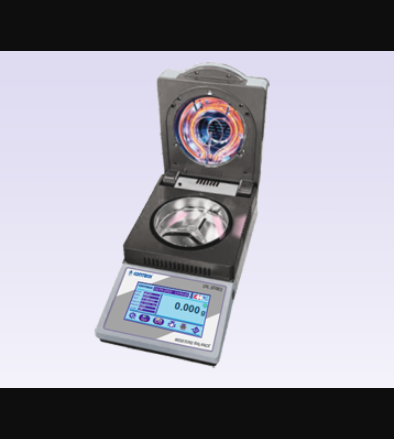 | Moisture Balances Moisture Balances (CAL Series) (0.001 g to 180 g) Moisture Balances (CAL Series) (0.001 g to 180 g) The CONTECH CAL Series Moisture Balances are advanced moisture analyzers designed for fast,... View product → |
Frequently asked questions
What does an infrared moisture balance measure?
It measures the mass a sample loses during controlled heating after taring the empty pan and weighing the sample.
How should you prepare a sample for moisture analysis?
Mix the sample, use a consistent mass, spread it evenly across the pan, and avoid changing it through exposure to air or heat.
What drying program suits powders, pastes, foods, and chemicals?
Set the temperature, heating profile, sample mass, and endpoint from the material’s drying behavior and a verified reference method.
When should a halogen moisture analyzer not replace an oven?
Do not replace an oven when your specification, customer method, or regulated procedure requires oven drying or a demonstrated method correlation.