
A moisture result is only as defensible as the method behind it: heating a sample until it loses mass does not prove that the lost mass was water. By the end, you will be able to match a method to your sample, specify the instrument features that matter, and test a Mumbai supplier’s claims against your own reference results.
Key takeaways
- Report LOD as mass loss with sample mass, temperature, time, and endpoint.
- Use Karl Fischer when you need selective water measurement.
- Specify temperature range, readability, pan size, calibration, and data export.
- Accept the instrument with your own samples and predefined repeatability limits.
What an LOD test actually measures—and how to report it
An LOD test measures loss of sample mass during heating; it does not identify water selectively. A thermogravimetric moisture analysis method instrument reports water accurately only when the matrix and method support that interpretation.
- Weigh the clean, empty pan and record its identity.
- Place the pan on the balance and tare it.
- Add a representative sample, then spread it in a thin, even layer.
- Heat the loaded pan at the validated method temperature.
- Monitor mass loss until the defined endpoint is reached.
- Calculate and report the final result on the stated basis.
If the wet sample weighs 10.000 g and the dried sample weighs 8.600 g, water or volatile loss is 1.400 g. Wet-basis moisture is (10.000 − 8.600) ÷ 10.000 × 100 = 14.0%. Dry-basis moisture is 1.400 ÷ 8.600 × 100 = 16.28%.
Your method record must identify sample mass, pan, temperature profile, endpoint, elapsed time, and result basis. Without the basis, two correct calculations can appear to disagree.
The instrument measures mass loss, not water alone. Solvents, residual reactants, plasticizers, decomposition products, and oxidation can inflate the reported value, so use Karl Fischer or another validated method when non-water volatiles affect the matrix.
How to set temperature, time, sample mass, and endpoint without distorting the result
Set temperature, time, sample mass, and endpoint from data on the actual matrix, not from a generic recipe. A method validated at 105 °C is not interchangeable with one at 80 °C or 130 °C: halogen, infrared, and hot-air systems produce different heating rates, sample-surface temperatures, crust formation, and drying curves.
Transfer a method by comparing replicate results with the reference procedure, then documenting the new temperature profile, elapsed time, sample mass, pan, and endpoint. Choose fixed time only when validation proves the sample reaches the required condition.
Prepare each test consistently:
- Use enough sample to represent the lot, but keep it shallow enough to dry evenly.
- Mix powders and control particle size before loading a uniform layer.
- Limit exposure between opening the container and weighing, especially during Mumbai’s humid monsoon.
- Reuse pans only after complete cleaning and inspection.
| Endpoint | Use only when | Main risk |
|---|---|---|
| Fixed time | Validation proves the chosen time reaches the required condition | Residual moisture or over-drying |
| Constant mass | Successive readings differ by no more than the documented limit | Slow drying can extend the test |
| Automatic rate of change | Checked against a reference method for that matrix | A crust can trigger a false early endpoint |
Sugary, fatty, oily, or heat-sensitive samples can melt, crust, react, decompose, or form a skin that traps moisture. Volatile or reactive materials need a safety assessment; Karl Fischer may be more defensible than a moisture analysis method instrument. Specify these controls when buying a moisture determination instrument in Mumbai.
When LOD is the wrong choice: compare the available moisture methods
Choose the method by matrix and reporting risk, not advertised drying speed. Conventional oven drying suits a laboratory that needs a recognised reference procedure and accepts longer turnaround; for cereals and cereal products, compare in-process readings with the ISO 712 reference oven approach.
| Method | Strength | Trade-off and best use |
|---|---|---|
| Conventional oven | Recognised reference procedure | Slow; suitable when documented reference results matter |
| Vacuum oven | Lower boiling temperature protects heat-sensitive material | Requires vacuum equipment, leakage checks, and longer method development |
| Karl Fischer titration | Selective for water | Requires reagents, solvent handling, electrode maintenance, and sample dissolution; choose it when solvents, non-water volatiles, or decomposition would distort LOD |
| Infrared or halogen analyzer | Rapid routine control | Heating profiles differ; correlate each matrix with Karl Fischer or the applicable reference method |
| Speedy moisture tester | Fast field or production checks | Gives less laboratory control and documentation |
A moisture analysis equipment in Mumbai search should end with a matrix-specific comparison, not a speed claim.
A moisture determination instrument in Mumbai is a poor choice if its endpoint has not been matched to your method: fixed time, constant mass, or automatic rate of change can produce different results for hygroscopic, fatty, sugary, or heat-sensitive samples.
Select from the matrix, reporting tolerance, daily sample volume, solvent and safety constraints, and bench space. A Karl Fischer result is not interchangeable with a halogen or infrared result until you establish correlation and validation.
Which specifications should a Mumbai buyer put in the quotation request?
Put the performance requirements in writing before comparing moisture analysis equipment in Mumbai. Ask each supplier to complete the same checklist and identify any specification that applies only under stated conditions.
- Temperature range and control resolution
- Temperature verification at the sample position, not only at the heater
- Heating source and heating profile
- Balance readability, repeatability, and linearity
- Maximum sample load, pan dimensions, and permitted sample-layer depth
- Fixed-time, constant-mass, and automatic-rate-of-change endpoints
- Method storage, password protection, and method locking
- Balance and temperature-system calibration options
- Printer or USB connectivity, software, raw-data export, and audit trail where required
- Power requirements: voltage, frequency, wattage, plug, and backup expectations
| Endpoint | What it means | When to request it |
|---|---|---|
| Fixed time | Stops after a defined duration | Only after validation shows sufficient drying |
| Constant mass | Stops when successive masses meet a documented difference | Useful when drying curves vary |
| Automatic rate of change | Stops when mass-loss rate reaches a set limit | Verify against a reference method before use |
State the intended sample containers, maximum time from opening to weighing, preconditioning, and humidity controls. Install the unit on a stable, low-vibration bench away from doors, air-conditioning discharge, direct sunlight, and process heat.
Do not use an open heated analyzer for solvent-rich, flammable, reactive, or potentially explosive material until extraction, vapour, fire, contamination, and corrosion risks are documented. For GMP, GLP, HACCP, or legal-trade use, define access control and electronic records, and distinguish laboratory precision weighing from legally controlled commercial weighing.
How to accept a supplier’s instrument using your own samples
An easy-to-dry powder proves little: it can hide poor heat transfer, uneven loading, endpoint errors, and balance drift. Ask the moisture analysis method instrument supplier in Mumbai to demonstrate performance on your retained samples, not a convenient showroom material.
- Select retained samples with low, medium, and high moisture levels. Confirm each level by Karl Fischer, ISO 712, an oven method, or your internally validated procedure.
- Run replicates at every level using the proposed pan, sample mass, layer depth, temperature, and endpoint. Agree written limits for bias, repeatability, endpoint time, and temperature stability before testing begins.
- Review the evidence together.
| Level | Compare | Record |
|---|---|---|
| Low, medium, high | Instrument result versus reference result | Bias at each level |
| Each level | Replicate results | Repeatability |
| Each method | Endpoint and temperature trace | Time and stability |
Do not treat displayed readability as moisture accuracy. A 0.001 g display does not prove 0.001 g moisture accuracy; assess balance repeatability, linearity, sample homogeneity, pan loading, and method repeatability as one system.
Require installation qualification, balance and temperature calibration, preventive-maintenance intervals, spare heating elements and pans, and a stated Mumbai response time. Require an application specialist who can re-establish transferred methods.
A buyer assessing CONTECH INSTRUMENTS LTD. or any moisture determination instrument in Mumbai should obtain these commitments in writing, rather than choose on price or a generic speed claim.
Related product
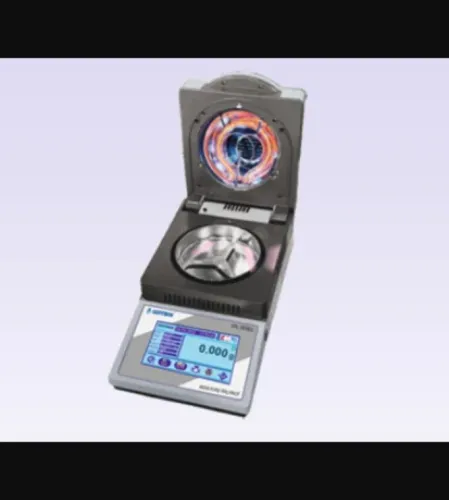
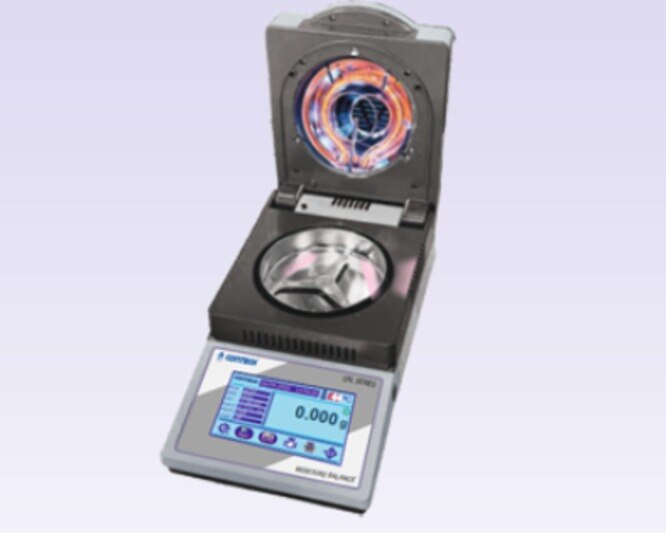
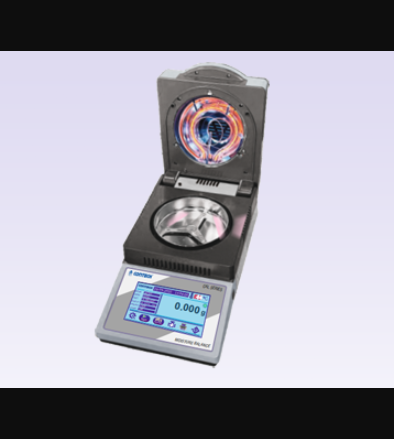 | Moisture Balances Moisture Balances (CAL Series) (0.001 g to 180 g) Moisture Balances (CAL Series) (0.001 g to 180 g) The CONTECH CAL Series Moisture Balances are advanced moisture analyzers designed for fast,... View product → |
Frequently asked questions
What does an LOD test actually measure?
LOD measures the mass lost from a sample during heating. It does not identify water selectively, so report the method conditions and interpret the result only when the matrix supports that conclusion.
How do temperature, time, sample mass, and endpoint affect LOD results?
Temperature can drive off volatile compounds or decompose the sample, while insufficient time leaves moisture behind. Sample mass, spreading depth, and the endpoint rule also affect repeatability, so define each before testing.
When is LOD the wrong moisture determination method?
Choose another method when the sample contains volatile non-water compounds, decomposes during heating, or requires selective water measurement. Karl Fischer titration is the direct comparison for water-specific results.
What should a Mumbai buyer include in an instrument quotation request?
Request the temperature range and accuracy, balance readability, sample capacity, pan dimensions, endpoint options, calibration procedure, data export format, power requirements, installation, training, and service terms.
How should you accept a moisture analysis instrument from a supplier?
Run predefined tests with your own representative samples, compare results with an established reference method, and check repeatability, heating performance, endpoint control, records, and operator workflow.