
A moisture reading is useful only when the sample represents the batch, the method matches the food, and the result is reported on the correct basis. By the end, you will know where a speedy moisture tester fits in a Mumbai food plant, how to prepare and test samples, and when to confirm its result with a reference method or water-activity measurement.
Key takeaways
- Sample and seal food quickly to prevent moisture gain or loss.
- Set the endpoint against a validated reference method, not convenience alone.
- Compare tester results with oven or Karl Fischer results before release use.
- Specify service, calibration and environmental requirements for Mumbai operations.
Where a Speedy Moisture Tester Fits in a Food Plant
A speedy moisture tester fits rapid receiving, in-process, and dispatch checks for wheat flour, rice, cereals, pulses, spice powders, snack pellets, fried snacks, bakery products, nuts, dehydrated vegetables, milk powders, and other plant materials. Use these results for intake screening, drying control, batch consistency, and storage decisions.
Wheat flour, rice, cereals, and pulses reveal changes that affect milling, cooking, and storage. Spice powders expose uneven drying; snack pellets and fried snacks help check expansion and process consistency. Bakery products, nuts, dehydrated vegetables, and milk powders can be screened before packing or release.
A pressure-based calcium-carbide speedy moisture tester measures water indirectly. Water in the prepared sample reacts with calcium carbide, generates acetylene, and produces pressure; the instrument converts that pressure into a moisture value.
| Method | How it works | What the reading means |
|---|---|---|
| Speedy moisture tester | Chemical reaction creates pressure | An indirect estimate of water content |
| LOD instrument | Weighs the sample before and after drying | Moisture inferred from mass lost during drying |
Wet-basis moisture equals water mass divided by original sample mass. Dry-basis moisture equals water mass divided by dry-solids mass, so the values are not interchangeable near a limit. State the reporting basis on every result.
How to Sample and Prepare Food Without Changing Its Moisture
A representative result starts with a defined lot, not a convenient handful. Treat one supplier batch, silo section, production shift or dispatch consignment as one lot, and record its identity, size and sampling points.
1. Take increments from different bags, bin depths or production points. Include the beginning, middle and end of a run when accessible. Use clean, dry tools and place every increment in a sealed container.
2. Combine the increments, mix the composite thoroughly, and reduce it to the test portion with a documented method such as quartering or a sample divider. Do not select only the driest-looking or largest particles.
3. Handle each matrix according to its structure. Mix cereals, pulses and spice blends to distribute particles before testing. For filled snacks, include whole pieces and sample coating, centre and filling together; do not test filling alone unless that is the stated specification. Mix powders gently to break segregation without exposing them unnecessarily.
4. Grind cereals, pulses or coarse snacks only when the method requires a uniform particle size. Grinding increases surface area, causing evaporation in dry air or moisture uptake in humid Mumbai conditions. Mix-only preparation suits fine, already uniform powders.
5. Keep portions sealed, open the container only for moisture measurement, and test promptly. Load a uniform quantity, avoid a wet lump, close the vessel immediately, and prevent splattering or crust formation.
6. Record the lot, sample reduction method, sample temperature, test mass, reagent condition and operator. These records help explain a disagreement between moisture testers and prevent a preparation error from becoming a release decision.
Choosing Temperature, Endpoint and the Right Stability Measure
Set the temperature and endpoint from product-specific trials, not a generic instrument setting. A low-moisture powder, flour or grain needs checks for incomplete reaction and incomplete drying; a sugar, bakery product or coated snack needs controls against scorching, caramelisation, crusting and splattering.
Spices, nuts and dehydrated foods require checks for volatile oils and other compounds that heating or handling can remove.
A speedy moisture tester is not interchangeable with oven Loss on Drying. Oven moisture content determination measures mass lost during drying, while a calcium-carbide tester measures water indirectly through acetylene pressure. Volatile compounds, residual solvents, alcohol and calcium-carbide-reactive ingredients can make the two results disagree.
Validate the endpoint and temperature against the chosen reference method for each important matrix.
| Measure | What it tells you | When to use it |
|---|---|---|
| Moisture content | Water relative to sample mass | Routine process or specification control |
| Total solids | Material left after removing water and other measured losses | Yield, formulation and concentration calculations |
| Water activity | Available water for microbial growth and reactions | Mould risk, microbial stability and shelf-life decisions |
Use water activity when available water, rather than total water, controls mould risk or shelf life. Do not treat one moisture result as proof of food safety: pathogens, toxins, sanitation, storage temperature and packaging require separate controls. A result outside its validated range is a warning to investigate, not a reliable release value.
Comparing Methods and Turning Results into Release Decisions
A speedy result is a release signal only after you prove what it means against a reference method. Pressure-based calcium-carbide testing is rapid moisture measurement, but it is destructive: water reacts with reagent to generate acetylene pressure, and matrix effects, reagent condition and technique can shift the result.
| Method | Turnaround and sample use | Reagent, calibration and matrix fit | Best production use |
|---|---|---|---|
| Pressure calcium-carbide | Minutes; destructive | Uses calcium carbide; needs reagent and product-specific checks; less flexible | Receiving, in-process and dispatch screening |
| Oven LOD | Hours; destructive | No reagent; reference gravimetric moisture content determination; broad matrix use | Reference testing and method correlation |
| Halogen analyser | Minutes; destructive | Heat calibration and endpoint control; matrix-dependent | Routine checks after validation |
| Karl Fischer titration | Minutes to hours; destructive | Uses reagents and solvent; strong for low moisture, but needs chemical calibration | Difficult low-moisture products and reference work |
| Near-infrared | Seconds; usually non-destructive | Requires calibration sets and ongoing verification; matrix-specific | High-throughput receiving and process monitoring |
For rice and wheat, correlate the speedy tester with the applicable reference method, including ISO 712 where relevant; do not assume equivalence. Test blinded low-, mid- and high-moisture samples in replicate, then review bias, repeatability, reproducibility and uncertainty near the release limit.
Set decisions against four separate benchmarks:
- Product specification and process control limit
- Shelf-life moisture target
- Relevant FSSAI commodity standard
- Instrument display resolution
A display of 0.1% is not accuracy of ±0.1%. Release acceptance limits require validated performance evidence.
How to Specify and Validate a Tester for Mumbai Food Operations
Approve a speedy moisture tester for food processing in Mumbai only when its evidence matches your commodities, release limits and working conditions—not because it displays moisture to 0.1%.
- Name each commodity: rice, wheat flour, pulses, chilli powder and spice blends.
- State the expected moisture range and whether results use wet basis or dry basis.
- Specify sample mass, particle size, grinding or mixing method, and acceptable turnaround time.
- Record receiving-area and production-floor temperatures, then require repeatability data at both temperatures; pressure readings are temperature-sensitive.
- Define the cleaning method, calibration-check frequency, reference standards and records needed for FSSAI, customer or export documentation.
- Require product-specific validation against your plant reference method across low, middle and high moisture samples, with bias, repeatability, reproducibility and uncertainty data. A generic calibration certificate is not enough.
- Confirm reagent storage conditions, shelf-life tracking and whether direct calcium-carbide contact is acceptable in the plant.
- Set acceptance limits separately from display resolution; a 0.1% display does not prove ±0.1% accuracy.
Calcium carbide reacts with water to produce flammable acetylene. Your procedure therefore needs ventilation, ignition-source control, eye and hand protection, dry reagent storage and controlled waste disposal; treat this tester differently from ordinary electronic moisture testers.
Ask CONTECH INSTRUMENTS LTD. to discuss instrument fit only against this evidence, including matrix validation and release-limit performance, rather than accepting a catalogue specification.
Related product
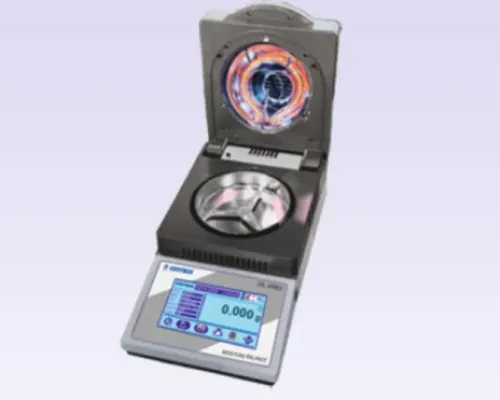
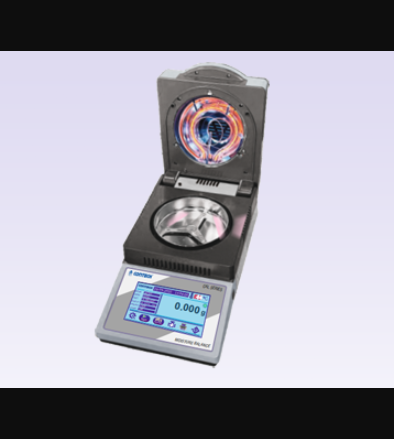 | Moisture Balances Moisture Balances (CAL Series) (0.001 g to 180 g) Moisture Balances (CAL Series) (0.001 g to 180 g) The CONTECH CAL Series Moisture Balances are advanced moisture analyzers designed for fast,... View product → |
Frequently asked questions
Where does a speedy moisture tester fit in a food plant?
Use it for rapid receiving, in-process and dispatch checks on materials such as flour, rice, cereals, pulses, spice powders, snacks, bakery products, nuts and milk powders.
How do you prepare food samples without changing their moisture?
Take a representative sample, minimise exposure to air, reduce particle-size differences consistently and test it promptly in a sealed container.
How should you choose the endpoint and stability measure?
Choose an endpoint that balances repeatability and turnaround time, then confirm that the displayed result remains stable enough for your release decision.
How do you validate a speedy moisture tester before routine use?
Compare repeated tester results with a suitable reference method, document bias and repeatability, define acceptance limits and verify performance with control samples.