
A reliable moisture result depends on more than placing a sample on a balance: sample preparation, heating conditions, endpoint selection and result basis all change the number you report. By the end, you will be able to run a CAL Series test, calculate wet- and dry-basis moisture, build a material-specific method and decide when to compare the result with an oven or Karl Fischer method.
Key takeaways
- CAL Series balances report mass loss from drying, not water concentration directly.
- Record sample mass, drying temperature, endpoint, and final dry mass for every test.
- Build programs by testing temperature, time, sample thickness, and repeatability.
- Validate results against a reference method before routine release testing.
How Loss on Drying Produces a Moisture Result
A CAL Series balance measures loss on drying, not water directly. It records the initial sample mass, heats the sample, removes volatile material, records the remaining dry mass, and calculates the mass loss as the reported result.
For moisture content determination, use the correct result basis:
- Wet-basis moisture = (initial mass − dry mass) ÷ initial mass × 100
- Dry-basis moisture = (initial mass − dry mass) ÷ dry mass × 100
A sample with 20% wet-basis moisture has 80 parts dry material and 20 parts lost material. On a dry basis, that same loss is 20 ÷ 80 × 100 = 25%, so the two percentages are not interchangeable.
Loss on Drying is an operational result defined by the selected temperature, heating profile, endpoint, and sample preparation. It is not automatically a water-specific measurement. The result can run high when the sample loses solvents, volatile oils, or decomposition products, and low when bound water is released slowly or a surface crust traps moisture.
Record the initial and final masses, temperature, program, endpoint or fixed time, result basis, and sample preparation during moisture content analysis. Without those conditions, a percentage cannot be compared reliably between laboratories or batches.
The Correct Operating Sequence for a CAL Series Test
Place the moisture determination balance on a rigid bench away from drafts, vibration, sunlight, heat sources and air-conditioning outlets. For moisture content determination with CAL Series balance in Navi Mumbai, keep the sample, empty pans and containers protected from humid air.
1. Keep the sample container sealed until preparation. Mix the lot, reduce it correctly, and take a representative portion. Test it promptly; hygroscopic material gains moisture during open handling.
2. Confirm the pan type, sample-loading range and approved method settings. Check the temperature, heating profile, endpoint or fixed time, result basis and data-recording fields.
3. Place the empty pan on its support and tare the balance. Add the test portion without spilling material onto the support.
4. Break oversized particles or prepare the material to the validated particle size. Spread it as a thin, even layer, not a heap. Large particles dry slowly, while uneven thickness creates wet and dry zones; poor spreading extends drying time and produces temperature and moisture gradients.
5. Close the heating chamber, select the approved program and start the test. Do not open the chamber during drying unless the method requires it.
6. Record the sample ID, initial mass, final mass, pan type, temperature, heating profile, endpoint or fixed time, result basis, final result, operator and instrument status.
Run duplicate portions when sampling error is significant; use triplicates for highly variable powders, grains or materials with visible moisture gradients. Keep exposure time from container opening to test start standardized for every portion.
How to Build a Drying Program for a New Material
Start with a finely divided, representative portion, then keep the sample mass, pan type and layer depth constant throughout development. An uneven heap or oversized particles create drying gradients, extend the test and reduce repeatability in moisture content analysis.
| Development choice | Compare | Decision rule |
|---|---|---|
| Temperature | Lower versus higher | Choose the highest temperature that does not cause charring, oxidation, Maillard browning, melting or loss of non-water volatiles |
| Heating profile | Direct heating versus ramp | Use a ramp when gradual heating prevents splashing, skin formation or decomposition |
| Drying duration | Fixed time versus endpoint | Use fixed time only after confirming the result reaches stability; otherwise validate a rate-of-change endpoint |
| Stop behaviour | Early versus extended drying | Extend the test when the sample has a long falling-rate phase |
Run both temperature trials on representative lots. A lower temperature reduces thermal damage but increases test time; a higher temperature shortens testing but can change the material rather than remove moisture.
Compare fixed-time results with a validated rate-of-change endpoint on a moisture determination balance. Automatic endpoint detection can stop too early during a long falling-rate phase, or too late when drafts, vibration or unstable heating disturb the mass signal.
After repeatability and drying stability are demonstrated, lock the temperature, ramp, time or endpoint, sample preparation and acceptance limits for routine work. Record these settings with the sample mass, pan and result basis so another operator can reproduce the method.
How to Validate the Result Before Routine Release Testing
Prove the method fits the matrix before using it for release. Run replicate portions from representative lots to assess repeatability, then compare results with a suitable reference and evaluate recovery or bias. Include drying-time or endpoint stability; a result that changes when drying continues is not ready for routine moisture content determination.
| Method | Use in validation | Limitation or action |
|---|---|---|
| Replicate CAL portions | Measures repeatability and sampling variation | Use representative powders, granules, foods, textiles or chemicals |
| Constant-mass oven | Tests agreement for a suitable solid matrix | Oven loss is not automatically water-specific; volatile solvents can inflate it |
| Karl Fischer titration | Provides selective water measurement | Check extraction, reagent compatibility and endpoint behavior for difficult matrices |
| Fixed time versus endpoint | Shows whether drying has reached a stable result | Extend the test if mass continues falling after the proposed endpoint |
Use Karl Fischer when other volatile substances could distort loss on drying. Investigate recovery and bias by spiking suitable materials or comparing known materials, rather than assuming agreement proves accuracy.
Check the balance with traceable test weights across the working mass range. Check heater indication and temperature distribution separately; mass calibration does not validate heating performance.
Record each moisture content analysis so another laboratory can reproduce it:
- Sample ID, pan type, portion mass and final mass
- Temperature, heating program, endpoint or fixed time, and wet- or dry-basis result
- Operator and instrument status, including calibration or verification state
Choosing and Specifying a CAL Series Setup in Navi Mumbai
Specify the complete method before requesting a moisture determination balance. For moisture content determination with CAL Series balance in Navi Mumbai, define the matrix, test portion, pan type and loading, particle preparation, layer thickness, temperature program, ramp, endpoint, wet- or dry-basis result, acceptance limits and required data output.
Ask the supplier to confirm the exact model documentation:
- Capacity and readability
- Heating range, temperature accuracy and temperature distribution
- Fixed-time and rate-of-change endpoint controls
- Data storage, printing, USB or software reporting
CAL configurations differ. Ask how installation will control drafts and vibration, how heater temperature will be verified separately from balance calibration, what service response covers Navi Mumbai, and whether application support is available for method development. CONTECH INSTRUMENTS LTD. can provide model-level documentation and discuss the application; its advice does not replace method validation.
Use this reporting template:
| Field | Record |
|---|---|
| Sample | ID, matrix, lot and operator |
| Loading | Pan, test portion and preparation |
| Program | Temperature, ramp, endpoint or time |
| Result | Final mass, wet/dry basis and percentage |
| Control | Acceptance limit and instrument status |
Extra decimal places cannot correct poor sampling, an uneven pan load or an unstable drying program.
Related product
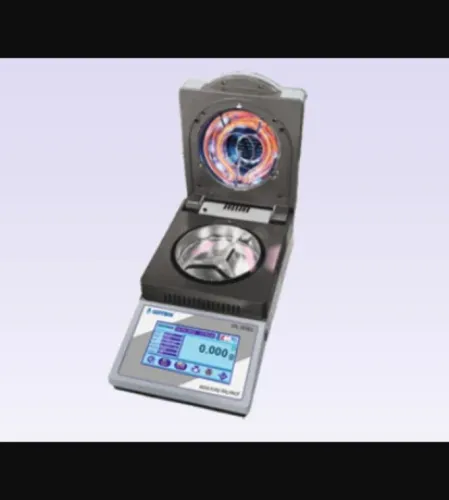
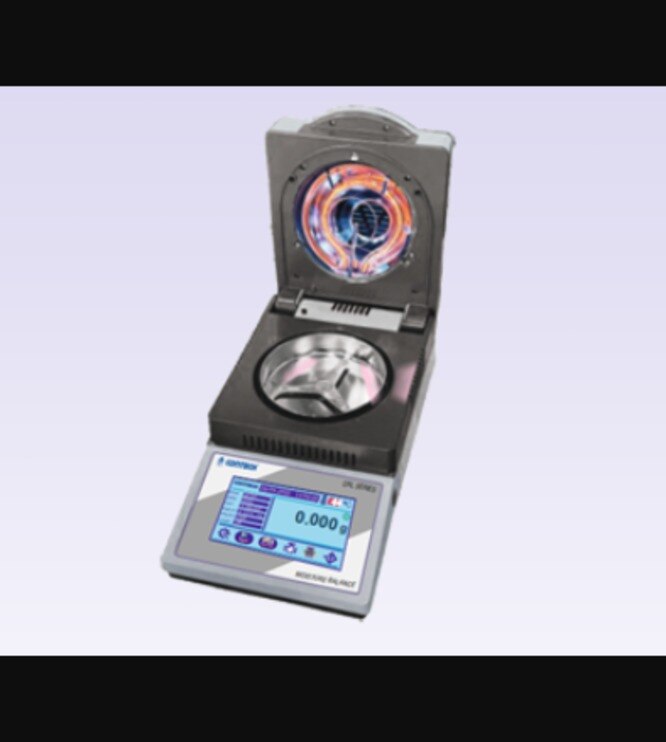
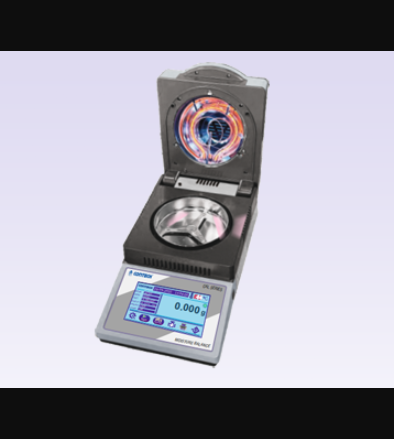 | Moisture Balances Moisture Balances (CAL Series) (0.001 g to 180 g) Moisture Balances (CAL Series) (0.001 g to 180 g) The CONTECH CAL Series Moisture Balances are advanced moisture analyzers designed for fast,... View product → |
Frequently asked questions
How does a CAL Series balance produce a moisture result?
It records the initial sample mass, heats the sample, removes volatile material, records the remaining dry mass, and calculates mass loss as the reported result.
What is the correct operating sequence for a CAL Series test?
Prepare and weigh a representative sample, place it in the pan, select the drying program, run the test to its endpoint, and review the final mass and result.
How do you build a drying program for a new material?
Test the material across suitable temperatures, drying times, sample thicknesses, and endpoints, then choose the program that produces stable, repeatable results without overheating the sample.
How do you validate a CAL Series moisture result?
Compare repeated CAL Series results with a suitable reference method, document bias and repeatability, and define acceptance limits before routine release testing.