
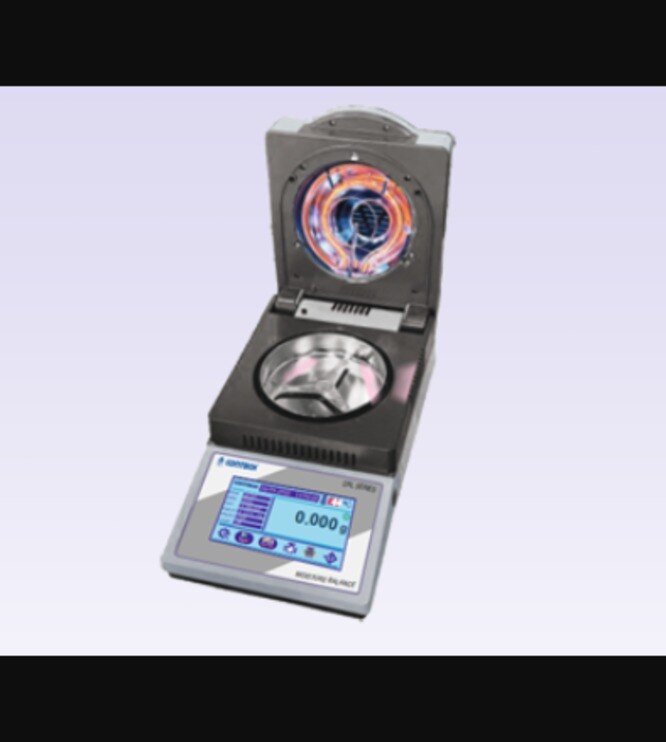
A moisture analyzer balance lets students connect mass loss to drying conditions without treating every lost gram as water. By the end, you will know how to run a classroom Loss on Drying exercise, judge whether its result is meaningful, and decide whether an analyzer is more useful than an oven, a separate balance, or a water-specific method.
Key takeaways
- Students observe mass loss as controlled heating removes moisture.
- Use Loss on Drying to compare initial mass with constant dry residue.
- Confirm mass loss is moisture by controlling temperature, time, and sample composition.
- Choose an analyzer when rapid, repeatable teaching demonstrations justify its cost.
What does a moisture analyzer balance demonstrate to students?
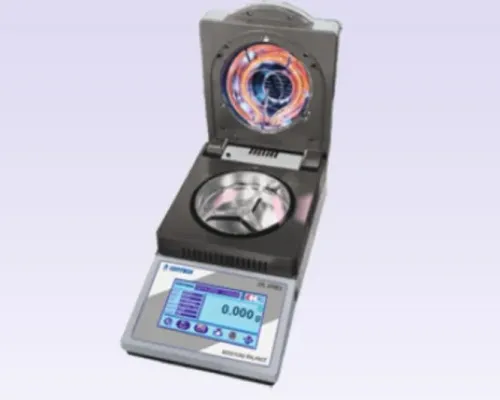
A moisture analyzer balance for teaching laboratories demonstrates how heating changes a sample’s mass. It combines a precision weighing mechanism with controlled heating, records the initial and changing mass, and reports moisture content, dry residue, or total mass loss.
| Instrument | What students observe | What it measures |
|---|---|---|
| Analytical or precision balance | The mass of a prepared sample | Mass at the time of weighing |
| Moisture analyzer balance | Mass falling as the specimen dries | Loss on Drying, moisture content, or dry residue |
Students can compare wet and dry mass, connect drying time and temperature to the final result, and calculate moisture percentage: (initial mass − final dry mass) ÷ initial mass × 100. They can then discuss how water or other volatile components affect sample composition.
Suitable heat-stable teaching samples include soil, flour, grains, paper, leaves, food products, powders, polymers, and other solids. Check each material’s thermal behaviour before heating; melting, browning, oxidation, decomposition, or splattering can invalidate the demonstration.
Moisture analysis by Loss on Drying measures water plus any other volatile material removed by the selected programme. It does not automatically identify water and does not measure water activity. Two samples can have similar moisture percentages but different water activities.
Report every result on a wet basis or dry basis because those numerical values differ. This distinction gives students a useful limit of the method: the analyzer tracks mass lost during drying, not water specifically.
How do students perform a Loss on Drying moisture determination?
Students run a moisture determination by measuring mass before and after controlled drying, then calculating the loss. The same sequence teaches moisture measurement and shows how sample preparation affects moisture analysis.
- Inspect the pan, remove residue, and clean and dry it. Weigh the empty pan, place it on the balance, and tare it.
- Homogenise the material and add a representative portion. Use a practical sample mass that suits the pan size and instrument capacity; record the initial sample mass after taring.
- Break up large pieces and spread the sample in a uniform thin layer. Avoid overloading, thick piles, clumps, and uneven distribution, which can trap wet regions or form a surface crust.
- Select a temperature and heating profile that remove moisture without melting, browning, oxidising, decomposing, splattering, or burning the material. Keep preparation and temperature consistent between portions.
- Run the programme. Choose timed drying for a fixed classroom comparison, repeated heating and weighing for constant-mass drying, or an automatic stability endpoint that stops when the rate of mass loss falls below its defined threshold.
- Remove or cool the pan as the instrument and laboratory procedure require, then record the final dry sample mass. Do not touch the pan, repeatedly open the chamber, or skip the tare.
Calculate: moisture percentage = (initial sample mass − dry sample mass) ÷ initial sample mass × 100. A short timed demonstration saves class time; constant mass gives the more defensible result when repeated heating and weighing show no further meaningful loss.
When does an analyzer result represent moisture rather than another mass loss?
An analyzer result represents moisture only when the programme removes water without removing other material or leaving water behind. Infrared or halogen heating is not automatically equivalent to a hot-air oven: temperature profile, airflow, sample geometry, endpoint rule, and composition change the measured loss.
| Method | What it measures | Practical comparison |
|---|---|---|
| Moisture analyzer balance | Mass loss during controlled heating | Fast moisture measurement, but verify the programme against a reference |
| Oven and balance | Mass loss after oven drying | Requires a drying oven, desiccator, cooling time, repeated weighing, and a separate balance |
| Karl Fischer titration | Chemically determined water | Preferable when water-specific selectivity matters |
Use the analyzer for faster demonstrations, then compare its moisture determination with a suitable procedure such as ASTM D2216 for soil and rock water content. Do not assume the methods are interchangeable.
A 0.001 g display is readability, not proof that the moisture result is accurate to 0.001 g or that its percentage has equivalent precision.
Residual solvents, fragrances, low-boiling constituents, and decomposition products can inflate Loss on Drying; burning, oxidation, hazardous vapours, or heat-sensitive materials make the method unsafe or unsuitable. Strongly bound water can remain. Choose Karl Fischer when chemical water determination matters, and describe the result as moisture only after checking that non-water mass loss is insignificant.
How should a teaching laboratory control the experiment?
Use one homogenised material, such as flour, for every group. Provide a control or reference portion and duplicate or triplicate samples. Groups can compare a fixed-time programme with an automatic stability endpoint, or vary sample thickness while holding temperature constant.
This makes moisture measurement a test of method, preparation, and repeatability rather than a single instrument reading.
Require every worksheet to record:
- Sample identity, operator, date, programme, replicate number, initial mass, final mass, result, and observations.
- Sample preparation, layer thickness, endpoint setting, pan condition, and any spills or interruptions.
| Programme | Comparison | Teaching point |
|---|---|---|
| Fixed time | All portions heat for the same duration | Results depend on elapsed time and incomplete drying |
| Automatic stability endpoint | Stops when the mass-loss rate falls below a defined threshold | Endpoint choice changes the moisture determination |
Protect students from hot surfaces with a marked exclusion area, heat-resistant tools, and tongs; never touch a hot pan. Provide ventilation, prohibit flammable materials near the heater, and define procedures for smoke, splattering, or burning. Dispose of cooled residues according to the material’s hazard assessment.
Plan time to prepare and homogenise samples, clean the pan between groups, prevent drafts and vibration, wait for the endpoint, and avoid cross-contamination. If results disagree, investigate heterogeneity, particle size, spreading, endpoint choice, temperature, balance-reading error, and incomplete drying before blaming the instrument.
Verify mass with a suitable test weight, check temperature performance, and test replicate reference material. Allow independent work only after training, a teacher-defined method, a hazard review, and clear instructor-intervention rules.
How do you decide whether a moisture analyzer belongs in the lab?
Choose a moisture analyzer balance for teaching laboratories by matching throughput to the lesson, not by choosing the largest capacity.
Ask how many student groups need results, how long the class lasts, how many samples must pass through one instrument, whether students must learn the reference oven method, and whether ventilation supports the selected materials and moisture analysis.
| Instrument | What it does | Best fit |
|---|---|---|
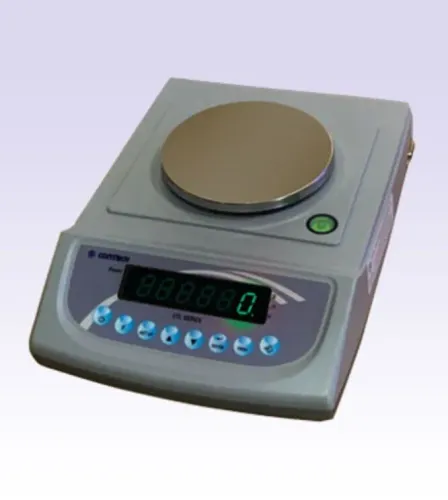
| CAS or CAI analytical balance | Weighs prepared samples only | Preparation, replicate weighing, or reference-oven work |
| Moisture analyzer balance | Heats the sample and records mass loss | Rapid Loss on Drying demonstrations and comparisons |
A specification such as 0.001 g to 180 g is a range to interpret, not evidence that a 180 g classroom sample is suitable. Check usable sample capacity, pan area, minimum practical load, and whether the material can be spread as a thin, even layer.
Before purchasing, ask for:
- Temperature range and uniformity, heater type, endpoint controls, and programme storage
- Display and export options, connectivity, and software requirements
- Cleaning access, spare-pan availability, calibration procedure, and electrical load
- Training, service response, warranty terms, and ventilation requirements
CONTECH INSTRUMENTS LTD. should answer these teaching-lab questions, rather than relying on the word “fast” or catalogue capacity as proof of throughput, repeatability, or independent student operation. A separate analytical balance still helps when students prepare portions or compare analyzer results with an oven method.
Related product
 | Moisture Balances Moisture Balances (CAL Series) (0.001 g to 180 g) Moisture Balances (CAL Series) (0.001 g to 180 g) The CONTECH CAL Series Moisture Balances are advanced moisture analyzers designed for fast,... View product → |
Frequently asked questions
What does a moisture analyzer balance demonstrate to students?
It demonstrates how controlled heating changes sample mass and links that change to moisture content, dry residue, or total mass loss.
How do students perform a Loss on Drying moisture determination?
Students weigh a prepared sample, heat it at a selected temperature, record the changing mass, and calculate mass loss relative to the initial sample mass.
When does an analyzer result represent moisture rather than another mass loss?
The result represents moisture when the sample’s lost mass is water under the chosen heating conditions, not volatile solvents, decomposition products, or splatter.
How should a teaching laboratory control the experiment?
Control sample mass, particle size, pan loading, heating temperature, endpoint criteria, calibration, and handling before and after the test.
How do you decide whether a moisture analyzer belongs in the lab?
Choose one when students need fast, repeatable moisture determinations and the lab can support method development, cleaning, calibration, and safe heated testing.