
A quoted moisture analyzer is not necessarily a complete testing system: the package may omit calibration tools, pans, software, temperature verification equipment, or the cable needed to export results. By checking the hardware, method controls, sample compatibility, data workflow, installation conditions, and service documents, you can compare quotations and identify whether the instrument fits your actual moisture test.
Key takeaways
- Request every included item as a separate quotation line.
- Match heating temperature, weighing resolution, and endpoint settings to your method.
- Test sample compatibility before selecting infrared or halogen heating.
- Confirm calibration tools, data export, validation records, and service terms.
Check the quoted package, not only the analyzer name
An analyzer name does not define the delivered package. Treat infrared moisture analyzer features and included equipment as separate quotation lines, because sample pans, calibration tools, software, and cables are often optional. Confirm that the quoted laboratory moisture analyzer uses infrared or halogen heating, not an unspecified heat source.
Request an itemised list covering:
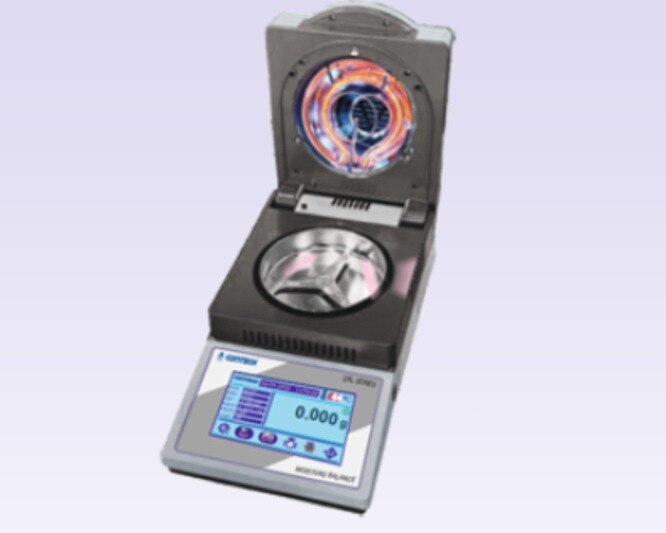
- Analyzer body with display, infrared heating element, weighing chamber or draft shield, and power cable
- Sample pans, pan lifter or holder, and any spare consumables
- Temperature-calibration accessory and weighing calibration weights
- Printer, data software, USB or other communication cable, and required drivers
- Operating instructions, installation requirements, calibration procedure, and maintenance guidance
- Warranty terms, factory test or calibration records, and a list of items excluded from the price
Check quantities, not just names. “Sample pan included” could mean one reusable pan or a starter pack of disposables.
For solvent-bearing samples, ask for the maximum solvent load, ventilation requirements, operating restrictions, and any hazardous-area or explosion-protection classification in writing. Ordinary infrared heating is not intrinsically safe.
If the supplier excludes a draft shield, calibration weights, or software, record the cost and delivery date before approval; otherwise the instrument can arrive unable to run your validated method.
Match heating and weighing specifications to your method
A test can be unusable even when the analyzer’s headline capacity looks adequate. Match the temperature range, weighing performance, sample quantity, and control functions to your moisture determination method before comparing brands.
| Specification | Check before purchase | Why it matters |
|---|---|---|
| Heating | Infrared element, usable temperature range, temperature resolution, ramp, step, and timed programs | A fixed-temperature heater can fail on samples that scorch, skin over, or release volatiles unevenly |
| Weighing | Readability, repeatability, minimum sample quantity, and stable weighing during heating | A coarse balance can hide small mass losses and distort low-moisture results |
| Capacity | Maximum pan or balance load and the supplier’s recommended sample mass | A 180 g capacity does not mean a 180 g sample gives reliable drying or safe heating |
| Control | Automatic endpoint, method storage, method locking, user access, date/time, sample ID, export, audit trail, and signatures | An electronic moisture analyzer must protect results as well as produce them |
Transfer the method by matching sample mass, pan type, layer thickness, heating profile, endpoint criterion, and cooling conditions. Copying only the nominal temperature can produce different results from an oven reference method.
Verify both measurement systems before acceptance: use traceable test weights for the balance and a suitable temperature device for the heater. Request calibration records, service intervals, and confirmation that adjustment is possible on site.
If your specification requires water-specific measurement, include Karl Fischer titration or validate the analyzer against it; infrared loss-on-drying also counts solvents and other volatile material as “moisture.”
Confirm what the instrument measures and how it ends a run
Specify the result format before buying: moisture content, dry mass, initial and final sample mass, elapsed time, temperature, and endpoint status. In loss-on-drying moisture content analysis, the displayed percentage represents mass lost during heating; it does not prove that the loss was water.
A moisture determination requiring water-specific measurement needs Karl Fischer validation or a separate method. Ask whether results can be stored, printed, or exported. For flammable solvents or vapours, confirm ventilation, maximum solvent load, operating instructions, and any hazardous-area classification; ordinary infrared heating is not intrinsically safe.
The drying program should support the sample matrix, not force one universal profile:
- Ramped heating for gradual temperature increase and reduced splattering.
- Stepped heating for samples that crust, bubble, or release moisture in stages.
- Timed drying when your validated method specifies a fixed duration.
- Automatic endpoint detection for routine samples with a predictable mass-loss curve.
| Endpoint | How it stops | Check before purchase |
|---|---|---|
| Automatic | Stops at a mass-loss-rate threshold | Confirm the threshold is adjustable; an aggressive setting can stop before equilibrium. |
| Timed | Stops after the selected duration | Set the duration from validated product data. |
| Manual | Stops when the operator accepts stable mass | Useful during method development, but operator judgement affects repeatability. |
The operating sequence should let you tare the pan, add and distribute the sample, select the temperature and program, start heating, monitor mass loss, and review or export the final result. Require repeatability data for your product, not just balance readability. A long or hot run can decompose the sample and overstate moisture.
Test sample compatibility before choosing the heating method
Choose infrared loss-on-drying for samples whose mass loss during heating represents moisture, such as free-flowing powders, granules, and stable solids. It is less suitable when heating also removes solvents, plasticizers, or decomposition products, because the instrument reports total mass loss as “moisture” rather than identifying water.
| Method | Suitable material or requirement | Main reason to choose it |
|---|---|---|
| Infrared loss-on-drying | Stable powders, granules, and thinly spread solids with a validated drying profile | Fast routine testing when volatile loss corresponds to moisture |
| Oven loss-on-drying | Thick samples, pastes, emulsions, films, or materials that crust under infrared heat | Gentle, uniform heating or continuity with an established reference method |
| Karl Fischer titration | Samples requiring water-specific results, including low-moisture materials or mixtures containing other volatile substances | Measures water selectively instead of total heating-related mass loss |
Before buying, run representative samples rather than a dry, easy powder. Check sample mass, particle size, pan type, layer thickness, reflectivity, spreading procedure, crust formation, and cooling conditions. Compare results with your existing oven method or Karl Fischer results during validation; copying only the nominal temperature does not transfer a method.
Review the infrared moisture analyzer features and included equipment against that procedure. Confirm that it supports ramped or stepped heating, timed drying, and automatic endpoint detection, plus the required sample quantity and spreading method.
Do not use ordinary infrared heating for flammable solvents until you have checked ventilation, solvent load limits, operating instructions, and any required explosion-protection classification.
Use a pre-purchase checklist for validation, data, and service
Require a product-matrix validation report before ordering, not only a balance readability figure. Ask for repeatability, bias, sample quantity, drying time and temperature, with replicate results on your material; a 1 mg display increment does not prove moisture-result accuracy.
CONTECH INSTRUMENTS LTD. can be asked to state these acceptance values for the quoted model rather than leaving them to commissioning.
- Require method records showing temperature profiles, ramp or step settings, endpoint rules, sample identification, date and time, user access, method locking, result export, audit trail and electronic signatures. FDA 21 CFR Part 11 describes electronic-record controls; it does not certify an electronic moisture analyzer by itself.
- Confirm the quote includes pans, pan lifter, draft shield, power supply, calibration weights, temperature-calibration accessory, software or printer, communication cable and operating instructions.
- Record installation requirements: supply voltage, bench clearance, ventilation, ambient limits and maximum solvent load. Flammable vapours require a chemistry review and any necessary hazardous-area classification; infrared heating is not intrinsically safe.
- Price recurring pans, heater or lamp replacements, calibration, software licences, service visits, training and freight. Obtain warranty length, response time, spare-parts availability, calibration intervals and an acceptance-test procedure.
- For water-specific moisture content analysis, require a validated comparison with Karl Fischer results or budget a separate Karl Fischer method.
| Requirement | Evidence to request | Reject when |
|---|---|---|
| Matrix validity | Repeatability and bias data | Only readability is supplied |
| Data integrity | Export, audit trail and signatures | Results cannot be traced |
| Service | Written warranty and response terms | Support remains verbal |
Related product
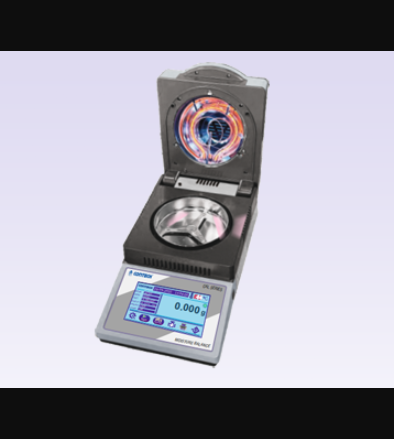 | Moisture Balances Moisture Balances (CAL Series) (0.001 g to 180 g) Moisture Balances (CAL Series) (0.001 g to 180 g) The CONTECH CAL Series Moisture Balances are advanced moisture analyzers designed for fast,... View product → |
Frequently asked questions
What should you check in an infrared moisture analyzer quotation?
Ask the supplier to list the analyzer, sample pans, calibration tools, software, cables, printer options, manuals, and service separately. Do not assume the analyzer name includes them.
Which specifications matter for moisture content analysis?
Compare heating method, temperature range, temperature control, weighing capacity, readability, repeatability, sample size, and endpoint settings with your test method.
How does a laboratory moisture analyzer end a run?
Confirm whether the instrument stops after a fixed time, when weight loss reaches a stability threshold, or through a user-defined endpoint. The endpoint must suit your sample and method.
How can you test sample compatibility before purchase?
Run representative samples and check for splashing, crust formation, burning, foaming, uneven drying, and residue on the pan. Compare the result with your reference moisture determination method.
What validation and service documents should you request?
Request calibration procedures, traceable calibration records, repeatability data, data-export details, user access controls, preventive-maintenance terms, response times, and spare-parts availability.