
A conventional XRF instrument measures characteristic X-rays from elements, not water concentration itself, so a gas proportional detector does not turn it into a direct moisture analyser. By the end, you will be able to separate direct moisture methods from indirect XRF models, choose a suitable reference procedure, and judge whether a supplier’s moisture claim is properly validated.
Key takeaways
- XRF detects elemental signals, not water molecules directly.
- Use oven drying or Karl Fischer titration to establish reference moisture values.
- Build indirect XRF models only for consistent materials and validated sample ranges.
- Compare XRF results with reference measurements before routine laboratory use.
Why XRF does not directly measure water
A gas proportional xrf detector measures incoming X-ray photons from elements, not water molecules. An x ray fluorescence spectrometer identifies characteristic elemental X-rays emitted after excitation; it does not read chemical compounds directly.
Hydrogen has no practical characteristic X-ray line for routine laboratory XRF. Oxygen does produce a low-energy line, but absorption by the sample, surface condition, atmosphere, and matrix composition can change its intensity. The detector cannot tell whether that oxygen came from water, an oxide, silicate, carbonate, or another compound.
A gas proportional xrf detector is a photon detector. Its fill gas creates charge multiplication when an X-ray enters, and pulse height supports energy discrimination; the fill gas does not sense humidity. Changing detector type therefore improves photon detection, not chemical identification of water.
| Detector | Light-element implication | Main control |
|---|---|---|
| Gas proportional | Useful for low-energy X-rays | Helium or vacuum, window transmission, air path |
| Silicon-PIN | Solid-state detection with practical low-energy limits | Window design and sample distance |
| SDD | Better energy resolution and count-rate handling | Window transmission, atmosphere, and geometry |
For all three systems, air absorption, detector-window transmission, and sample-to-detector distance control low-energy results. Surface water can attenuate those X-rays, while drying changes packing density, porosity, particle adhesion, and roughness. Use XRF for elemental composition and a separate validated method for water or loss on drying.
Which laboratory methods establish moisture content
Use a validated moisture analysis method as the primary result, not an XRF estimate. For Loss on Drying, calculate moisture content as (initial mass − dried mass) ÷ initial mass × 100.
Homogenise the sample, weigh a defined portion, dry under controlled conditions, cool in a desiccator where required, reweigh, and document the temperature, time, endpoint, and mass change. Ovens also remove solvents and other volatiles; excessive heat can decompose or oxidise the sample.
| Method | Primary measurement | Main limitation or use |
|---|---|---|
| Oven or infrared/halogen drying | Mass lost during heating | Fast, but the loss is not necessarily water |
| Thermogravimetric analysis | Mass change as temperature changes | Separates events, but assigning one event to water requires interpretation |
| Karl Fischer titration | Water consumed in a chemical reaction | Preferable when water itself is the measurand |
Choose coulometric Karl Fischer for low water levels and volumetric Karl Fischer for higher water amounts or larger reagent additions. Check solubility, dispersion, reaction interference, and slow water release before accepting the result; calculate titrant consumption and record the endpoint.
Use a matrix-specific procedure where one exists. ASTM D2216 covers water content in soil and rock by mass, while ASTM C566 specifies loss on drying for aggregates. Neither procedure transfers unchanged to foods, polymers, ores, pharmaceuticals, or volatile-containing powders. That distinction is central to defensible moisture content analysis.
Where indirect XRF moisture models can work
An indirect model can support moisture content analysis when XRF results correlate with a validated reference method for one defined matrix and sample population. It can also reveal elemental changes associated with moisture-related reactions, but that evidence does not equal a water measurement.
Practical candidates include:
- Uniform powders with consistent particle size
- Selected soils and ores with stable mineralogy
- Slurries, oils, polymers, and pharmaceutical powders with controlled sampling
- Materials whose XRF signal remains stable after a documented preparation procedure
Avoid samples containing volatile solvents, strong moisture gradients, changing mineralogy, unstable surfaces, or unknown particle-size distributions. These conditions make a calibration appear accurate while predicting the wrong subsample.
Seal the material promptly, homogenise it, and remove a defined subsample. Prepare that subsample as a controlled pressed pellet or sample cup, recording fill mass, packing pressure, cup geometry, surface finish, and measurement time.
Measure the same material by XRF and by the reference method, such as Karl Fischer titration, thermogravimetric analysis, or a matrix-specific loss-on-drying procedure.
Equal bulk moisture does not guarantee equal XRF results. Surface water can attenuate low-energy X-rays; packing density and porosity change absorption paths; particle adhesion alters segregation; and roughness changes the sampled surface. Use the model only within the conditions represented by its paired calibration data.
How to validate an indirect XRF moisture result
An indirect XRF moisture result is fit for a laboratory only when independent evidence shows that predictions remain accurate across the laboratory’s actual sample population. Calibration standards must cover the intended moisture range and the expected matrix, particle-size range, packing density, temperature, and interfering elements.
- Keep calibration and validation samples separate; include several moisture levels and realistic heterogeneity rather than replicate portions of one uniform batch.
- Compare every validation prediction with a named reference method: Karl Fischer, thermogravimetric analysis, or a matrix-specific Loss on Drying procedure.
- Report bias, repeatability, reproducibility where tested, calibration range, detection limit, outliers, and failure cases.
- Define ongoing verification frequency and acceptance limits before routine use.
- Do not transfer a model developed for one powder or process automatically to oils, soils, ores, polymers, slurries, or pharmaceutical powders.
- Repeat verification after changes in grinding, drying, storage, sample temperature, cup filling, or instrument configuration.
| Evidence | What to document | What failure means |
|---|---|---|
| Calibration | Matrix coverage, moisture range, particle size, packing, temperature, interferents | The model is extrapolating beyond its design |
| Validation | Separate samples, reference results, bias, repeatability, outliers | Agreement has not been demonstrated |
| Routine control | Verification frequency, limits, failed cases, corrective action | Drift can pass unnoticed |
A model that performs well only on prepared standards is not validated for production material. The reference method must measure the same defined measurand and subsample as the XRF prediction.
How to choose an XRF-and-moisture workflow
Use XRF for elemental composition and a separate validated method for water or loss on drying. Elemental results can then reveal matrix changes, such as altered mineral content, that explain calibration drift. Do not present XRF as a moisture assay without independent validation.
Before buying, ask any supplier, including CONTECH INSTRUMENTS LTD., for an application report that identifies:
- The exact sample matrix and reference method
- Calibration and validation sample counts
- Moisture range, bias, repeatability, and detection limit
- Sample preparation, temperature control, and failure cases
A search for “gas xrf spectrometer for moisture content analysis in Pune” does not establish capability. Location, detector type, speed, and a generic accuracy statement prove nothing about moisture performance.
| Method | Precision and bias | Throughput and effort | Transfer and robustness |
|---|---|---|---|
| XRF plus reference method | Indirect prediction; matrix-dependent bias | Fast XRF, but reference testing remains necessary | Sensitive to particle size, packing, surface moisture, and temperature |
| Infrared or microwave | Rapid result after reference calibration; bias remains matrix-dependent | High throughput and low routine effort | Calibration transfer can fail with particle-size or temperature changes |
| Karl Fischer | Measures water directly; strong choice for water-specific precision | More operator handling and solvent or reagent control | Transfer depends on solubility, reaction chemistry, and endpoint control |
XRF can support moisture analysis indirectly, but a direct claim requires validation against KF, TGA, or a matrix-specific LOD procedure for the exact sample population.
Related products
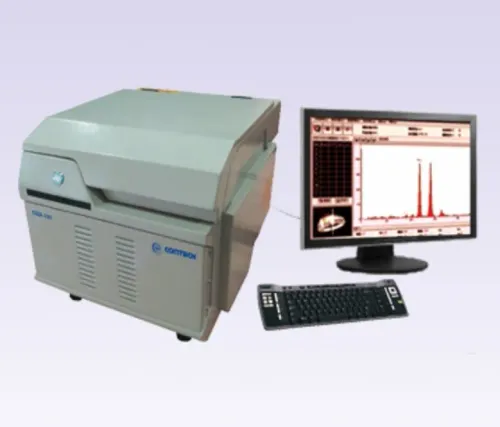
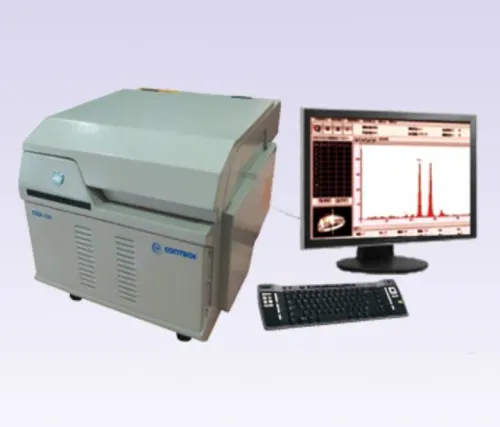
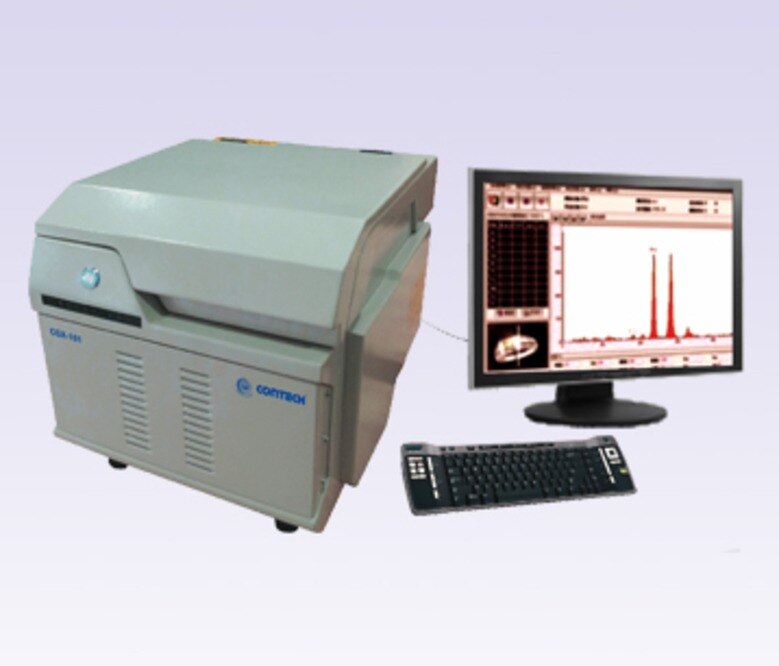
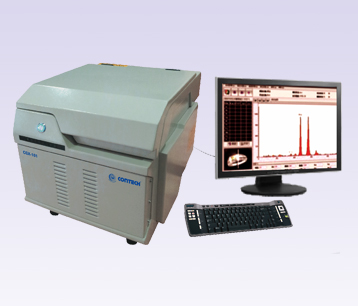 | X-RAY FLUORESCENCE SPECTROMETERS X-Ray Fluorescence Spectrometer – Gas Proportional XRF Detector CGX-101 X-Ray Fluorescence Spectrometer – Gas Proportional XRF Detector CGX-101 The X-Ray Fluorescence Spectrometer – Gas Proportional XRF Detector CGX-101... View product → |
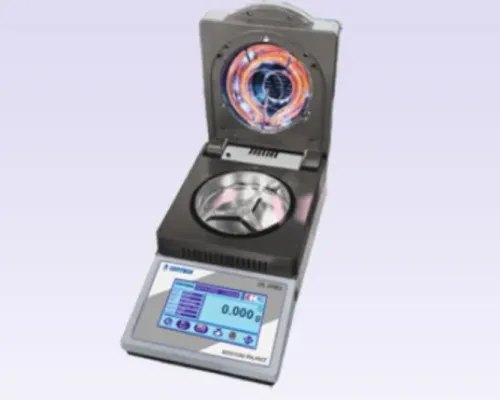
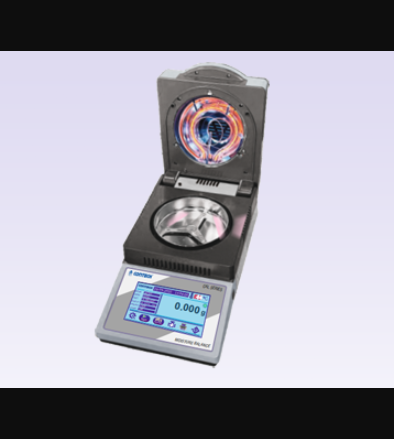 | Moisture Balances Moisture Balances (CAL Series) (0.001 g to 180 g) Moisture Balances (CAL Series) (0.001 g to 180 g) The CONTECH CAL Series Moisture Balances are advanced moisture analyzers designed for fast,... View product → |
Frequently asked questions
Why does XRF not directly measure water?
A gas proportional XRF detector measures characteristic elemental X-rays. It does not directly identify water molecules or chemical compounds.
Which methods establish moisture content for comparison?
Use a defined reference method such as gravimetric oven drying, loss on drying, or Karl Fischer titration, selected for the material and required accuracy.
When can indirect XRF moisture models work?
Indirect models can work when moisture correlates consistently with measurable elemental or matrix signals across a controlled material range.
How do you validate an indirect XRF moisture result?
Test representative samples with both XRF and the reference moisture analysis method, then assess bias, repeatability, prediction error, and performance on new samples.