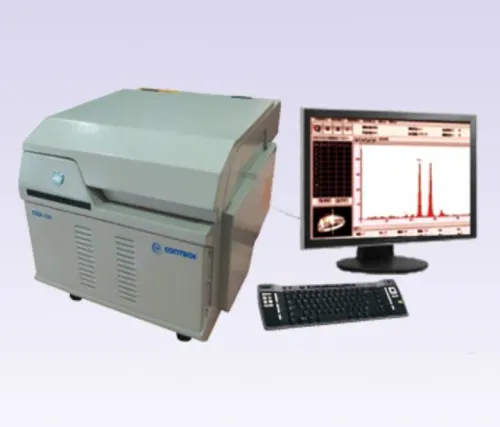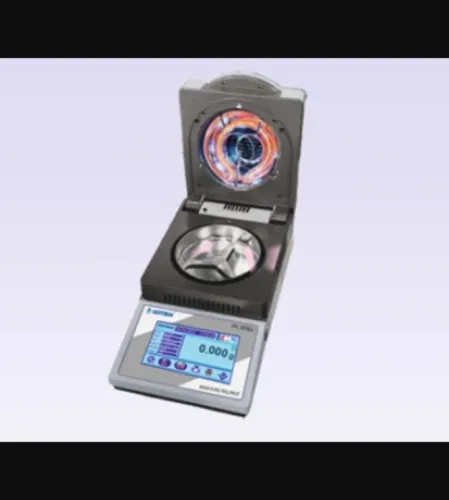

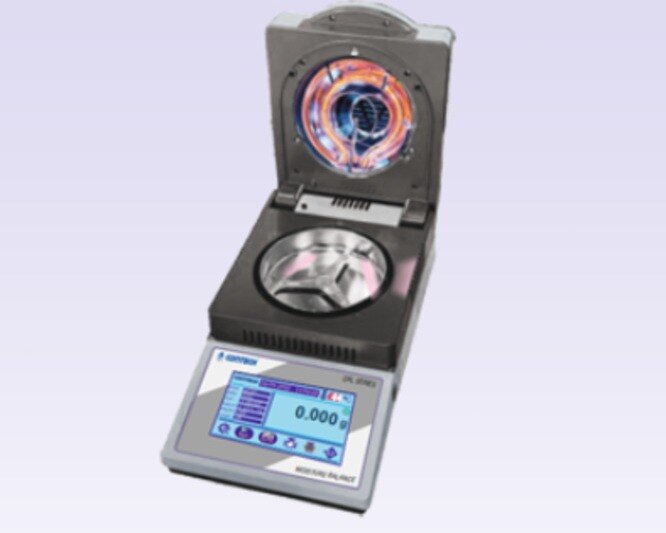
An electronic moisture analyzer and a conventional moisture balance may refer to the same integrated instrument, but an ordinary precision balance paired with an oven is a different workflow. By comparing heating methods, sample requirements, measurement claims, and reference procedures, you can specify the right equipment and build a defensible moisture test for your material.
Key takeaways
- Treat moisture analyzer and moisture balance as names for the same integrated instrument.
- Match infrared, halogen, or other heating to the sample’s composition and heat sensitivity.
- Choose capacity and readability from the sample mass and reporting tolerance.
- Compare the analyzer’s results with a reference oven method before routine testing.
Are an electronic moisture analyzer and a moisture balance the same instrument?
An electronic moisture analyzer and a moisture balance usually describe the same integrated instrument: a precision balance, controlled heater, programmed drying cycle, endpoint logic, and moisture calculation in one unit. “Digital moisture analyzer” is another common name for this class.
| moisture analyzer weighing balance | What the term may mean | What it can do |
|---|---|---|
| Integrated moisture analyzer | Balance combined with heater and software | Controls temperature, records the drying curve, detects stable mass, and calculates moisture percentage |
| Electronic moisture balance | Usually the same integrated instrument | Runs a programmed Loss on Drying test |
| Ordinary precision balance | Balance used beside a drying oven | Measures mass but does not heat, define an endpoint, or calculate drying loss |
| Balance-and-oven setup | Separate balance, oven, desiccator, and timed weighing | Offers flexibility but requires manual temperature control, cooling, weighing, and calculations |
Ask the supplier whether the unit controls temperature, records the drying curve, detects a stable mass, and calculates moisture percentage. An ordinary balance cannot replace those functions.
For a basic Loss on Drying test, weigh the empty pan, add and record the sample mass, heat it, monitor the falling mass, and calculate: moisture percentage = (initial mass − final mass) ÷ initial mass × 100. Record the sample identification, starting mass, temperature profile, endpoint, final mass, result, and operator.
When comparing an electronic moisture analyzer in Pune, compare these workflow functions rather than the product label.
Which heating method and sample type suit the test?
Halogen and infrared heating suit powders, granules, slurries, pastes, and many food, chemical, pharmaceutical, and polymer samples that release moisture without decomposing. They transfer heat quickly and shorten cycles, but an aggressive profile can crust the surface, splatter liquid, char solids, or trap moisture beneath a dry layer.
| Heating method | Best fit | Main limitation |
|---|---|---|
| Halogen | Routine rapid LOD for stable, free-flowing samples | Excessive heat can scorch or crust samples |
| Infrared | Fast screening of powders, granules, and pastes | Uneven surfaces can produce uneven drying |
| Hot air | Reference procedures and gentle drying | Requires timed weighing, cooling in a desiccator, and a defined endpoint |
Use the specified hot-air oven method when a customer specification or compendial procedure names it. Use a vacuum oven for heat-sensitive materials or samples that dry poorly at atmospheric pressure. Choose Karl Fischer titration when water alone must be measured: LOD also counts evaporating solvents, residual chemicals, and some decomposition products.
Before buying an electronic moisture balance in Pune, ask whether it provides:
- Controlled heating profiles, ramp control, and stepwise temperature programs
- Time, stability, and manual endpoint modes
- A reference-method correlation option for samples that crust, splatter, decompose, or dry unevenly
Fast heating is not automatically better. A stable mass endpoint is more defensible than one fixed time for every batch.
How do you choose capacity, readability, temperature, and endpoint settings?
Choose the usable sample-mass range for your material, not simply the pan’s maximum capacity. An oversized load can dry unevenly or exceed safe loading; an undersized load makes drafts, balance noise, pan contamination, and handling loss significant.
A 1 mg mass change equals 0.10 percentage points for a 1 g sample but 0.01 percentage points for a 10 g sample. Therefore, a 0.001 g display does not guarantee moisture accuracy or meaningful moisture-result resolution.
| Specification | What to compare | Failure prevented |
|---|---|---|
| Capacity | Material-specific working mass range | Uneven drying or unsafe loading |
| Readability | Smallest displayed mass increment | Mistaking display precision for result accuracy |
| Repeatability | Spread across repeated tests | Accepting unstable results |
| Accuracy | Agreement with a reference value | Reporting a precise but biased result |
| Temperature | Safe operating range and setpoint control | Crusting, splattering, charring, or decomposition |
| Endpoint | Stability, time, stepwise-temperature, and manual modes | Under-drying slow samples or overheating fast ones |
Specify these points before comparing instruments:
- Expected moisture range and target moisture-result resolution
- Sample mass, pan loading pattern, and maximum cycle time
- Ramp rate and heating profile
- Acceptable repeatability against an oven or other reference method
- Endpoint based on a small mass change over time rather than one fixed time
Readability is not repeatability, and neither proves accuracy. Before selecting a moisture analyzer weighing balance in pune, confirm that the instrument records the drying curve and supports the endpoint your material requires.
How should you prepare a sample and prove the method agrees with an oven?
Build the method around the material, not the oven’s temperature. Mix the bulk sample thoroughly; grind coarse or non-uniform material to a consistent particle size, and protect it from moisture loss during preparation.
- Weigh promptly, keep the pan covered until loading, and spread the sample in a uniform thin layer.
- Do not heap paste or wet solids in the centre. Uneven thickness changes the drying path and can create a false stable mass.
- Establish a starting mass that dries evenly and stays within the pan’s safe load.
- Test temperature, ramp rate, sample thickness, mixing, and endpoint until the result is repeatable without overheating, crusting, splattering, or charring.
Compare replicate samples with the site’s reference method at low, medium, and high moisture levels.
| Reference method | What to compare | What to record |
|---|---|---|
| Reference oven | Paired loss-on-drying results | Bias and spread |
| Karl Fischer method | Water-specific result versus mass loss | Difference and sample moisture level |
| Customer or validated method | Analyzer result versus the approved procedure | Acceptance limit and pass/fail decision |
Plot the paired results, calculate bias and spread, and define the acceptance limit before approving the method. Repeatability alone is insufficient: an analyzer can produce identical results while remaining biased against the reference.
For a digital moisture analyzer in Pune, retain the approved preparation steps, heating programme, endpoint, raw data, replicate results, and acceptance limits as one controlled method. This proves agreement for that material and method; it does not prove that every product or oven temperature will transfer unchanged.
What should a Pune buyer verify before installation and routine use?
Before ordering, write the acceptance checklist into the purchase specification rather than comparing readability or cycle time alone. Require the supplier to confirm each item in writing.
1. Electrical and environment: Verify compatibility with Pune’s 230 V, 50 Hz, single-phase supply, an earthed socket, and the supplied plug or adapter. Record the permitted temperature and relative-humidity range, installation clearance, warm-up time, and protection from vibration and direct airflow.
2. Sample protection: Require a draft shield with doors that close around the weighing pan. Check that the pan is removable, easy to clean, corrosion-resistant, and large enough for an even thin layer. Monsoon humidity and air-conditioning changes can alter hygroscopic samples during weighing and preparation even when the analyzer remains within its rated environment.
3. Verification: Require mass calibration with traceable weights and independent heater-temperature checks at defined setpoints. For a balance-and-oven workflow, check temperature uniformity and stability across the chamber, not only the controller display. The certificate must state traceability, measurement uncertainty, measured points, and dates.
4. Records and service: Confirm export in CSV or another usable format, including sample ID, mass readings, temperature profile, endpoint, timestamp, and operator. Get the calibration interval, preventive-maintenance plan, spare-parts availability, and written service response time.
5. Controlled use: For regulated or customer-audited work, lock sample preparation, heating profile, endpoint, acceptance limits, raw-data retention, and periodic balance and temperature checks. Use ISO/IEC 17025 when calibration or testing-laboratory competence matters.
CONTECH INSTRUMENTS LTD. belongs in the Pune comparison only if it documents these installation checks, method support, calibration planning, and after-sales controls against your specification.
Related product
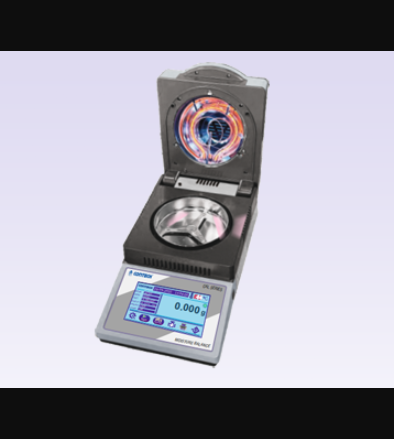 | Moisture Balances Moisture Balances (CAL Series) (0.001 g to 180 g) Moisture Balances (CAL Series) (0.001 g to 180 g) The CONTECH CAL Series Moisture Balances are advanced moisture analyzers designed for fast,... View product → |
Frequently asked questions
Are an electronic moisture analyzer and a moisture balance the same instrument?
Usually, yes. Both terms describe an integrated precision balance, heater, drying program, endpoint logic, and moisture calculation. Suppliers also use digital moisture analyzer and moisture analyzer weighing balance.
Which heating method and sample type suit the test?
Use a heating method that dries the sample evenly without scorching or altering its chemistry. Match the method to the sample’s moisture level, texture, particle size, and heat sensitivity, then confirm it against an oven reference.
How do you choose capacity, readability, temperature, and endpoint settings?
Select capacity above the combined mass of the pan and sample, choose readability that supports your reporting tolerance, and set temperature and endpoint from a validated method. Avoid copying settings from a different sample.
How should you prepare a sample and prove the method agrees with an oven?
Homogenise the sample, reduce particle-size variation, spread a consistent thin layer, and test replicate portions. Compare analyzer results with the specified oven method across representative moisture levels, then document bias, repeatability, temperature, time, and endpoint.
What should a Pune buyer verify before installation and routine use?
Check the supply voltage, earthing, bench stability, ventilation, ambient temperature limits, calibration procedure, pan availability, service coverage, training, software or data export, warranty terms, and installation documentation before purchase.