
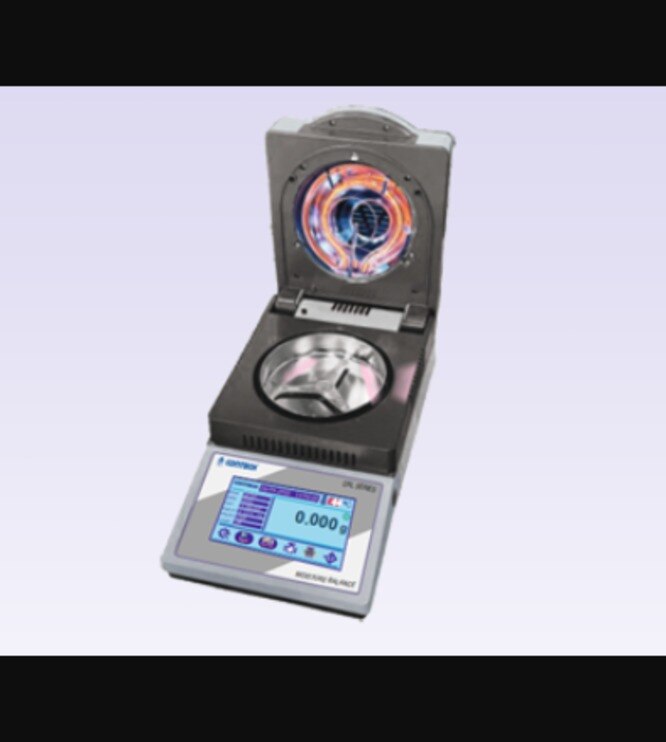
A low-priced moisture balance can reduce testing time, but its number represents mass lost under a chosen heating programme—not water automatically. You will be able to judge the real cost, build a defensible operating method, and decide when an oven or Karl Fischer test is the safer reference.
Key takeaways
- A cheap moisture balance measures loss on drying, not water alone.
- Dry samples in thin, even layers and record mass, temperature, and time.
- Treat volatile solvents and decomposition products as sources of false moisture loss.
- Compare service, calibration, ventilation, software, and repeatability—not purchase price alone.
What does a cheap moisture balance actually measure?
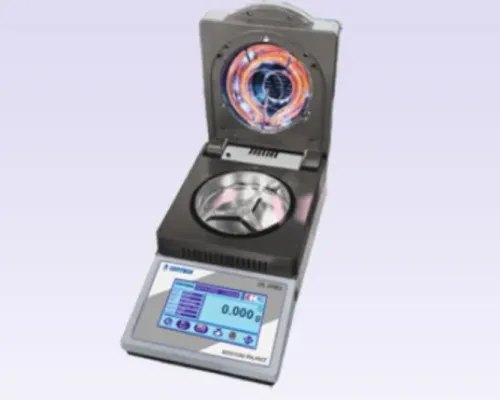
A cheap moisture balance usually performs loss-on-drying, not water-specific analysis. It measures how much mass disappears while the sample follows a selected heating programme.
- Tare the empty pan and record its mass.
- Add a representative sample, weigh it as the initial mass, and spread it in a thin, even layer.
- Select the drying temperature, time or automatic endpoint, then heat the sample while the balance tracks falling mass.
- Record the final mass and calculate:
Moisture or mass loss percentage = (initial sample mass − final sample mass) ÷ initial sample mass × 100
That result is total mass loss under the selected temperature, time, and endpoint. Residual solvent, plasticiser, fragrance, or decomposition products can be counted as “moisture”; the balance cannot identify which substance evaporated.
Wet-basis reporting divides mass loss by the initial wet sample mass. Dry-basis reporting divides the water or measured loss by the final dry-solids mass, then multiplies by 100, so the percentage is higher than the same result on a wet basis.
A moisture analysis method in Pune must state sample mass, preparation, particle size, pan loading, heating programme, endpoint, and result basis. Change any of these and the reported value can change without changing the chemical.
That control matters for moisture measurement in Pune, where handling time and ambient humidity can alter hygroscopic samples before heating begins.
How should you prepare and dry a chemical sample?
A reliable result starts before heating: control what happens between opening the container and starting the test. This matters especially for hygroscopic powders and salts in Pune’s warm or humid conditions, where the sample can gain or lose water within minutes.
1. Homogenise the container gently. Mix powders and granules, or fold pastes, until the portion represents the whole batch. Do not grind excessively: grinding can expose new surfaces, change diffusion, or drive off surface water.
2. Open, take the representative portion, and weigh it quickly. Record the handling time from opening to weighing and loading. Use a covered weighing area or controlled environment when air exposure affects the result.
3. Select a sample mass that gives a measurable loss without overloading the pan. Spread powders, pastes, or granules as a thin, even layer; a thick heap can crust outside while retaining moisture inside. Fix the particle-size and loading procedure rather than leaving it to operator preference.
4. Match temperature and heating intensity to behaviour. Use gentler heating and a smaller portion for materials that boil, oxidise, decompose, crust, or form a skin. For a known product, use a validated fixed-time programme. Use an automatic endpoint only after confirming that slow diffusion does not make the instrument stop prematurely.
5. Before routine moisture measurement in Pune, compare drying curves and repeatability across repeated preparations. Record the sample mass, preparation, temperature, programme, endpoint, and result basis. A moisture balance instrument in Pune is ready for routine use only when those checks produce consistent results.
When does moisture loss stop meaning water?
A heated balance stops meaning water when the sample loses anything volatile, not only free water. Treat it as unsuitable if the sample loses solvent, decomposes before water leaves, reacts with air, contains chemically bound water released only during breakdown, or emits other non-water components.
A dry surface can form a crust or skin that slows internal diffusion, so the displayed endpoint may stop before the interior is dry. Aggressive halogen or infrared heating can also overstate loss by causing boiling, oxidation, or decomposition rather than water evaporation.
| Method | What it measures | Behaviour and limitation |
|---|---|---|
| Oven-based LOD | Mass lost at a defined temperature and time | Slower reference; still measures total loss, not water specifically |
| Infrared or halogen drying | Mass lost during accelerated heating | Faster, but higher intensity can create crusting or decomposition |
| Karl Fischer | Water specifically | Choose volumetric or coulometric measurement; check extraction, matrix reactions, and interference |
| Thermogravimetric analysis | Mass change through a controlled temperature programme | Separates successive loss events more informatively |
For a moisture analysis method in Pune, match the method to the specification. If it names oven LOD, LOD, or Karl Fischer, do not substitute a rapid balance without documented equivalence or approval.
For moisture measurement in Pune, Karl Fischer suits low water concentrations and volatile non-aqueous matrices. A rapid balance suits total volatile-loss screening only after comparison with the named reference method.
What does “cheap” cost after the purchase?
A cheap moisture balance in Pune is cheap only when its validated cost per reportable result is low. Include drying time, operator involvement, repeatability, rejected or repeated tests, consumable pans, replacement lamps or heaters, calibration, temperature verification, local service access, downtime, and correlation with an oven or Karl Fischer reference.
| Cost item | What to assess | Why it changes the result cost |
|---|---|---|
| Drying cycle | Minutes per sample and operator attendance | A slow or hands-on method consumes labour |
| Consumables and service | Pan, lamp, heater, calibration, and Pune service costs | Low purchase price does not prevent recurring expense |
| Method correlation | Oven or Karl Fischer comparisons | One comparison cannot establish equivalence |
A display reading 0.01% moisture is readability, not accuracy. It cannot correct sample non-homogeneity, convection and buoyancy, temperature non-uniformity, or a wrong drying programme.
Before accepting a moisture balance instrument in Pune, complete these checks:
- Test balance repeatability with replicate weighings.
- Verify temperature at the sample position, not only against the supplier’s stated heater specification.
- Check drying-curve or automatic-endpoint repeatability.
- Compare low, normal, and high moisture samples with a validated reference method.
Keep mass calibration, heater-temperature checks, and performance verification as separate controls. Record the sample identity and drying programme for every check; routine mass calibration cannot repair a faulty method. Correlation work itself costs analyst time and reference testing, but skipping it creates unreportable results, disputes, and downtime.
How should a Pune laboratory decide whether to buy or use one?
Buy a cheap moisture balance in Pune for process screening only after correlation across your actual product range. One comparison at one moisture level does not prove equivalence at low, normal, and high moisture.
1. Define the release method before testing. Keep Karl Fischer for low water concentrations or matrices containing volatile non-aqueous components. Keep the named compendial, customer, or regulatory method when replacement lacks documented equivalence or approval.
2. Run acceptance checks on representative samples: balance repeatability, temperature at the sample position, drying-curve or endpoint repeatability, and comparison with the validated reference method. Record the sample, mass, programme, temperature, endpoint, and result basis.
- Sample-position temperature verification and calibration arrangements
- Repeatability data and stored-programme capacity
- Pune service response time and method-transfer support
- Calibration and routine temperature-check procedures
- Spare heater or lamp availability, pan costs, and operator training
A laboratory comparing equipment from CONTECH INSTRUMENTS LTD. should request those acceptance records instead of relying on headline capacity, display resolution, or temperature claims. That is the difference between a moisture balance instrument in Pune that supports useful moisture measurement in Pune and one that produces attractive but indefensible numbers.
Buy cheaply when the method is simple, stable, correlated, and supportable. Pay for a different technique when the result must identify water specifically or defend a formal specification.
Related product
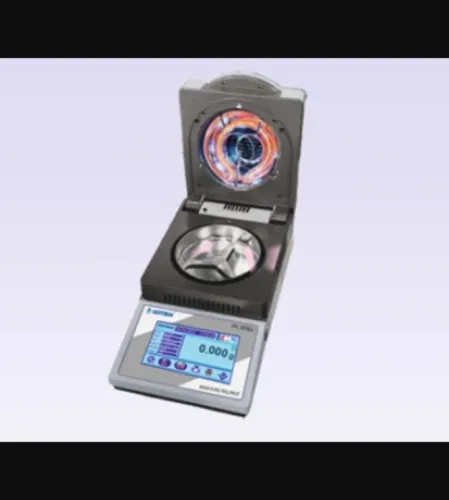
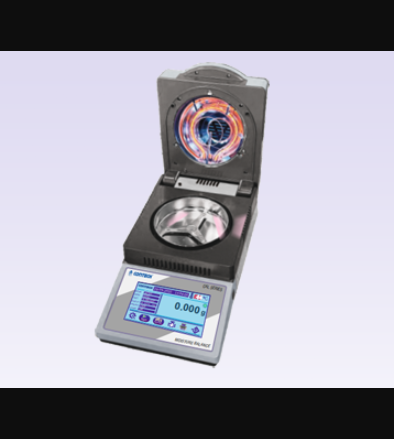 | Moisture Balances Moisture Balances (CAL Series) (0.001 g to 180 g) Moisture Balances (CAL Series) (0.001 g to 180 g) The CONTECH CAL Series Moisture Balances are advanced moisture analyzers designed for fast,... View product → |
Frequently asked questions
What does a cheap moisture balance actually measure?
It measures loss on drying: the mass lost while a sample follows a programmed heating cycle. That loss can include water, solvents, and volatile or decomposed material.
How should you prepare and dry a chemical sample?
Homogenise the sample, use a clean dry pan, spread a thin even layer, and record the sample mass, heating temperature, drying time, and endpoint. Keep the same method for every comparison.
When does moisture loss stop meaning water?
Loss on drying stops being a water-specific result when the sample contains volatile solvents, subliming compounds, hydrates, or ingredients that decompose at the drying temperature. Confirm with a water-specific method when composition makes that distinction important.
What does cheap cost after the purchase?
Include calibration, service visits, replacement pans, method development, staff time, ventilation, failed tests, and downtime. A low purchase price can cost more when results are inconsistent or difficult to defend.
How should a Pune laboratory decide whether to buy or use one?
Buy after confirming that loss on drying answers your quality question and that the instrument meets your required repeatability, temperature range, load capacity, records, and service support. Use an external laboratory or a water-specific method when the result must isolate water or meet a formal specification.