
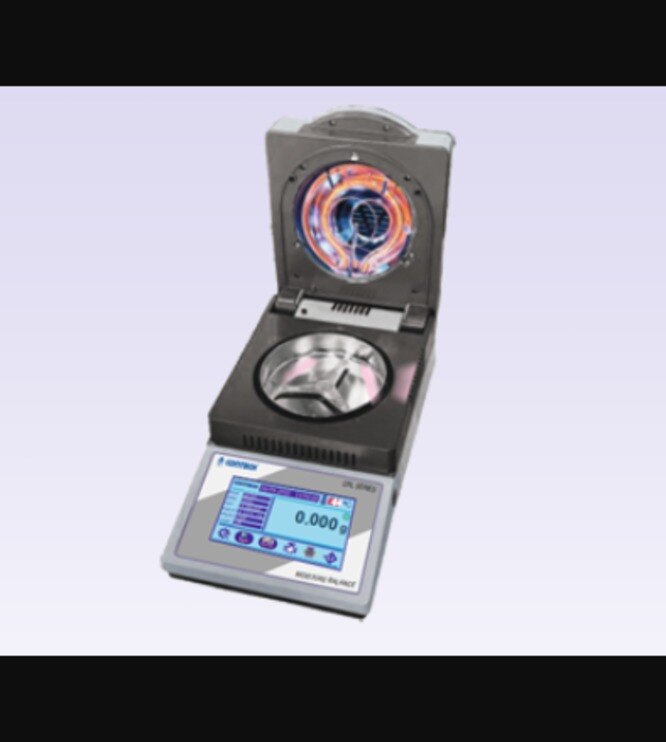
A moisture balance can produce a result within minutes, but the displayed percentage is only meaningful when the sample, heating program, endpoint and reporting basis are controlled. By comparing those method variables rather than relying on readability or speed alone, you can select an instrument and verify whether its result is suitable for routine testing, process control or product release.
Key takeaways
- Spread samples evenly and record wet and dry mass.
- Match temperature, endpoint, sample size, and weighing resolution when comparing balances.
- Validate loss-on-drying results against a reference method and repeat tests.
- Check calibration, service support, ventilation, and local operating conditions in Bengaluru.
How a laboratory moisture balance calculates moisture
- An LOD test heats a weighed sample while a laboratory moisture balance continuously tracks mass loss.
- Tare the empty, dry pan, add a representative sample, and record the initial wet mass. Spread it evenly so heating reaches the material rather than only its surface.
- Heat at the specified temperature and monitor the falling mass until the selected endpoint. Record the final mass; mass loss equals initial mass minus final mass.
- Calculate the reported percentage from those weights, not from the instrument label alone.
| Basis | Calculation | Meaning |
|---|---|---|
| Wet basis | (Initial mass − final mass) ÷ initial mass × 100 | Loss relative to the original wet sample |
| Dry basis | (Initial mass − final mass) ÷ final dry mass × 100 | Loss relative to the remaining dry material |
Name the basis in the test method, certificate and customer specification. The same sample produces different numerical percentages under wet-basis and dry-basis reporting.
Loss on drying is not automatically water. Residual solvent, reagent, decomposition products and other volatile matter can contribute to the result. For plastics, ASTM D6980 covers thermogravimetric moisture measurement, but warns against materials that lose constituents besides water under the selected conditions.
Temperature is therefore a method variable: raising it can speed drying but trigger decomposition, oxidation, charring or volatile loss. Confirm that the material’s behaviour at that temperature matches the intended moisture analysis.
How sample preparation and heating conditions change the result
Prepare a representative sample before you choose a drying program. Reduce large particles without heating or losing fines, mix thoroughly, and take a subsample from several locations. Record its mass, transfer it quickly, and spread it as a shallow, even layer across the pan.
Do not set sample mass from the balance’s maximum capacity. Establish it from the material: an overloaded pan traps moisture, while an uneven pile forms a dry crust over wetter material. Spattering can remove solids, and a stable-looking endpoint can still be biased because the surface dried before the interior.
Temperature is a method variable, not merely a speed control. Select it by testing moisture removal against evidence of damage, including oxidation, charring, decomposition, and evaporation of non-water volatiles.
| Heating source | Drying behaviour | Main risk or comparison point |
|---|---|---|
| Halogen | Fast response and concentrated heating | Surface overheating, crusting, or charring if the layer is thick |
| Infrared | Rapid radiant heating with material-dependent absorption | Uneven sample temperature when colour, shape, or spreading varies |
| Other sources, such as resistance heating | Slower, steadier heat with broader distribution | Longer tests, but reduced surface shock in sensitive materials |
For moisture measurement in Bengaluru, keep hygroscopic powders in sealed containers, load them quickly, and use the same transfer technique every time. Record laboratory temperature and relative humidity, and prevent hot samples from reabsorbing moisture before weighing. Consistent handling often matters more than finer readability.
Which specifications make two moisture balances genuinely comparable
Compare the method settings and performance evidence, not just the displayed moisture percentage. A laboratory moisture balance must be assessed using its complete temperature range, heating behaviour, endpoint logic and weighing performance.
| Specification | What to compare | Why it matters |
|---|---|---|
| Temperature | Complete range, fixed or programmable profiles, ramp control and heater uniformity | Temperature changes drying speed and can cause charring, decomposition or loss of non-water volatiles |
| Endpoint | Endpoint type, mass-change threshold, time interval and stabilization time | “Constant weight” is not universal; one instrument may stop when mass change stays below a programmed rate for a defined period, while another applies a different rule |
| Weighing | 0.001 g readability, accuracy, repeatability, linearity and minimum sample increment | Readability alone does not prove weighing quality or moisture-method accuracy |
| Results | Replicate repeatability, drift and agreement with a reference method | A fine display cannot correct poor homogeneity or an unsuitable method |
Treat heater-temperature verification as a separate check from balance calibration. A balance can pass weighing calibration while the sample temperature is biased, or the heater can be accurate while the weighing system drifts.
- Compare every candidate using identical material, particle preparation, sample mass, temperature program, endpoint and replicate plan.
- Do not compare one instrument’s factory application with another’s default settings; the programs are not equivalent evidence.
- Use a moisture balance CAL series comparison as a neutral framework, then confirm performance with your own samples and method. Record the threshold, interval and stabilization result, not merely the final percentage.
How to validate an LOD result before relying on it
A result is fit for release or process control only after comparison with a defensible reference. Use the applicable oven method for routine solids, Karl Fischer titration when the material contains only water, or a certified reference material when its matrix and moisture value match the product.
For grains and cereals, use ISO 712 as the reference method; correlate temperature, sample mass, preparation and endpoint rather than copying them casually into a laboratory moisture balance method.
- Select representative low-, medium- and high-moisture samples covering the release or operating range. Test each level in replicates using the proposed moisture analysis procedure.
- Compare results with the reference and calculate repeatability, intermediate precision and bias. Assess recovery where a controlled moisture addition is appropriate, and estimate measurement uncertainty.
- Record the sample container, sealing condition, exposure time before weighing, sample mass, laboratory temperature and relative humidity. Control these factors because hygroscopic samples can gain or lose moisture during handling.
- Set acceptance criteria before reviewing the results, including allowable bias, precision and uncertainty for the decision being made. Investigate failed criteria rather than averaging away an abnormal result.
An ISO/IEC 17025 laboratory needs documented method validation or verification and technically valid results. Qualification and periodic checks must include both balance calibration and heater-temperature verification: correct weighing does not prove correct sample temperature, and a verified heater does not prove weighing accuracy.
A practical buying checklist for moisture analysis in Bengaluru
Choose a laboratory moisture balance for moisture analysis in Bengaluru by matching the method to the material, not by selecting the largest capacity or finest display. Record laboratory temperature and relative humidity; Bengaluru humidity can change hygroscopic samples during open-pan handling.
- Define the material and reporting basis: wet-basis or dry-basis moisture.
- Identify the reference method, such as ISO 712 for grains, ASTM D6980 for plastics, Karl Fischer titration, or an oven method.
- Test for solvents, reagents and other non-water volatiles; mass loss is not automatically water.
- Specify sample mass, particle size, mixing, representative subsampling and a thin, even pan layer.
- Compare the heating source, full temperature program, ramp and maximum temperature.
- Require a documented endpoint: threshold, time interval and stabilization rule.
- Review replicate repeatability and verify heater temperature separately from balance calibration.
- Plan calibration, service response, records and user training.
| Heating source | Main comparison | Risk to check |
|---|---|---|
| Halogen | Fast response and concentrated heating | Surface crusting, charring or spattering |
| Infrared | Broad radiant heating | Uneven sample temperature |
| Other programmed heating | Flexible ramps and holds | Results depend on the exact profile |
Minimize open-pan exposure, load quickly, and prevent hot-sample reabsorption before final weighing. Store hygroscopic products in sealed containers. Finer readability cannot correct poor homogeneity or uncontrolled handling.
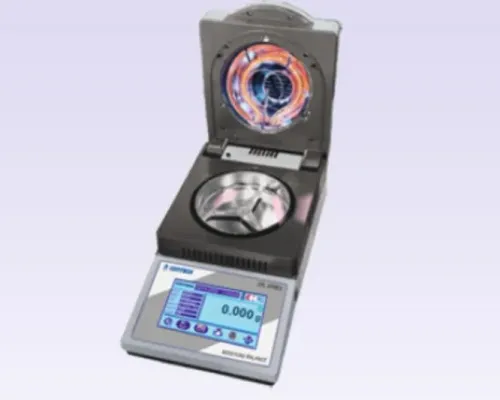
For a moisture balance CAL series comparison, ask CONTECH INSTRUMENTS LTD. for application data, temperature-program details, endpoint settings, calibration records and a side-by-side trial using your samples. Compare identical preparation, mass, program, endpoint and replicates—not product labels or maximum capacity.
Related product
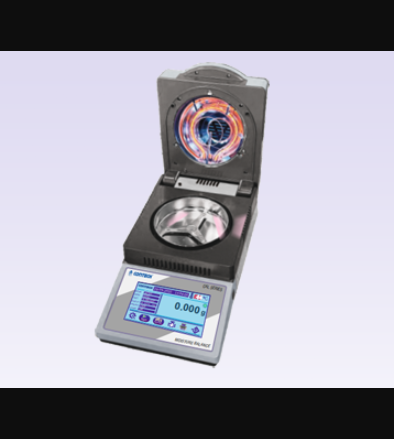 | Moisture Balances Moisture Balances (CAL Series) (0.001 g to 180 g) Moisture Balances (CAL Series) (0.001 g to 180 g) The CONTECH CAL Series Moisture Balances are advanced moisture analyzers designed for fast,... View product → |
Frequently asked questions
How does a laboratory moisture balance calculate moisture?
It weighs the sample, heats it, tracks mass loss, and calculates moisture from the difference between initial wet mass and final dry mass.
How do sample preparation and heating conditions affect moisture analysis?
Sample thickness, particle size, distribution across the pan, heating temperature, and endpoint selection can all change the measured mass loss.
Which specifications make two moisture balances comparable?
Compare weighing capacity, readability, temperature range, heating method, sample-pan size, endpoint controls, repeatability, and reporting functions.
How can you validate an LOD result before relying on it?
Repeat the test, compare results with an established reference method, use a representative sample, and investigate differences caused by temperature or endpoint settings.
What should you check before buying a moisture balance in Bengaluru?
Check the required test range, local calibration and service support, power and operating conditions, ventilation needs, documentation, software, and compatibility with your sample workflow.