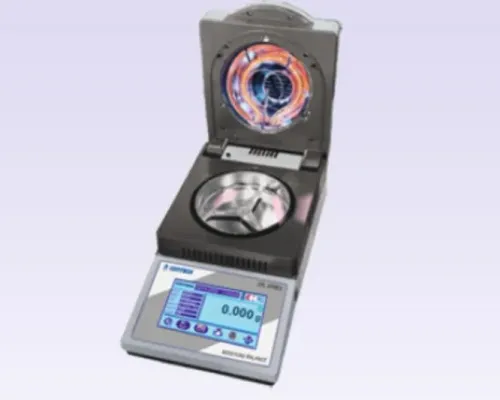

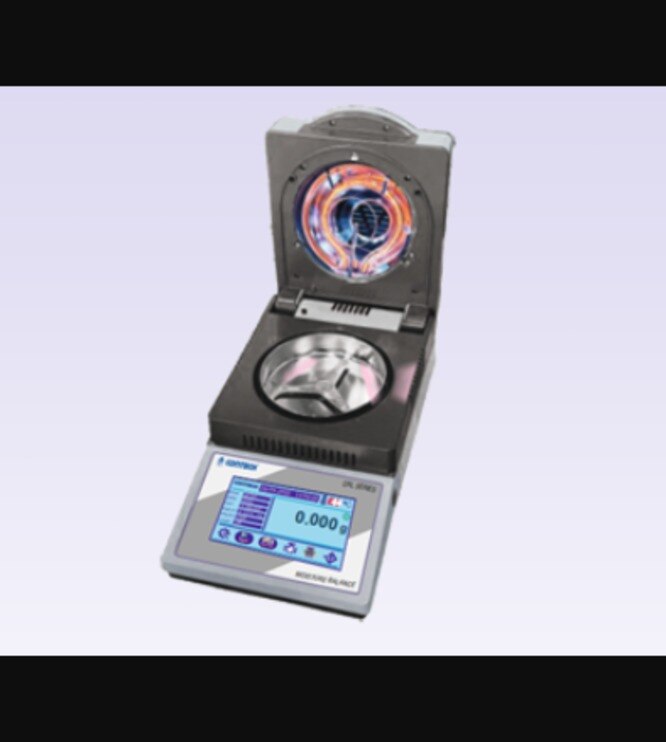
A moisture determination analyzer combines a precision balance, controlled heater and software to measure how much mass a sample loses during drying. By the end, you will know how the method works, when its result represents water, how to validate it, and what to check before choosing equipment for a Chennai laboratory.
Key takeaways
- Use controlled heating and continuous weighing for rapid moisture content determination.
- Record sample mass, temperature, drying time and endpoint settings for every test.
- Use loss on drying when heat removes moisture without decomposing the sample.
- Compare repeatability, temperature range, sample capacity, calibration and service support before buying.
What Does a Moisture Determination Analyzer Measure?
It measures mass lost from a sample during controlled heating, then converts that loss into a reported moisture value. A moisture determination analyzer in Chennai combines a precision balance, heater and software; an ordinary laboratory balance only weighs, while a conventional drying oven heats without continuously weighing.
| Option | What it does | Main limitation |
|---|---|---|
| Ordinary laboratory balance | Records mass before and after drying | Requires separate heating, cooling and calculations |
| Drying oven plus balance | Heats a sample, then relies on repeated weighing | Slow workflow and manual endpoint checks |
| Moisture determination analyzer | Heats while monitoring mass loss continuously | Reports loss on drying, not automatically water |
- Select a representative sample and weigh it into the pan.
- Heat it using the chosen temperature program while the balance tracks evaporated mass.
- Stop at the defined time or stable-mass endpoint, then cool or stabilise the residue before recording final mass.
- Calculate and report the basis used.
Wet-basis moisture (%) = (initial mass − final dry mass) ÷ initial mass × 100. Dry-basis moisture (%) = (initial mass − final dry mass) ÷ final dry mass × 100. With 10.000 g initially and 8.500 g finally, the results are 15.0% wet basis and 17.65% dry basis.
Do not compare those figures as if they use the same denominator.
This moisture measurement is operationally loss on drying. Free or surface moisture, volatile solvents, oils and decomposition products can all reduce mass, so the result is not automatically water content.
How Should You Prepare the Sample and Set the Drying Method?
1. Select a representative portion from several points in the batch, then homogenise it. Grind grains, powders, food, pharmaceuticals, chemicals or plastics only as much as needed; excessive friction generates heat and drives off moisture before weighing.
2. Tare a clean, dry pan and confirm that the reading is stable. Weigh a repeatable mass, spread it as a thin, even layer, and start moisture measurement promptly. Avoid oversized loads, oily or sticky samples, crust-forming materials and splashing sludge: each dries unevenly and can trap wet material beneath a dry surface.
3. Choose a temperature that releases water without changing the material. Excessive heat can scorch, decompose the sample or evaporate oils and solvents, causing moisture analysis to over-report; insufficient heat leaves bound or residual moisture and under-reports moisture content determination. Use a validated heating ramp when a sudden temperature rise causes splashing or crusting.
4. Set a fixed-time program when the material and drying curve are consistent. Use an automatic endpoint only when a defined mass change, such as 1 mg over 60 seconds, reliably indicates completion. Slow diffusion, skin formation or a long falling-rate period makes that endpoint unsuitable; use a longer fixed time or a validated alternative.
5. Powders, grains and many foods suit thin-layer testing. Pharmaceuticals, chemicals, plastics and sludge require matrix-specific validation because solvents, decomposition or difficult diffusion can alter loss on drying.
6. Do not overload the pan, accept an unstable tare, leave the pan exposed, touch the sample after weighing or stop before a stable endpoint. Record the sample mass, temperature, ramp, endpoint and replicate results.
When Is Loss on Drying the Right Method?
Loss on drying is the right method when heating can remove the material you define as moisture without significant loss of solvents, oils or decomposition products. A moisture analyzer provides faster moisture analysis than an oven because it heats while continuously weighing; the result remains an LOD value, not automatically water.
| Option | Speed and sample size | Effort, selectivity and limitations |
|---|---|---|
| Moisture analyzer with infrared or halogen heating | Minutes; small sample | Automated continuous weighing; destructive; rapid settings need validation |
| Hot-air oven plus balance | Multi-hour exposure; larger sample | Preheat, dry, cool in a desiccator, reweigh repeatedly and calculate manually; poor for fast release testing |
| Karl Fischer titration | Fast; small sample | Destructive and more complex, but selectively measures water; solvents require suitable reagent and endpoint control |
| Thermogravimetric analysis | Program-dependent; very small sample | Destructive, highly informative mass-versus-temperature curve, but costly and method-intensive |
Choose Karl Fischer when a specification requires selective water measurement in the presence of solvents or other volatiles. USP General Chapter <921> covers Karl Fischer water determination; USP <731> covers loss on drying. Do not treat them as interchangeable.
For cereals, compare rapid results with ISO 712; for oilseeds, use ISO 665 as the reference. Establish matrix-specific correlation across the operating range before factory use.
Develop the method by fixing:
- Temperature and ramp
- Sample mass and pan loading
- Endpoint and repeat-test count
- Acceptance limits
Run replicates against an approved reference procedure before accepting a program for a new material.
How Do You Make a Moisture Result Defensible in Chennai?
In Chennai’s humid coastal air, exposed hygroscopic samples can change before moisture measurement begins. Keep them in sealed containers, minimise open time, test promptly, condition samples consistently, and record laboratory temperature and relative humidity. Place the balance away from air-conditioning drafts and direct heat.
Verify the balance and heater separately. Use traceable mass checks for weighing, temperature checks for the heater, routine repeatability tests, documented reference materials, and periodic comparison with an established oven method. A correct temperature display does not prove correct moisture determination.
Record every moisture analysis with:
- Sample identification, batch number, sample mass, program temperature, endpoint, final mass, calculation basis, replicates, operator, instrument ID and date.
Clean the pan, heating chamber, temperature sensor and surrounding surfaces after use. Residue can cause carryover, alter heating, obstruct the sensor and create cross-contamination between samples.
Investigate problems in this order:
- Drifting results: check airflow, balance stability, room conditions and sample exposure time.
- High loss: check sample homogeneity, temperature and non-water volatiles.
- Failed endpoints: check pan loading, sample thickness and endpoint settings.
- Poor replicate agreement: remix the sample and repeat with consistent mass and spreading.
- Disagreement with the oven: compare temperature, endpoint, sample preparation and whether either method is measuring solvents or other volatile material rather than water.
What Should You Compare Before Buying an Analyzer in Chennai?
Define the matrix, expected moisture range, reporting basis, sample mass, temperature range, endpoint and repeatability target before comparing a moisture determination analyzer in Chennai. “Moisture accuracy” means little without a named material and validated method.
| Feature | Compare | Why it matters |
|---|---|---|
| Weighing | Readability and repeatability | A 0.001 g specification describes balance readability, not guaranteed moisture-result accuracy. Sample properties, settings and repeatability determine the reported value. |
| Heating | Halogen, infrared or hot-air; range and ramp control | Heating uniformity and ramp speed affect drying, scorching and non-water losses. |
| Capacity | Maximum sample load and pan size | Overloading causes uneven drying, splashing and failed endpoints. |
| Endpoint | Fixed time, manual stop or defined mass-change stability | Slow diffusion, skin formation and falling-rate drying can defeat automatic stability. |
| Workflow | Method storage, display, data export and audit trail | Stored programs and traceable records reduce transcription errors. |
| Support | Calibration access, cleaning, electrical requirements, installation and service response | A correct temperature display alone does not prove correct moisture measurement. |
Ask for a demonstration using your own powders, grains, food, pharmaceutical or chemical matrix. Request balance and temperature calibration documentation, confirm ventilation and power needs, and check replacement pans and consumables. CONTECH INSTRUMENTS LTD. can be evaluated against these practical criteria rather than a headline claim.
Buy when frequent testing makes oven preheating, multi-hour drying, desiccator cooling and repeated weighing costly. Keep the oven for low-frequency work, difficult sample behaviour or a regulated procedure that mandates it; validate any rapid moisture content determination against that reference method.
Related product
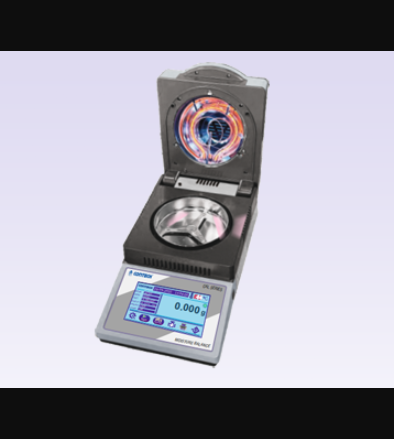 | Moisture Balances Moisture Balances (CAL Series) (0.001 g to 180 g) Moisture Balances (CAL Series) (0.001 g to 180 g) The CONTECH CAL Series Moisture Balances are advanced moisture analyzers designed for fast,... View product → |
Frequently asked questions
What does a moisture determination analyzer measure?
It measures mass lost during controlled heating and reports that loss as a moisture value. The instrument combines a precision balance, heater and software.
How should you prepare a sample and set the drying method?
Homogenise the sample, spread a representative portion evenly across the pan, and record sample mass. Set temperature, drying profile and endpoint using a validated method for the material.
When is loss on drying the right method?
Use loss on drying when heating removes moisture without significant decomposition, evaporation of other volatile substances or chemical change that would distort the result.
How do you make a moisture result defensible in Chennai?
Document the sample identity, batch, mass, temperature, drying time, endpoint, calibration status and operator. Control storage and room conditions, then verify the method with repeat tests.
What should you compare before buying an analyzer in Chennai?
Compare balance readability, heater temperature range, sample capacity, repeatability, endpoint controls, data records, calibration options, maintenance and local technical support.