
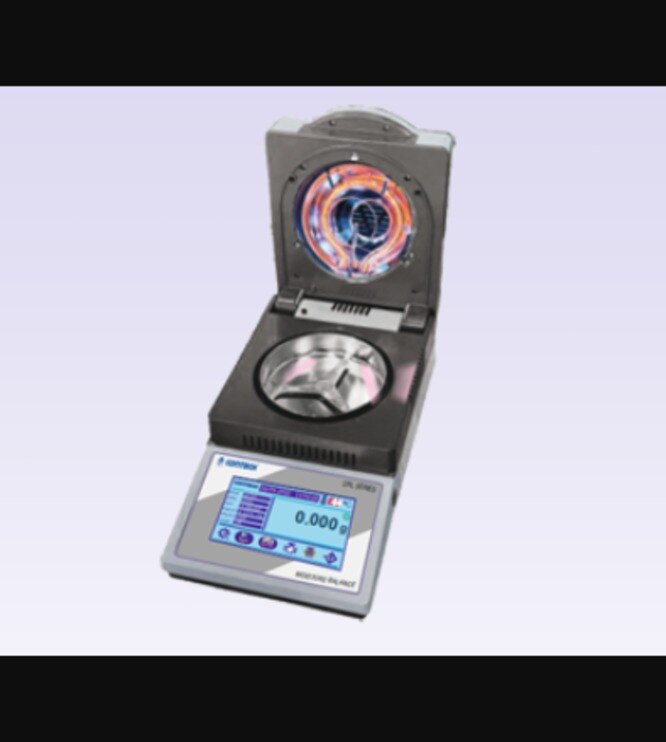
A moisture balance does more than weigh a sample before and after heating: it tracks mass while the sample dries and applies a defined stop condition. By the end, you will know how to prepare the sample, interpret the reported loss, select drying settings, and check whether the result is fit for your material and laboratory method.
Key takeaways
- Spread a representative, finely prepared sample evenly across the pan.
- Set temperature and endpoint conditions from a validated method, not guesswork.
- Calculate moisture from the initial and final sample masses.
- Verify results with repeat tests and a reference method when required.
What happens inside a moisture balance during a test?
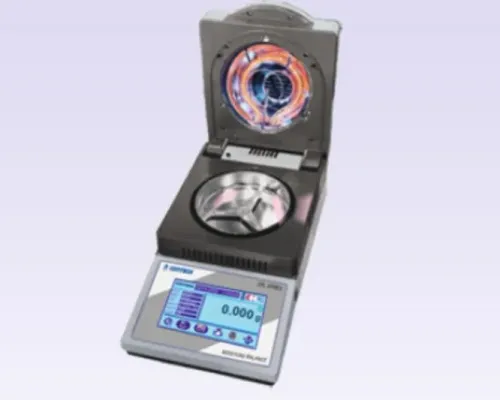
A moisture balance instrument in Hyderabad combines a balance, sample pan, controlled heater, and software. Unlike a simple before-and-after weighing, it tracks mass during heating and applies a defined endpoint. Moisture measurement is the observed mass change; moisture determination is the complete, validated procedure used to convert that change into a reportable result.
- The empty pan is placed on the balance and tared to zero. Any residue, pan weight, or handling error left at this stage shifts the final result.
- You add a representative wet sample and record its starting mass. The software uses this value as the denominator, so sample loss during loading or a poorly mixed portion affects the calculation.
- The heater raises the sample according to the programmed temperature. The balance repeatedly measures mass while vapour leaves the material.
- The test stops at its selected endpoint: a defined mass change over time, a fixed drying period, or a manual stop. The software then records the final mass and calculates the result.
The usual calculation is mass lost during heating divided by starting mass, reported as a percentage. That loss represents water plus any evaporated solvent, oil, fragrance, or decomposition product unless the method has proved selective for water.
A simple before-and-after procedure only compares two weighings; it does not show the drying curve or control when drying is complete. Therefore, a stable displayed result is meaningful only when the sample method and endpoint have been validated for that material.
How should you prepare a sample before heating?
Prepare a representative, homogeneous portion before the pan is heated; uneven sampling can distort the moisture content determination before the instrument starts calculating.
1. Take portions from different parts of the lot or container, then combine enough material for a representative test. Do not test only the surface, where drying or moisture uptake may already have occurred.
2. Mix the combined material thoroughly. Break up clumps so one part of the pan does not contain most of the wet or dry material.
3. Reduce particle size when the matrix permits, using a clean grinder or mortar. Use the same grinding procedure for every test; grinding can release moisture or heat-sensitive volatiles, so avoid prolonged processing.
4. Keep hygroscopic powders, grains, salts, and pharmaceuticals in tightly closed containers until loading. In Hyderabad’s humid conditions, record the time between opening the container and placing the sample on the pan, or control it with a fixed equilibration and transfer time. Rapid transfer limits moisture uptake from room air.
5. Spread the sample as a thin, even layer across the pan. Avoid overloading, thick wet layers, and piled material: a hard surface crust can trap moisture and produce a falsely low result, while spattering or foaming can eject material and create a falsely high apparent loss.
Inspect the layer before starting moisture measurement. If it is uneven, compacted, bubbling, or touching the pan cover, reload it consistently rather than treating a poor preparation as a valid result.
How do temperature and the endpoint determine the result?
Choose the drying temperature by comparing the moisture balance result with an established reference method for that specific material. Higher temperatures shorten the test, but they increase the risk of scorching, oxidation, decomposition, solvent loss, boiling, splashing, and crust formation; lower temperatures protect heat-sensitive samples but can leave bound moisture behind.
The heater setpoint is not the sample temperature. Halogen or infrared heating can create hot surfaces and cooler interiors, especially in dark, oily, thick, or poorly mixed samples. A hard crust can stop surface evaporation while moisture remains underneath, producing a falsely low moisture content determination.
Spattering or foaming can eject solids and report an artificially high loss.
| Stop method | How it decides drying is complete | Main limitation |
|---|---|---|
| Constant mass | Ends when successive mass readings change by less than a defined amount over a defined time | A false plateau can form when a dry surface blocks diffusion |
| Timed drying | Ends after a fixed temperature and duration | The chosen time may be too short for a wet batch or waste time on a dry one |
| Manual stopping | An operator stops the run after reviewing mass and curve behaviour | Results vary between operators unless the decision rule is written |
Validate the endpoint for each matrix; a stable display alone is not proof of complete drying. Compare drying curves and replicate tests against the reference method, then document temperature, ramp rate, sample mass, layer thickness, and stop rule.
Remember that most moisture determination methods measure loss on drying, so solvents, oils, fragrances, and decomposition products can appear as moisture unless selectivity for water has been demonstrated.
How do you calculate and verify a moisture result?
Use the same basis as the specification. For wet-basis moisture content determination, subtract the final dry mass from the initial mass, divide by the initial mass, and multiply by 100.
| Basis | Formula | Meaning |
|---|---|---|
| Wet basis | (Initial mass − final dry mass) ÷ initial mass × 100 | Moisture as a percentage of the original sample mass |
| Dry basis | (Initial mass − final dry mass) ÷ final dry mass × 100 | Moisture as a percentage of the dried solids mass |
These values are not interchangeable. The difference becomes substantial for wet materials, so label every report as wet basis or dry basis rather than copying the displayed percentage.
Run a blank when the method requires correction for pan, heater, or background mass effects. Test replicate portions from the same prepared sample, inspect their drying curves, and compare the result with an established oven reference method.
A stable curve can still be false: a dry surface can block diffusion, while another material continues losing mass after the default endpoint.
Document the method’s:
- Repeatability and bias against the oven result
- Endpoint setting, drying temperature, and ramp
- Sample preparation, mass, and layer thickness
- Balance calibration status
- Independent heater-temperature verification
Readability is not moisture-result accuracy. A balance that displays 0.001 g changes cannot correct for sample heterogeneity, evaporation during loading, uneven heating, or a reference method that measures different volatile substances. Calibration checks mass; temperature verification checks heating. Neither replaces the other.
When is a moisture balance suitable for your Hyderabad laboratory?
Use a moisture balance for moisture determination only after confirming that the specification accepts loss on drying. A stable plateau can still be false: a dry surface may block diffusion, or slow mass loss may continue after the default endpoint.
Compare the method with an oven loss-on-drying result; choose Karl Fischer titration when the specification concerns water specifically and solvents, oils, fragrances, or decomposition products could bias the gravimetric result.
Evaluate a moisture balance instrument in Hyderabad with this checklist:
- Control the time between opening, mixing, sampling, and pan loading; hygroscopic materials can change before heating begins.
- Run replicates and record repeatability within one session.
- Test reproducibility across analysts, days, and relevant sample lots.
- Quantify bias against the laboratory’s established oven or product-specific reference method.
- Verify heater temperature independently with a temperature verification kit; a heater check does not replace balance calibration.
- Confirm the balance calibration status, including the calibration date and acceptance results for check weights.
- Document the material-specific procedure: sample mass, grinding, layer thickness, temperature, ramp, endpoint, and handling time.
CONTECH INSTRUMENTS LTD. can help compare instrument capacity and method setup, but selection should follow these validation results rather than nominal readability.
Choose Karl Fischer when water alone is reported. Keep the moisture balance when its loss-on-drying result matches the specification and reference method for that matrix.
Related product
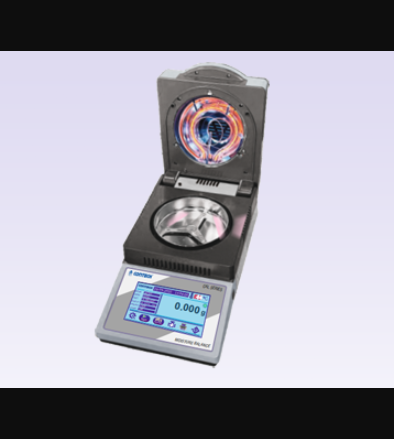 | Moisture Balances Moisture Balances (CAL Series) (0.001 g to 180 g) Moisture Balances (CAL Series) (0.001 g to 180 g) The CONTECH CAL Series Moisture Balances are advanced moisture analyzers designed for fast,... View product → |
Frequently asked questions
What happens inside a moisture balance during a test?
The instrument weighs the sample, heats it under controlled conditions, and tracks mass loss until the selected endpoint is reached.
How should you prepare a sample before heating?
Take a representative portion, reduce large pieces consistently, and spread the sample in a thin, even layer across the pan.
How do temperature and the endpoint determine the result?
Temperature controls drying intensity, while the endpoint defines when the instrument stops. Both settings affect measured moisture and must match the validated method.
How do you calculate and verify a moisture result?
Calculate moisture from the initial and final masses, then check repeatability and compare results with a reference method when necessary.
When is a moisture balance suitable for a Hyderabad laboratory?
It suits routine moisture content determination when the sample tolerates controlled heating and the laboratory has a validated method for its matrix.