
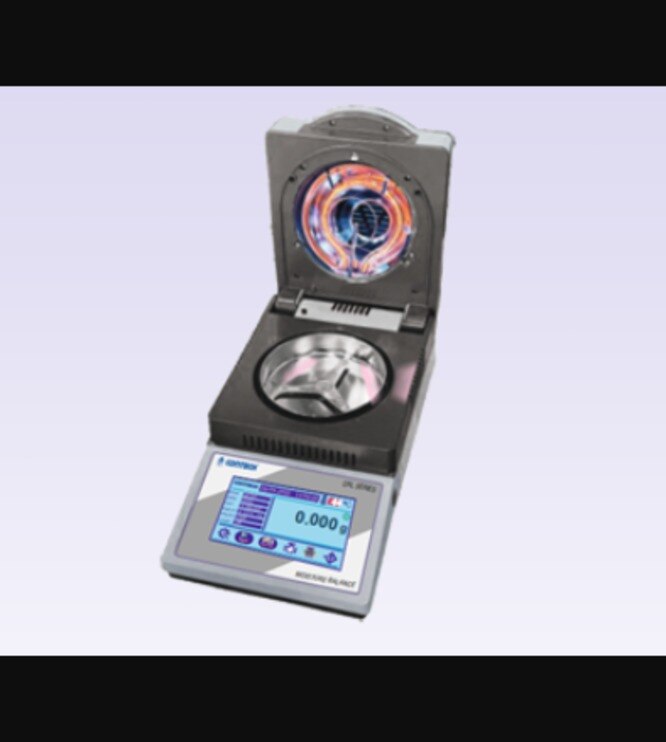
Pharmaceutical teams in Mumbai need moisture results quickly, but humid air, open-container exposure and heat-sensitive formulations can make a fast reading misleading. By the end, you will be able to match a moisture method to the material, run a defensible LOD test and judge whether an analyzer will improve testing without replacing validation.
Key takeaways
- Control moisture to protect stability, flow, compression, and assay results.
- Record sample mass, temperature, endpoint, and method for every loss-on-drying test.
- Match drying temperature and endpoint criteria to the pharmaceutical material.
- Check accuracy, repeatability, calibration, and data records before choosing an analyzer.
Why moisture control matters in a Mumbai pharmaceutical laboratory
Moisture control protects pharmaceutical quality from both chemical and physical failure. Excess or variable moisture can accelerate degradation, support microbial growth, alter powder flow and tablet compressibility, change capsule or tablet performance, and shift assay results against the product specification.
- Hygroscopic APIs and excipients absorb water after container opening, changing the sample before you weigh it.
- Granules with inconsistent moisture can produce uneven compression, sticking, capping, or poor disintegration.
- Excess water can reduce stability and create conditions that support microbial growth.
- A moisture result that is biased low or high can lead to an incorrect release or process decision.
Mumbai’s coastal humidity and monsoon air make exposure time a measurement variable. An analyst who opens a container, walks the sample to the balance, and delays weighing can obtain a different result from the same material tested immediately.
Air conditioning adds another risk: rapid movement between humid room air and a dry, cool laboratory can change surface moisture quickly.
The practical moisture analyzer benefits in Mumbai include shorter open-container time and faster operator feedback, but speed does not replace handling controls. Keep containers capped, transfer samples quickly, record exposure limits, and control receipt and weighing conditions.
A moisture analyzer measures heated mass loss, not automatically water. Solvents, residual reagents, or decomposition products can also evaporate, so report “moisture” only after the method demonstrates that other losses are negligible. Verify the balance and heating temperature separately.
How to run a defensible loss-on-drying test
A defensible loss-on-drying result starts with representative sample preparation, not the instrument. Mix or reduce the sample as the validated method specifies, control particle size when milling is permitted, and minimise exposure between opening the container and weighing. Record the sample identity, batch, date, condition, and analyst.
| Variable | Defensible choice | What goes wrong with a shortcut |
|---|---|---|
| Preparation | Use a representative, homogenised portion | Surface sampling can miss moisture gradients |
| Loading | Tare the pan; use the validated mass and spread an even, thin layer | A thick or uneven bed dries at different rates |
| Heating | Use the validated temperature and heating profile | Excess heat can decompose material or remove non-water volatiles |
| Endpoint | Use successive mass readings against a documented stability limit and interval | Fixed time can bias results when particle size or matrix changes |
| Records | Capture initial mass, final mass, temperature, endpoint, program, instrument ID, and calculation | An unexplained result cannot support comparison or release |
Establish these variables during validation against the applicable compendial loss-on-drying procedure. Compare the moisture analyzer with the laboratory’s reference oven using representative batches, not only water or one standard material.
Verify the heating temperature and balance separately. Use traceable mass checks, temperature verification, routine performance checks, and preventive-maintenance records; repeatability alone will not reveal a constant temperature or weighing bias.
Describe the result as moisture only after demonstrating that solvents, reagents, decomposition products, and other volatile losses are negligible. Otherwise report it accurately as percentage mass loss.
Choosing temperature and method for each pharmaceutical material
A heated moisture analyzer suits a material when validated heating removes water without melting, decomposing, reacting, or driving off other volatile substances. It measures mass loss, not water exclusively, so compare the method with the applicable compendial procedure before calling the result moisture.
| Material | Heated moisture analyzer | Karl Fischer preference |
|---|---|---|
| Tablets | Suitable for routine checks when the tablet remains stable and the validated result matches LOD | Use when excipients or coatings release non-water volatiles |
| Powders and granules | Suitable for in-process and release-support testing after validated mixing, spreading, and temperature selection | Use when the powder is heat-sensitive or contains volatile solvents |
| APIs | Suitable when thermal stability and water-specific correlation are demonstrated | Preferable for low water levels, decomposition risk, or a water-specific result |
| Excipients | Suitable when mass loss represents water and the material does not melt or react | Preferable when bound water, solvents, or heat-labile components confuse LOD |
| Creams | Suitable only after confirming uniform heating and no spattering or volatile loss | Preferable for emulsions or heat-sensitive formulations |
| Hygroscopic materials | Suitable with capped containers, rapid transfer, and a documented exposure limit | Preferable when ambient exposure changes the result before heating |
Choose the lowest temperature that gives complete, repeatable drying without melting or decomposition. A fast moisture balance analyzer reduces open-container time in Mumbai’s humid conditions, but it does not replace controlled handling.
Use Karl Fischer when the specification means water specifically, especially for thermolabile, solvent-containing, or very low-moisture samples. Record the basis, temperature program, endpoint, sample mass, method identifier, and replicate policy.
What a moisture analyzer measures compared with other methods
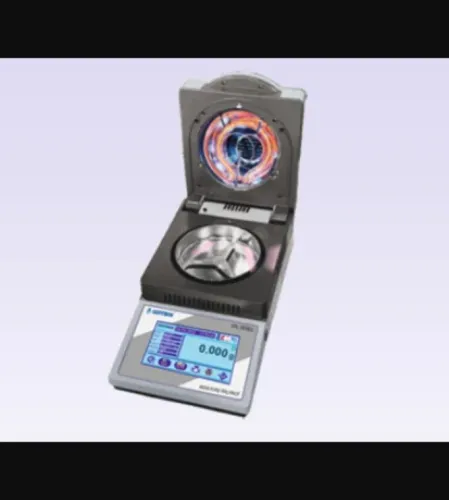
A heated digital moisture tester reports mass lost during a programmed heating cycle, not necessarily water alone. A moisture balance analyzer combines heating and weighing in one instrument, so it can deliver a loss-on-drying result faster than an oven, but only after correlation with the applicable compendial method.
| Method | What it measures | Practical difference |
|---|---|---|
| Oven LOD | Mass lost after oven drying, usually by separate weighing | Reference-style procedure with longer turnaround; volatile non-water substances also contribute to loss |
| Karl Fischer titration | Water through a chemical reaction | Selective for water, including low levels; preferred for thermally unstable or volatile samples |
| Thermogravimetric analysis | Continuous mass change as temperature or atmosphere changes | Shows multiple transitions and decomposition, not simply a routine moisture percentage |
| Balance-plus-oven setup | Mass before and after oven drying using separate equipment | Requires transfers, cooling, desiccation and manual calculations, creating more handling and timing variation |
| Moisture analyzer | Mass loss measured continuously while a built-in heater dries the sample | Rapid in-process or release-support testing when a validated LOD method fits the material |
Do not substitute a moisture analyzer result for Karl Fischer data without sample-specific equivalence evidence. Heating arrangement, radiation absorption, airflow and endpoint logic can change the result.
Report wet-basis or dry-basis moisture, method identifier, temperature program, endpoint, sample mass and replicate policy. Compare representative batches, not only water standards, and keep balance calibration separate from heater-temperature verification.
Specifications and qualification checks before you choose an instrument
Choose an instrument only after separating its specifications from its evidence. For a team assessing moisture analyzer benefits in Mumbai, prioritise stable heating, traceable weighing and records that survive an audit—not a low display resolution alone.
| Specification | Performance check | Record to review |
|---|---|---|
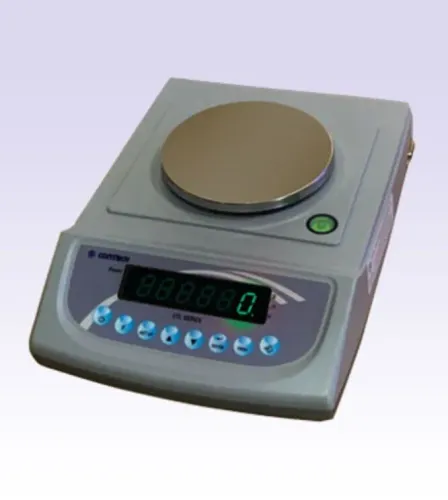
| Balance | Readability, capacity, repeatability, eccentricity and linearity using traceable weights | Calibration certificate, results and acceptance limits |
| Heating system | Temperature accuracy, stability and uniformity across the pan at the intended method temperature | Temperature-verification report and corrective actions |
| Method and data | Programmable endpoint, wet- or dry-basis reporting, method lock, export or printout, and user access control | Approved method, audit trail and raw-result file |
Treat balance calibration and temperature verification as separate controls. A stable repeatability result cannot reveal a heater running 5°C high or a drifting balance. Request IQ, OQ and PQ records, then confirm routine performance checks, preventive-maintenance history and instrument software version.
For a moisture balance analyzer, require correlation against the applicable pharmacopoeial loss-on-drying procedure before using it for release support. The study should include representative powders, granules or finished products, replicate results, acceptance criteria and investigation rules.
Ask whether the method distinguishes water from solvent or decomposition loss, and record sample mass, spreading practice, temperature program, endpoint, basis and replicate policy. In Mumbai, include exposure controls for monsoon humidity and rapid air-conditioned-room changes.
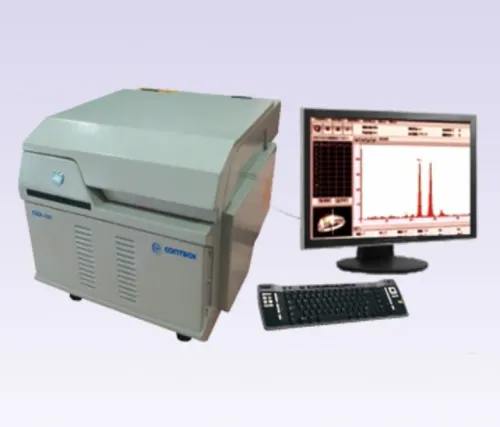
If comparing a CAL-series instrument, CONTECH INSTRUMENTS LTD. should be asked for method-data and qualification support rather than product claims alone.
Related product
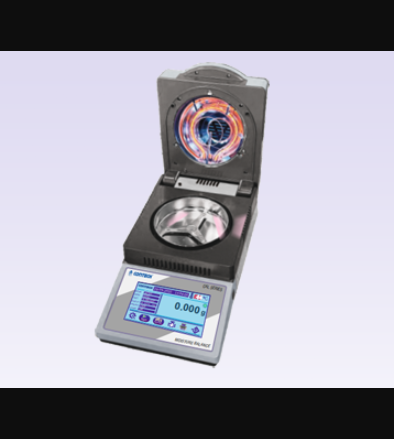 | Moisture Balances Moisture Balances (CAL Series) (0.001 g to 180 g) Moisture Balances (CAL Series) (0.001 g to 180 g) The CONTECH CAL Series Moisture Balances are advanced moisture analyzers designed for fast,... View product → |
Frequently asked questions
Why does moisture control matter in a Mumbai pharmaceutical laboratory?
Excess or variable moisture can accelerate degradation, support microbial growth, alter powder flow and tablet compressibility, affect dosage-form performance, and shift assay results. Mumbai’s humid conditions also make sample exposure time and container closure important control points.
How do you run a defensible loss-on-drying test?
Define the sample size, drying temperature, endpoint, weighing procedure, and acceptance limit before testing. Record the sample identity, batch number, initial and final masses, drying time, instrument identification, temperature, and operator, then verify the method with repeatability checks.
How do you choose a drying temperature for pharmaceutical materials?
Use the temperature specified in the applicable pharmacopoeial monograph or validated internal method. If no fixed method exists, assess the material’s thermal stability and volatile components before setting the temperature and endpoint.
What should you check before choosing a moisture analyzer?
Check weighing capacity, readability, heating range, temperature uniformity, endpoint control, repeatability, calibration options, audit trails, export formats, and qualification support. Confirm that the instrument’s performance suits your sample size and approved test method.