
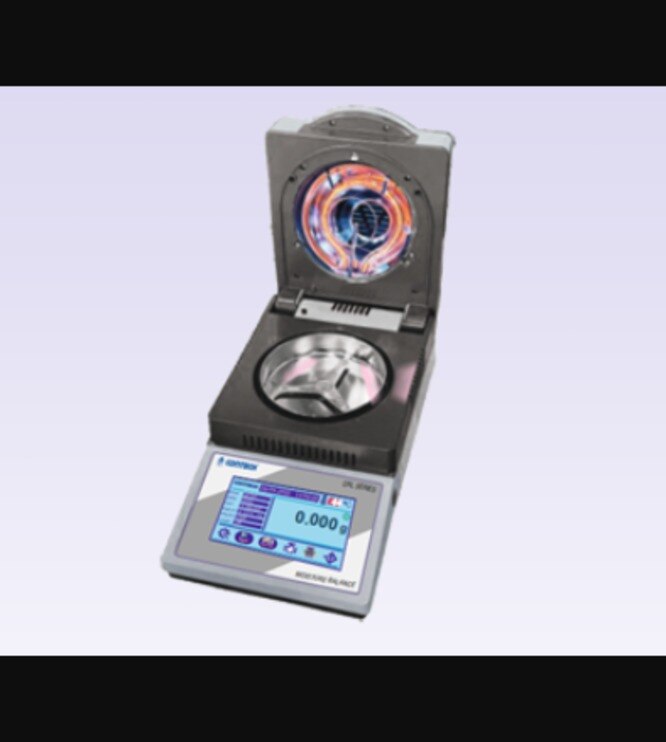
A heated moisture balance can produce a result in minutes, but its reading is only as trustworthy as the sample preparation, temperature programme, endpoint, and reporting basis behind it. You will be able to choose between loss-on-drying, oven, Karl Fischer, and infrared methods, then specify and validate equipment for your laboratory’s actual materials and Mumbai operating conditions.
Key takeaways
- A heated balance measures mass loss, not water alone.
- Dry samples evenly and record temperature, time, and endpoint settings.
- A 0.001 g, 180 g capacity suits many small laboratory samples.
- Use Karl Fischer titration when other volatile solids affect mass loss.
What does a heated moisture balance actually measure?
A heated moisture analyzer balance measures mass lost during heating, not water alone. In the moisture analysis method, you weigh the empty pan, add the sample, record its initial mass, heat it, and monitor mass continuously.
The instrument calculates loss on drying as initial sample mass minus final mass, divided by initial sample mass, multiplied by 100. The result describes mass loss under that specific temperature, ramp, and endpoint programme.
The measured loss can include:
- Water
- Residual solvents
- Unreacted reagents
- Plasticizers
- Volatile decomposition products
A higher temperature or longer drying period can remove more than water. Thermal decomposition creates an artificially high result, while surface crusting or poor spreading can trap water or solvent and produce a low result.
Reaching constant mass at 105 °C does not make the result equivalent to drying at 130 °C or using a stepped programme.
Use Karl Fischer when your specification requires water-specific measurement, particularly at low water levels or when other volatile substances are present. Coulometric Karl Fischer suits small water quantities; volumetric Karl Fischer suits higher water contents. Neither result is automatically interchangeable with loss on drying.
The balance display resolution also does not prove moisture-result accuracy: repeatability, temperature uniformity, endpoint stability, and comparison with an independent reference method must be demonstrated.
How should you prepare the sample and set the drying programme?
Use a validated sample mass and a thin, uniform layer; otherwise, the balance may report drying behaviour rather than the material’s true moisture content.
1. Mix the batch before sampling. Take enough powder, food, paste, liquid, or granules to represent its variation, but keep the validated mass constant. A tiny portion dries quickly but magnifies sampling and tare errors; a large portion improves representation yet can form a crust and prolong drying.
2. Standardise particle size. Grind powders, food, or pharmaceutical granules only when the reference method permits it, then mix thoroughly. Coarse particles dry slowly inside; excessive grinding exposes bound water and can change the result.
3. Tare the clean pan, add the sample, and spread it evenly across the base. Avoid piles, overlapping granules, and uncovered areas. Stir viscous pastes gently and distribute liquids as a thin film; splashing or skin formation causes handling loss and uneven heating.
4. Select temperature from the validated method, not simply the fastest setting. A programme at 105 °C is not equivalent to 130 °C: the higher temperature can remove volatile ingredients or decompose food and pharmaceutical materials. Use a lower temperature for heat-sensitive samples.
5. Control the ramp rate. A rapid ramp can boil liquids, spatter pastes, or form a dry surface that traps moisture; a slower ramp gives heat-sensitive materials a controlled release. Use stepped heating when the sample requires it.
6. Select an endpoint such as constant mass or a defined mass-change rate, then verify it with replicate portions against the laboratory reference method. Record the mass, particle preparation, temperature profile, ramp, and endpoint for every method.
Does a 0.001 g, 180 g instrument fit your laboratory method?
A 0.001 g readability and 180 g capacity fit only if your method’s sample mass, drying loss, and uncertainty justify them. The displayed increment is not moisture-result accuracy: evaporation, temperature uniformity, endpoint behaviour, and sample homogeneity can outweigh the last displayed digit.
Check usable weighing range, not just maximum capacity. A 2 g sample that loses 0.1 g gives a 5% moisture result; a 0.01 g mass error then has a much larger effect than the same error in a 50 g sample.
Record the complete drying time and repeatability for your matrix, including replicate results against the laboratory’s reference method.
A moisture analyzer balance combines weighing, heating, and continuous mass recording, reducing transfers and hands-on time. An analytical balance plus separate drying oven offers greater control over batch size, temperature exposure, and parallel samples, but requires pan handling, cooling in a desiccator, and separate weighing; those steps add transfer and endpoint errors.
Ask the supplier for:
- Usable weighing range, readability, recommended sample mass, pan diameter, and maximum sample depth
- Heating range, ramp and programme options, temperature uniformity, and typical drying time
- Repeatability, endpoint algorithms, calibration facilities, stored methods, and export formats
- Operating temperature and humidity limits, plus evidence of agreement with your reference procedure
For moisture analyzers or moisture balances in Mumbai, ask CONTECH INSTRUMENTS LTD. to document those method-specific figures rather than selecting a moisture analyzer balance from capacity alone.
Related product
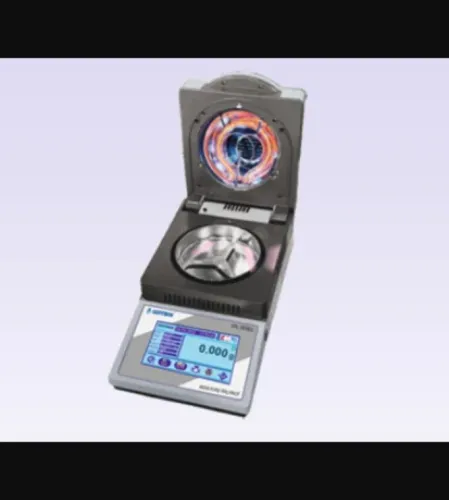
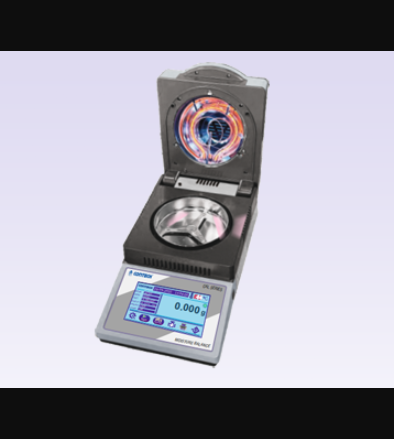 | Moisture Balances Moisture Balances (CAL Series) (0.001 g to 180 g) Moisture Balances (CAL Series) (0.001 g to 180 g) The CONTECH CAL Series Moisture Balances are advanced moisture analyzers designed for fast,... View product → |
How do you validate and operate the instrument in Mumbai conditions?
Install the analyzer on a rigid, level bench away from direct sunlight, doors, pumps, and traffic. Keep air-conditioning flow off the weighing pan; drafts, vibration, and rapid temperature changes disturb readings. Record Mumbai laboratory temperature and relative humidity, confirm the manufacturer’s limits, and complete the specified warm-up before site acceptance.
Use this operating and quality-control sequence:
- Verify the weighing function with two traceable test weights covering the working range; record identification, certificate traceability, readings, and acceptance limits.
- Verify heater temperature with a calibrated temperature device or approved temperature-verification procedure. A correct display does not prove correct heating.
- Run replicate portions of a representative powder, paste, liquid, granule, or food sample at the intended mass and programme. Assess repeatability, bias, endpoint consistency, and pan-to-pan variation.
- Compare the mean result with the laboratory’s oven or other reference method. Test the real material, not only a supplier’s salt standard.
- Study temperature and time for decomposition, volatile loss, crust formation, and incomplete drying. Decomposition gives an artificially high moisture loss; crusting can trap water and give a low result.
- For hygroscopic samples, condition pans and samples where appropriate, open containers briefly, transfer promptly, and use sealed or controlled-humidity handling when required.
- Save the method, sample identity, operator, balance checks, temperature verification, raw mass data, endpoint, replicate results, deviations, environmental readings, and approval in an electronic record.
Repeat the checks after relocation, service, failed control results, or a major programme change. Treat displayed resolution as a setting, not proof of moisture determination accuracy.
When is loss on drying the wrong moisture determination method?
Loss on drying is the wrong moisture determination method when a sample releases solvents, plasticizers, residual reagents, or decomposition products alongside water. The result then reports total mass loss, not water content.
| Option | What it measures | Choose it when |
|---|---|---|
| Loss on drying | Mass lost during heating | Only water evaporates before decomposition, and the method matches a validated temperature and endpoint |
| Karl Fischer | Water specifically | The specification is water-specific, moisture is low, or other volatile compounds are present; use coulometric KF for small quantities and volumetric KF for higher water content |
| Infrared measurement | Rapid surface or spectroscopic moisture estimate | You need screening or fast process control and have a matrix-specific calibration; confirm it against a reference |
| Oven reference method | Mass change after a defined drying procedure | A named matrix method controls release, such as AOAC 925.10 for flour or ASTM D2216 for soil and rock |
ASTM E1868 defines loss-on-drying by thermogravimetry, but it does not make every heated balance equivalent. Decomposition can create a falsely high result; crusting can trap water and produce a low one.
Before buying moisture analyzers or moisture balances in Mumbai, ask:
- Which standard, temperature, ramp, sample mass, pan, and endpoint does the instrument reproduce?
- What evidence compares its result with Karl Fischer or the applicable oven method?
- What are the heating range, repeatability, temperature uniformity, method-storage and export formats?
- Does the sample decompose, boil violently, or contain volatile non-water compounds?
A displayed 0.01% resolution is not accuracy. Transfer the full method and acceptance limit, not just the sample name.
Frequently asked questions
What does a heated moisture balance actually measure?
It measures the mass lost from a sample during heating. That loss can include water, solvents, and other volatile substances, so it is not automatically moisture alone.
How should you prepare a sample for moisture analysis?
Mix the sample, spread a representative portion in a thin even layer, record its initial mass, and select a drying programme suited to its composition.
Is a 0.001 g, 180 g moisture analyzer suitable for laboratory work?
It suits methods using samples within the 180 g capacity and requiring 0.001 g readability. Confirm the required sample size, repeatability, temperature range, and endpoint before choosing it.
How do you validate a moisture analyzer in Mumbai conditions?
Check repeatability with a reference material, verify the balance using traceable weights, confirm temperature performance, and control drafts, humidity, sample handling, and air-conditioning effects.
When is loss on drying the wrong moisture determination method?
Use another method when the sample contains volatile substances besides water, decomposes at the drying temperature, binds water strongly, or requires water-specific measurement. Karl Fischer titration is a common alternative.