
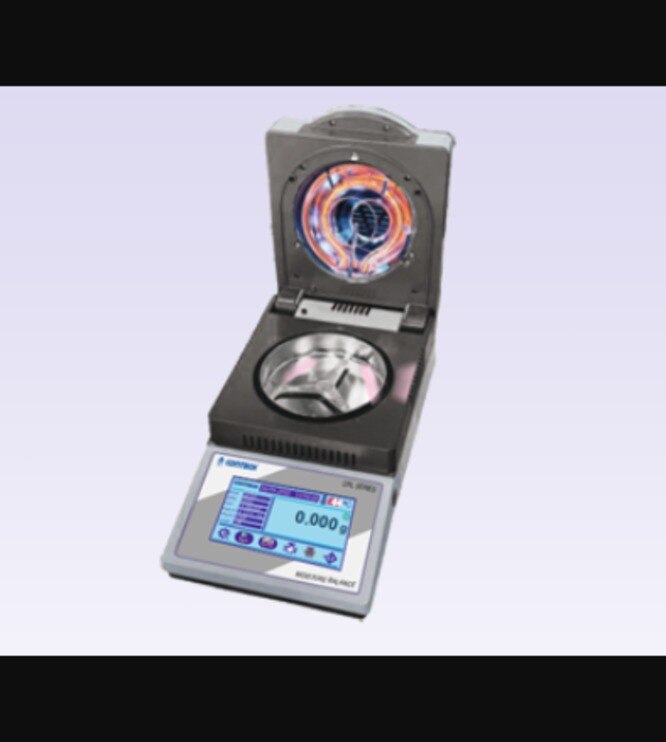
A moisture test is not just a heated weighing cycle: the sample, pan, temperature program, endpoint and handling time all affect the reported mass loss. By the end, you will be able to follow the test from sampling through result approval, calculate the result correctly and recognise when the method needs validation or replacement.
Key takeaways
- Sample multiple locations before combining or testing the portion.
- Use mass loss and dry mass to calculate moisture content.
- Set temperature and endpoint for the material, not by habit.
- Repeat and document results with sample, method and instrument details.
How a moisture analysis method in Mumbai runs from sample to result
A complete moisture analysis method in Mumbai begins with a representative portion, not the first convenient scoop. Take increments from multiple locations in a hopper, bag, vessel, or conveyor according to the sampling plan, combine or test them as specified, and place the portion in a sealed, labelled container.
Record the time from sampling to testing because humid air can make hygroscopic powders gain moisture while wet materials lose it.
- Mix the laboratory sample without altering its moisture, then reduce it to the test portion. Break lumps or mill particles only when the approved method requires it.
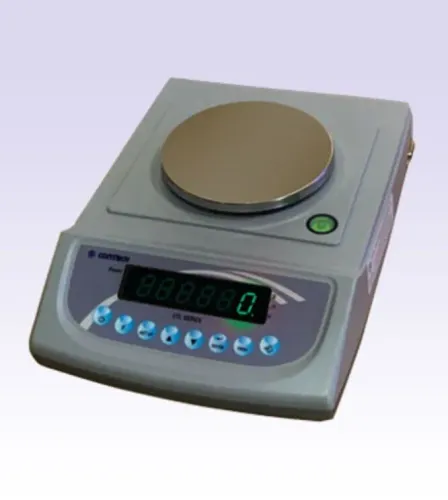
- Inspect and clean the pan, place it on the moisture analyzer balance, close the chamber, and tare it. Do not touch the pan with bare fingers.
- Spread the specified mass evenly in a thin layer. Close the chamber quickly; an open pan allows evaporation or moisture uptake before heating begins.
- Select the validated temperature ramp, drying temperature, and endpoint or fixed drying time for that material. Start the program.
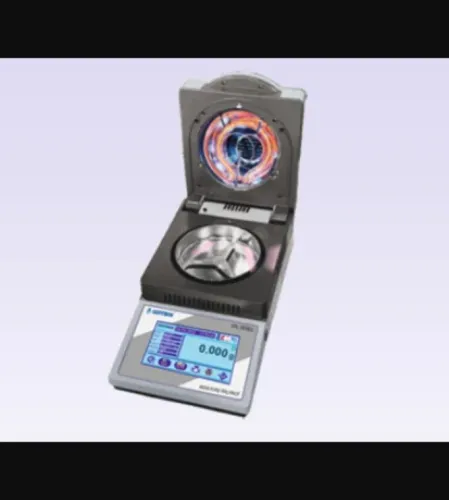
- The heater removes volatile mass while the balance sensor tracks the changing sample mass. The instrument stops at the endpoint or programmed time and displays the calculated moisture.
- Remove or cool the pan only as the procedure states, then record sample identity, test portion mass, temperature program, endpoint, replicate number, result basis, and unusual behaviour such as foaming or crusting.
The calculation is moisture (%) = [(initial mass − final dry mass) ÷ initial mass] × 100. Run the required replicates and compare them with the accepted reference method before treating the result as routine.
How the analyzer converts mass loss into moisture content
A moisture determination analyzer starts with the sample’s initial mass, measured by its precision balance sensor. The sensor tracks mass continuously while the heater supplies controlled energy to remove volatile material from the sample.
The drying program controls how that energy is applied. It may hold a set temperature for a defined time or continue until the measured mass becomes stable. The endpoint tells the instrument when to stop; without a suitable endpoint, early termination leaves residual moisture, while excessive heating can remove non-water volatiles or decompose the sample.
The instrument calculates mass loss as initial sample mass minus final dry mass. Its basic equation is:
Moisture (%) = [(initial mass − final dry mass) ÷ initial mass] × 100
If a 5.000 g portion finishes at 4.250 g, the lost mass is 0.750 g and the reported moisture is 15.0%. The percentage describes the fraction of the starting sample that disappeared during the programmed heating cycle.
That result is a thermogravimetric moisture content determination, not proof that the lost mass was water. Residual solvent and other volatile components also contribute to loss on drying. A moisture content determination therefore needs the sample identity, test portion mass, temperature program, endpoint or drying time, result basis, and replicate results.
High balance resolution does not make the method valid by itself. Establish the complete procedure against an accepted reference method, because heating profile, sample distribution, and matrix behaviour can change the result.
How to set sample preparation, temperature and endpoint for each material
Do not copy a 105°C, 10-minute programme across products. Establish sample mass, particle size, layer thickness, heating profile and endpoint for each matrix, then compare the result with an accepted reference method. In Mumbai, seal samples quickly: hygroscopic powders gain moisture, while wet samples lose it during transfer.
| Material | Sample preparation | Temperature, time and endpoint |
|---|---|---|
| Powders | Use a representative portion large enough for a stable mass signal; sieve or gently triturate, then spread a thin, even layer. | Start below the temperature that causes melting or decomposition. Use constant mass or a validated rate-of-change endpoint; crusting means the method needs investigation. |
| Granules | Test several granules or crush them only if crushing does not release moisture or heat the sample. Distribute without piling. | Use a staged ramp if the surface dries before the centre. Extend time until the endpoint is repeatable. |
| Food | Homogenise quickly, record whether the sample contains oil, sugar or volatile flavour compounds, and avoid a thick layer. | Select a temperature that avoids browning or boiling. Use constant mass or a fixed validated time, not the first stable-looking display. |
| Chemicals | Check the specification for hydrates, solvents and decomposition. Use the smallest representative portion that gives a stable result. | Lower the temperature for volatile or reactive materials and define endpoint by time or mass-loss rate. |
| Soil | Mix the increments, remove foreign matter, and sieve to the method’s size fraction. | Use an even layer and a validated constant-mass endpoint; bound water can make the result unsuitable as “moisture.” |
| Pharmaceuticals | Protect from humidity, reduce particle size without altering the product, and document excipients. | Use a validated low-temperature programme and endpoint tied to the reference method. |
Record sample mass, temperature profile, drying time, endpoint and unusual behaviour for every moisture analyzer balance result. This is the moisture analyzer balance for scale process in Mumbai—not a universal preset.
When Loss on Drying gives the wrong answer
Use Loss on Drying (LOD) only when the method defines mass lost during heating as the result. A moisture analyzer balance using infrared or halogen heat performs thermogravimetric moisture content determination: water, residual solvent and other volatile components all reduce the displayed mass.
Choose the method that matches the failure risk:
- Use infrared or halogen drying for rapid routine moisture determination analyzer testing when the sample is thermally stable and the program has been validated against the reference method.
- Use oven drying when a hot-air oven method is the specified reference. Do not copy its nominal temperature into a halogen analyzer; heat transfer and sample temperature can differ.
- Use Karl Fischer titration when the specification concerns water specifically, especially with volatile non-aqueous components or thermally unstable solids.
- Use LOD only when decomposition, oxidation, boiling, foaming and staged solvent release do not contribute to mass loss under the chosen conditions.
Surface moisture can disappear quickly while moisture inside particles remains, producing a low result if the sample is poorly ground or the endpoint stops early. Chemically bound water may not leave at the drying temperature; raising the temperature can cause decomposition before release, so validate Karl Fischer sample preparation or another method.
Treat flammable solvents and combustible vapours as a safety decision, not an ordinary moisture test. Check the analyzer’s temperature limits, ventilation and containment; a moisture analyzer is not automatically intrinsically safe.
How Mumbai laboratories verify, repeat and document the result
A displayed 0.001 g readability is adequate only when its contribution to uncertainty is small for the test portion. At 1.000 g, one display increment equals 0.1%; at 10.000 g, it equals 0.01%. Compare that effect with the method’s repeatability and reporting limit, not with the number of decimals alone.
Use the approved sampling plan: take increments from multiple locations or time points, combine them when specified, and seal the labelled portion immediately. In Mumbai humidity, hygroscopic powders gain water during transfer and wet samples lose it before the pan closes. Record sampling-to-test delay, container condition, and any unusual exposure.
Run duplicates under the same program and compare the difference with the method’s predefined repeatability limit.
- If duplicates pass, report the replicate result or approved mean, with the result basis.
- If they fail, do not average them to hide the failure. Check sample homogeneity, spreading, pan cleanliness, temperature, endpoint, and delay; prepare fresh portions and repeat.
- If the repeat still fails, place the result on hold, investigate the method or instrument, and obtain technical approval before release.
For a moisture analyzer balance for scale process in Mumbai, verify balance indication with traceable weights, weighing repeatability, temperature indication or heating performance, pan condition, and the complete drying procedure against an accepted reference method. CONTECH INSTRUMENTS LTD. can be considered only after those checks fit your material-specific procedure.
Record sample identity, portion mass, program, endpoint or time, replicates, results, operator, instrument ID, and deviations in the worksheet, batch record, and release decision. State the impact assessment and approval for every deviation.
Related product
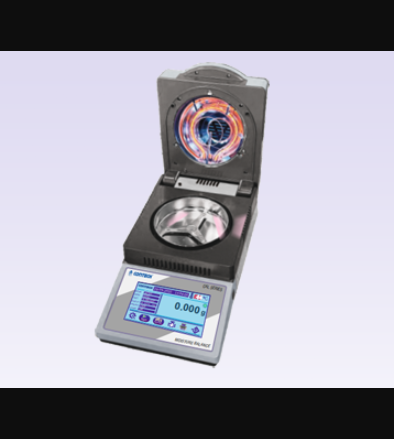 | Moisture Balances Moisture Balances (CAL Series) (0.001 g to 180 g) Moisture Balances (CAL Series) (0.001 g to 180 g) The CONTECH CAL Series Moisture Balances are advanced moisture analyzers designed for fast,... View product → |
Frequently asked questions
How does a moisture analysis method in Mumbai run from sample to result?
Collect increments from multiple locations, combine or test them according to the sampling plan, and store the portion in a sealed, labelled container before analysis.
How does a moisture analyzer convert mass loss into moisture content?
It heats the sample, measures the mass lost during drying, and expresses that loss relative to the starting sample mass as moisture content.
How should you set sample preparation, temperature and endpoint?
Choose the sample portion, drying temperature and endpoint for the material's composition, particle size and drying behaviour rather than using one fixed programme.
When does Loss on Drying give the wrong answer?
Loss on Drying is unsuitable when heating removes volatile substances other than water, causes decomposition, or leaves bound water that the method does not release.
How do Mumbai laboratories verify, repeat and document moisture results?
Verify the method with repeat measurements, investigate inconsistent results, and record the sample identity, preparation, programme settings, endpoint and final result.