
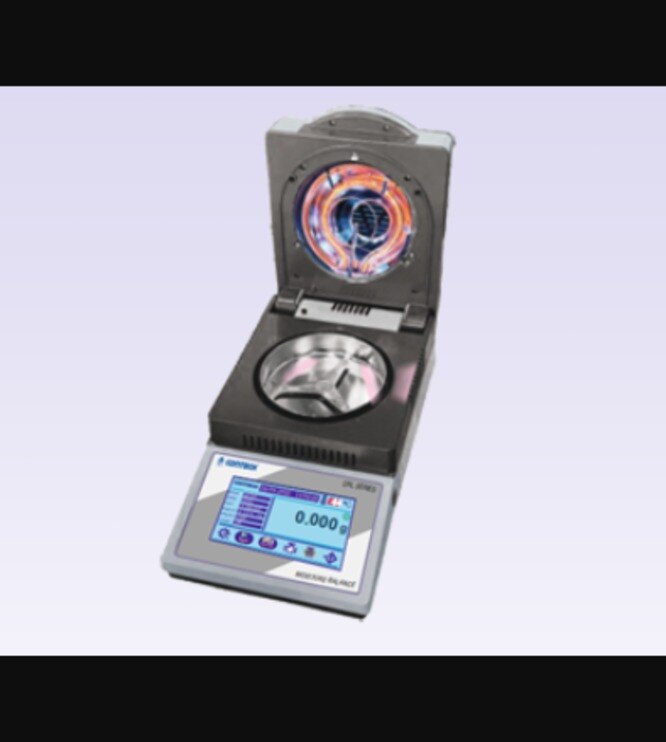
A halogen moisture analyzer can shorten testing for powders, granules, excipients, and finished products, but its result is mass loss, not automatically water content. By the end, you will know when the technique is suitable, how to build a defensible method, and when Karl Fischer titration or an oven-based procedure is the better choice.
Key takeaways
- Interpret results as mass loss unless you prove the loss is water.
- Use samples that tolerate heating without decomposition or volatile excipient loss.
- Set temperature, endpoint, sample mass, and preparation from a reference method.
- Compare analyzer results with a validated reference method before routine QC use.
What a halogen moisture analyzer actually measures
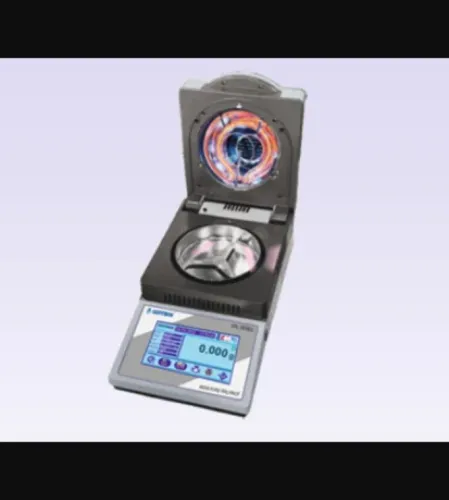
A halogen moisture analyzer measures mass lost during controlled heating, not water alone. A halogen radiator heats the sample directly at the pan while an integrated balance records mass continuously. The reported percentage normally equals mass loss divided by starting mass, multiplied by 100.
That loss can include water, residual solvents, volatile excipients, or decomposition products.
| Technique | What it measures | Key distinction |
|---|---|---|
| Halogen or infrared drying | Heated mass loss | The sample-temperature profile depends on the radiation source and method settings |
| Forced-air oven | Mass loss after specified heating | Air circulation and sample temperature can differ from halogen heating |
| Microwave drying | Mass loss after electromagnetic heating | Energy absorption can create a different heating pattern |
| Karl Fischer titration | Water through a chemical reaction | More specific when the specification says water content |
Do not assume matching temperatures produce matching results. Halogen heating can produce a different sample-temperature profile from a forced-air oven, so compare paired samples across the intended range before replacing an established procedure. USP <731> Loss on Drying requires the stated drying conditions and endpoint; USP <921> covers water determination.
Therefore, treat halogen moisture content analysis as a method-dependent loss-on-drying procedure, not a universal water assay. Label the result as moisture content only when the approved method supports that interpretation.
Which pharmaceutical materials suit the technique
Powders, granules, many compressed tablets, hygroscopic excipients, and process intermediates suit a halogen moisture analyzer when mass loss tracks the quality attribute you need to control. That makes the method useful for rapid moisture measurement during drying, blending, and incoming-material checks.
| Material | Suitability | Main condition |
|---|---|---|
| Powders and granules | Strong candidate | Control sampling and diffusion |
| Compressed tablets | Often suitable | Confirm uniform heating and complete drying |
| Hygroscopic excipients | Suitable with strict handling | Limit humidity and transfer exposure |
| Creams and ointments | Conditional | Spread evenly without separation, splattering, uncontrolled melting, oxidation, or unwanted component loss |
| Thermally unstable APIs or products | Poor candidate | Reject if decomposition begins before drying |
A low result does not prove dryness. A hard surface crust can trap moisture inside a granule or tablet, producing incomplete diffusion and a falsely low moisture determination.
Treat a material as unsuitable when it contains several volatile ingredients, reacts with oxygen, or requires water-specific measurement. Halogen drying measures total mass loss, so it cannot reliably distinguish water from residual solvents, volatile excipients, or decomposition products.
For hygroscopic samples, keep the container closed until transfer, control ambient humidity, mix consistently, shorten the interval between opening and starting the run, and record those conditions. Screen each API and finished product for thermal stability before routine testing.
Compare paired samples across the intended range with the existing oven or Karl Fischer procedure. Investigate bias, repeatability, and recovery or agreement before replacing the established test.
How to develop the heating and sample-preparation method
Choose the drying conditions from the material’s thermal behaviour and pharmacopoeial monograph, not from the analyzer’s default program. A repeatable moisture content analysis method removes the target volatile matter without melting, decomposing, oxidising, or removing unintended residual solvents.
1. Confirm the intended attribute. Use the monograph’s specified temperature, pressure, time, and endpoint for loss on drying. If the specification requires water content, do not assume that halogen moisture measurement is equivalent to Karl Fischer titration.
2. Run a temperature study across a safe range. Inspect each drying curve and the sample after testing. A sudden extra loss can indicate decomposition, a long tail can indicate incomplete diffusion, and crusting or a changed colour can show that the sample is being damaged.
3. Define the method parameters: ramp profile, drying temperature, endpoint or switching criterion, maximum test duration, pan type, cooling conditions, handling time, and acceptance limit. Record them in the controlled method; these settings materially affect moisture measurement.
4. Set sample mass from validation data, never from weighing capacity or a generic application note. Mix the material before taking the portion. Grind only when the approved procedure requires it, because grinding can generate heat or expose hygroscopic surfaces.
5. Specify particle-size treatment, break agglomerates consistently, and spread the portion in a thin, even layer. A thick or uneven bed creates temperature and diffusion differences, producing a stable-looking but incomplete endpoint.
This approach supports halogen moisture analyzer pharmaceutical quality control without sacrificing sample integrity. Validate the method across the intended range before using its moisture content analysis result for a pharmaceutical decision.
How to prove the result is fit for pharmaceutical QC
A release result is fit for purpose only when the validated method measures the intended attribute, not merely when the instrument displays a number. Under ICH Q2(R2), document accuracy, precision, specificity, linearity and range, robustness, and detection or quantitation capability where relevant.
| Method choice | Evidence required | Limitation |
|---|---|---|
| Halogen moisture analyzer | Paired-sample agreement across the specification range | Loss can include water, solvent, or decomposition products |
| USP <731> | Compliance with the monograph’s drying conditions and endpoint | It measures volatile mass loss, not water selectively |
| USP <921> or Karl Fischer | Water-specific procedure and current monograph compliance | Do not replace it with LOD without demonstrated equivalence |
Prove specificity by showing that the measured loss is not caused by decomposition, solvent evaporation, or another volatile component. Establish repeatability and intermediate precision across analysts, days, instruments, and relevant moisture levels. Compare paired samples with the official procedure across the full intended range, investigate bias and agreement, and check the current USP or Ph.
Eur. monograph before substitution.
Instrument qualification is separate from method validation. Site procedures must control balance performance, temperature measurement, endpoint behaviour, repeatability, calibration status, and data integrity. When reviewing CONTECH INSTRUMENTS LTD. or another supplier, request records supporting these controls rather than relying on speed or capacity.
The approved moisture determination record must include:
- Sample identity, batch, mass, preparation, pan, temperature profile, endpoint, duration, result, analyst, instrument, and every deviation.
That evidence makes moisture measurement defensible for release, stability, or in-process control.
Related product
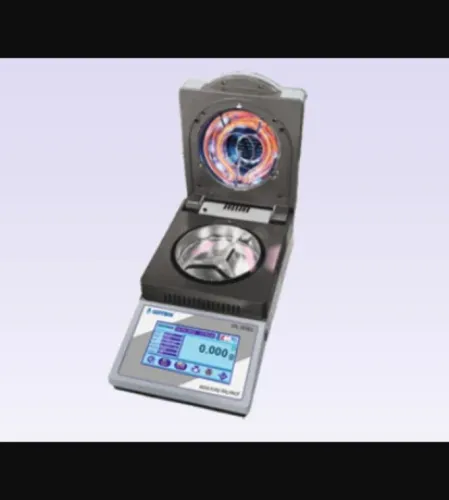
 | Moisture Balances Moisture Balances (CAL Series) (0.001 g to 180 g) Moisture Balances (CAL Series) (0.001 g to 180 g) The CONTECH CAL Series Moisture Balances are advanced moisture analyzers designed for fast,... View product → |
Where the analyzer adds value in the QC workflow
Use a halogen moisture analyzer for pharmaceutical quality control when its validated result tracks a controllable attribute: drying progress, granule conditioning, powder handling, or excipient moisture. It provides rapid moisture measurement for process decisions, but not an automatic replacement for an official method.
1. Identify the batch and take a representative portion. Minimise exposure during transfer, especially with hygroscopic powders and granules, because ambient humidity can change the moisture content analysis before heating begins.
2. Follow the approved preparation exactly: mixing, sample mass, particle-size treatment, pan loading, temperature profile, endpoint, and maximum duration. The operator can use the result to stop drying, investigate a batch trend, or screen incoming material before a longer confirmatory test.
3. Review the drying curve, not only the final percentage. Investigate a result that passes numerically but shows a sudden loss, prolonged tail, or other unusual profile indicating decomposition, crusting, or incomplete diffusion.
4. Use the result for release only when the specification, method validation, and comparability study support the reported attribute. Set the acceptance limit from product and process data, never from an instrument default.
If the monograph specifies water, use the specified water determination unless an approved equivalence study supports substitution. If it specifies loss on drying under USP <731>, reproduce its temperature, pressure, time, and endpoint or formally validate the alternative. The value is faster evidence for a defined decision, not merely faster testing.
Frequently asked questions
What does a halogen moisture analyzer actually measure?
It measures mass lost during controlled heating. The result represents water only when other volatile losses and decomposition are excluded or controlled.
Which pharmaceutical materials suit halogen moisture analysis?
Materials that release water without decomposing, splattering, crusting, or losing other volatile substances are the strongest candidates. Powders, granules, and selected excipients require method checks.
How do you develop a halogen moisture analyzer method?
Define sample mass, spreading thickness, heating temperature, endpoint, and preparation. Compare results across settings and confirm the selected method against a reference procedure.
How do you prove a moisture result is fit for pharmaceutical QC?
Demonstrate accuracy against a validated reference method, repeatability, intermediate precision, selectivity, and stability under the chosen heating conditions.