
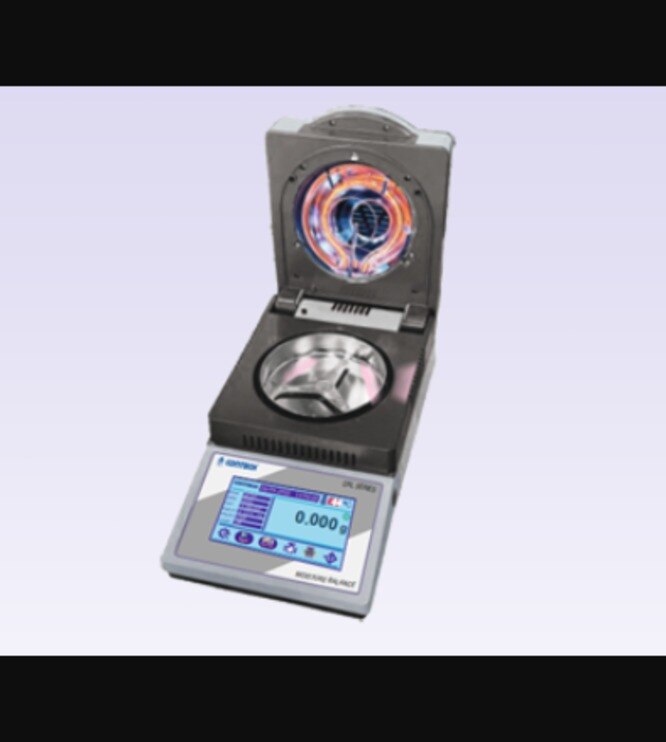
A moisture reading is the result of a controlled sequence: the instrument establishes the starting mass, heats a prepared sample, tracks the mass that leaves, and converts that change into a percentage. By following each stage, you can judge whether a result reflects water loss, poor sample preparation, or the loss of another volatile substance.
Key takeaways
- Tare the empty pan before weighing the sample.
- Track mass loss continuously as heating removes moisture.
- Calculate moisture percentage from starting mass and final dry mass.
- Validate LOD results with consistent sample preparation and temperature control.
How the Analyzer Establishes the Starting Mass
Before heating begins, the digital moisture analyzer establishes a reliable sample mass by removing the pan’s contribution from the measurement. The integrated balance does not detect water directly; it measures total mass, so every later moisture result depends on this starting value.
1. Place a clean, dry pan on the balance and seat it correctly. Residual product, fingerprints, a bent pan, air movement, vibration, or an unstable installation can shift the gravimetric signal.
2. Close the chamber and tare the pan. The analyzer records the pan as zero, allowing the next balance reading to represent the sample rather than the pan and its container.
3. Add the prepared sample without spilling it onto the heating chamber or balance area. Spread and record the portion consistently, because an uneven layer changes heating and drying behaviour even when the measured mass is correct.
4. The balance records the loaded sample’s mass and waits for a stable reading before heating starts. That stable value becomes the initial mass used in the moisture measurement; it is not an estimate based on the sample type.
Allow the analyzer’s chamber and balance to reach a stable starting condition before comparing measurements. Drafts, vibration, temperature changes, or a moving reading can produce a false initial mass, and every later percentage will inherit that error. The instrument then stores this value for comparison with the mass remaining after drying.
How Heating and Continuous Weighing Produce Mass Loss
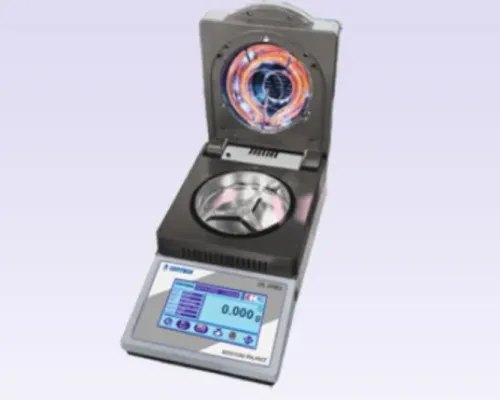
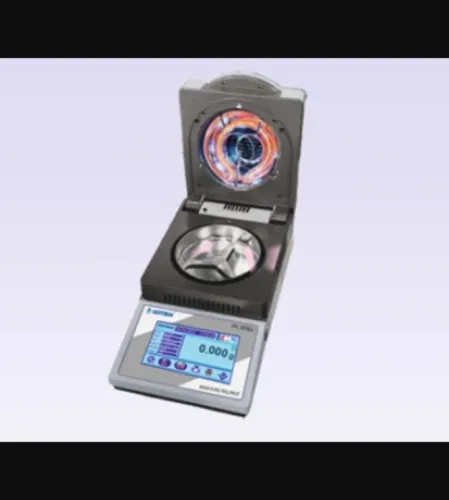
Once the sample is loaded, the pan sits on the integrated balance inside the heating chamber. The instrument records the starting mass, then applies controlled heat while the balance keeps measuring the sample without removing it from the chamber.
As water evaporates, the sample becomes lighter. The balance sends repeated mass readings to the control system, which compares each reading with the starting value. The heater and balance therefore operate as one system: heating drives evaporation, while weighing tracks the resulting loss.
A moisture balance instrument does not detect water molecules directly. It detects mass leaving the sample, so solvents, oils, fragrances, or decomposition products can also contribute to the measured loss. That is why moisture analysis requires a validated drying method before you label the result as water content.
The analyzer stops heating and weighing when its programmed endpoint is reached. Common endpoint rules include:
- A mass-loss rate below a specified limit for a defined period
- A fixed drying time
- A method-specific temperature and time combination
The displayed endpoint does not prove that every water molecule has been removed. Slow diffusion can stop the test too early, while overheating can cause decomposition and create extra mass loss. Record the drying temperature, endpoint rule, and observed changes such as bubbling or crust formation so you can explain an unexpected result.
How the Instrument Converts Mass Loss into Moisture Percentage
The displayed percentage depends on the denominator used. A digital moisture analyzer defines mass loss as initial mass minus final mass after drying, divides that loss by the selected reference mass, and multiplies by 100. It measures changing mass, not water molecules; solvents, oils, fragrances, or decomposition products can also leave during heating.
| Basis | Formula | Example using 10 g initial mass and 8 g final mass |
|---|---|---|
| Wet basis | (Initial mass − Final mass) ÷ Initial mass × 100 | 2 ÷ 10 × 100 = 20% |
| Dry basis | (Initial mass − Final mass) ÷ Final mass × 100 | 2 ÷ 8 × 100 = 25% |
The same specimen therefore has two legitimate values: wet basis expresses lost mass as a share of the original sample, while dry basis expresses it relative to the remaining dry material. Confirm the basis before comparing a certificate with your own moisture measurement.
The display should identify the basis, result, temperature program, and endpoint or drying time. Record the sample identity, preparation, sample mass, and observations such as bubbling or crusting, then repeat the test to assess variation. Without those conditions, a difference between results could reflect sampling, method, or non-water mass loss rather than instrument error.
How Sample Preparation and Temperature Control Affect the Result
Spread a representative portion thinly and evenly across the pan; a thick mound can trap moisture in its centre while the surface dries, causing a premature endpoint. Mix the bulk sample before taking the test portion, and grind coarse material only enough to improve uniformity.
Excessive grinding creates heat and can drive off moisture before the moisture balance instrument begins weighing.
- Record sample identity, preparation method, sample mass, temperature program, endpoint or drying time, result basis, and observations such as bubbling, crusting, smoke, or colour change.
- Use replicate measurements. A wide spread between replicates points to sampling or preparation variation, not automatically to an instrument fault.
- Select a temperature that removes moisture at a steady rate without browning, melting, splashing, or decomposing the sample.
- Treat an endpoint based on a small mass-loss rate as a method setting, not proof that all water has left. Slow diffusion can stop the test too soon; decomposition can keep mass falling too long.
| Program choice | Strength | Main risk |
|---|---|---|
| Lower temperature with longer drying | Protects heat-sensitive samples and reduces scorching | The test can take longer and diffusion can delay the endpoint |
| Validated moderate temperature with mass-loss endpoint | Balances speed and repeatability for routine moisture analysis | A crust or uneven layer can make the endpoint appear early |
| Higher temperature with fixed drying time | Shortens tests for stable, fast-drying materials | Surface sealing, splashing, decomposition, or loss of oils and solvents can inflate the result |
Report the wet- or dry-basis result with the temperature and endpoint, not simply as “moisture.”
How to Confirm That an LOD Result Means What You Think It Means
A loss-on-drying result is not automatically a water result: the balance records every substance lost during heating. Solvents, oils, fragrances, decomposition products, and reactive components can leave with water, so label the result “moisture” only after validating the method for that material.
1. Define the measurand and basis. Record wet-basis or dry-basis reporting, the temperature program, endpoint rule or drying time, and the reference method. Use Karl Fischer titration when the specification requires selective water determination.
2. Run replicate portions from the same prepared sample, then repeat across separately sampled material. Compare the spread, not just the average; uneven sampling, bubbling, crusting, or scorching can create larger differences than the balance itself.
3. Confirm agreement against an accepted method, such as Karl Fischer or a validated oven method, across low, medium, and high moisture levels. Investigate bias before approving the digital moisture analyzer for routine release or incoming inspection.
4. Keep a method record containing sample identity, preparation, portion mass, temperature profile, endpoint, result basis, replicate results, and observations. Without it, you cannot tell whether a changed result came from the instrument, sample variation, or method conditions.
For moisture analysis, a search for a digital moisture analyzer for moisture for analysis in Pune should focus on programmable heating, stable weighing, calibration controls, repeatability data, stored methods, and exportable records—not capacity alone. CONTECH INSTRUMENTS LTD. is one supplier to ask for evidence that its routine method settings suit your actual material.
Related product
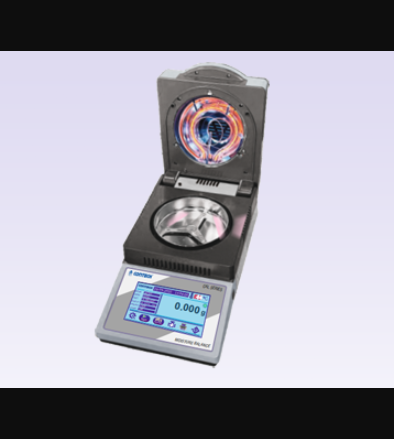 | Moisture Balances Moisture Balances (CAL Series) (0.001 g to 180 g) Moisture Balances (CAL Series) (0.001 g to 180 g) The CONTECH CAL Series Moisture Balances are advanced moisture analyzers designed for fast,... View product → |
Frequently asked questions
How does a digital moisture analyzer establish the starting mass?
It tares the empty sample pan, then records the combined mass of the pan and sample as the starting value.
How does heating produce a moisture result?
The analyzer heats the sample while its integrated balance records mass loss until the selected endpoint is reached.
How is moisture percentage calculated?
Moisture percentage equals the lost mass divided by the initial sample mass, multiplied by 100.
How can you confirm that an LOD result represents moisture?
Use a consistent sample preparation method, control temperature, and confirm that the material’s mass loss comes from water rather than solvents or volatile components.