
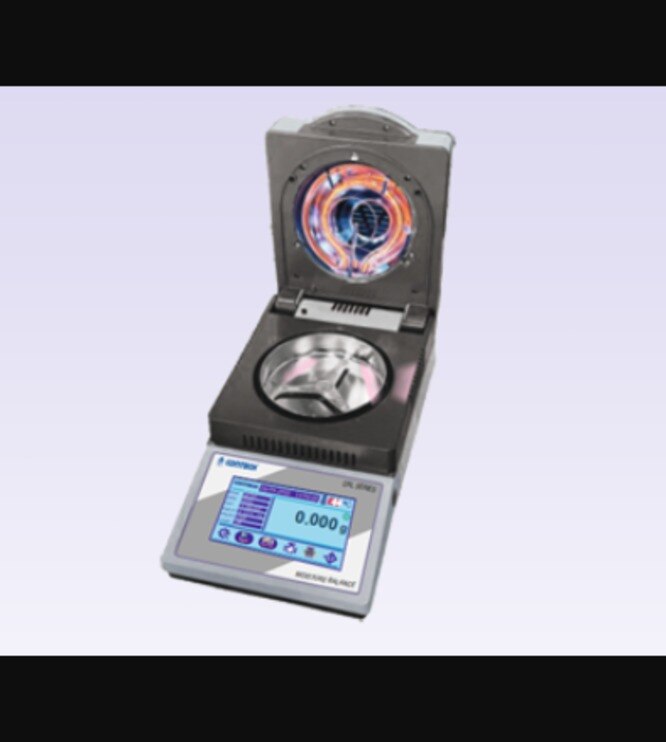
A moisture result is only useful when the laboratory controls what was heated, how it was weighed, which volatile substances were lost, and whether the calculation uses a wet or dry basis. By the end, you will be able to plan representative sampling, choose drying conditions, compare a moisture balance with an oven method, and document results that stand up to customer and ISO/IEC 17025 scrutiny.
Key takeaways
- Report mass loss as moisture only when the drying method supports that interpretation.
- Mix and reduce samples before weighing to avoid results from segregated material.
- Set temperature, time, and endpoint criteria for the material, not convenience.
- Use an oven for reference methods and a moisture analyzer for faster routine testing.
What moisture content analysis actually measures
A moisture result is a mass change, not automatically a water concentration. In moisture content analysis, the laboratory weighs the sample before heating, dries it under a specified programme, detects the endpoint, and weighs the remaining solids.
The lost mass is treated as moisture only when the method has been shown to exclude other volatile material and decomposition.
For a loss-on-drying method:
- Initial sample mass = m₀
- Dried residue mass = m₁
- Loss on drying (%) = [(m₀ − m₁) ÷ m₀] × 100
The result represents mass lost during that heating cycle. Volatile solvents, decomposition products, and bound water can all increase it. A moisture balance therefore needs comparison with a suitable reference procedure before you use it for release decisions.
State the calculation basis clearly. Wet-basis moisture is water mass divided by original sample mass. Dry-basis moisture is water mass divided by dry-solids mass. For example, 10% wet-basis moisture equals 11.11% dry-basis moisture, so a percentage without its basis can mislead comparisons with a supplier or specification.
A Pune laboratory should also record:
- Sample identification, initial mass, method, temperature, time, and endpoint
- Wet or dry basis, units, replicate results, and reported mean
- Pan exposure and cooling controls, especially during humid weather
Keep hygroscopic samples sealed until weighing and cool the residue in a desiccator. Otherwise, moisture measurement may capture handling-related moisture exchange rather than the sample’s condition.
How to prepare and load a representative sample
A wet sample can report a false low moisture value if you take only the dry-looking surface; a thick pan layer can create the same error by drying the surface before water escapes from the interior. Representative sampling and controlled spreading matter as much as the instrument.
1. Mix the bulk material before taking the test portion. Reduce particle size only if it improves uniformity without warming the sample; heat from grinding can drive off water. For volatile or hygroscopic material, prepare quickly, use sealed milling, or analyse an unground portion immediately.
2. Protect the portion from ambient air and record its mass promptly. Keep the container closed between mixing and weighing, and do not leave powder exposed while moisture analyzers wait for a run.
Select sample mass by validated repeatability and uncertainty, not displayed readability alone; a 0.001 g display does not prove that a 1 g portion supports 0.1% accuracy.
3. Place the portion at the pan centre and spread it into a thin, even layer. Do not pile, compress, or load beyond the validated amount: an overloaded or uneven pan lengthens drying and can fool the endpoint system. Validate mass and layer thickness for each matrix.
4. Run duplicates when establishing or checking the method. Compare their moisture measurement results, and investigate a difference before averaging; inconsistent preparation can masquerade as a material change.
Use the same mixing, timing, mass, and spreading technique in every run. Record the initial sample mass and pan condition with the result.
How to choose drying conditions for each material
Choose the lowest temperature that removes the target moisture within a practical time without decomposing the matrix or driving off other volatiles. A moisture balance analyzer does not know whether the lost mass was water: its result depends on the temperature program, heating rate, endpoint criterion, sample mass, and layer thickness.
| Matrix | Starting basis | Decision on loss on drying |
|---|---|---|
| Soil or mineral material | 105–110 °C, following ASTM D2216 | Suitable when the laboratory follows the specified oven procedure. Demonstrate any rapid analyzer method against ASTM D2216 before replacing it. |
| Cereals and cereal products | The grinding, test portion, temperature, and time specified by ISO 712 | Suitable only when the method is verified against the applicable ISO 712 procedure; a general analyzer program is not automatically equivalent. |
| Solvent-bearing, heat-sensitive, or reactive material | A validated lower-temperature program or a water-specific reference method | Reject loss on drying when solvent evaporation, decomposition, or bound-water release contributes materially to the mass loss. |
Test whether the reported loss represents water for the matrix, rather than assuming it does. Compare analyzer results with an established reference method across low, normal, and high-moisture samples; investigate bias before routine use.
Validate the sample mass and spread thickness as well as temperature. An overloaded or thick pan can dry at the surface while retaining moisture underneath, causing a false endpoint. If the material changes colour, smokes, crusts, or gives inconsistent replicates, reduce the temperature or choose a water-specific method instead.
Record the complete program so moisture content analysis remains comparable between runs.
Moisture balance analyzer or oven: which workflow fits your laboratory?
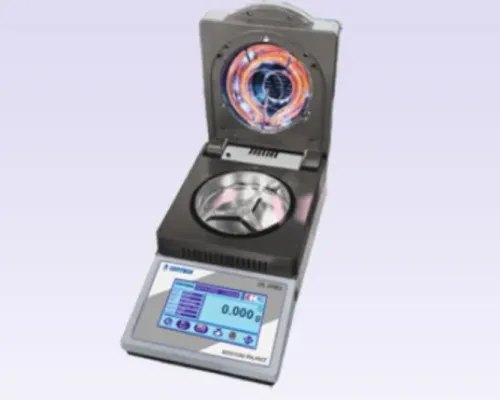
Choose an integrated moisture balance when you need a rapid, repeatable screening result and the same matrix is tested regularly. It combines weighing, controlled heating, continuous mass measurement, and endpoint detection in one workflow, removing the transfer and reweighing steps required with an oven.
| Workflow | Practical advantage | Main control point | Best fit |
|---|---|---|---|
| Moisture balance analyzer | Gives a result directly after programmed drying; uses less handling and bench space | Validate sample mass, layer thickness, temperature, endpoint, and drying curve | Routine batches, in-process checks, and high sample throughput |
| Hot-air oven plus external balance | Separates drying from weighing and accommodates larger loads or established reference methods | Control oven temperature, cooling in a desiccator, balance performance, and weighing time | Reference testing, larger samples, or methods that specify an oven |
The integrated option does not make poor loading harmless. A thick layer, overloaded pan, or unsuitable endpoint can dry the surface while moisture remains inside, so moisture analyzers still require matrix-specific method checks.
For moisture content analysis, testing laboratories in Pune should choose the faster workflow only after comparing repeatability against the laboratory’s oven method. Record balance checks, temperature verification, sample mass, program settings, and representative reference results under ISO/IEC 17025 controls.
CONTECH INSTRUMENTS LTD. is one source to evaluate when comparing moisture-balance specifications, but the validated method—not the instrument label—determines fitness for purpose.
Use Karl Fischer titration under ISO 760 when the specification is water specifically or oven heating would evaporate solvents or decompose the sample.
Related product
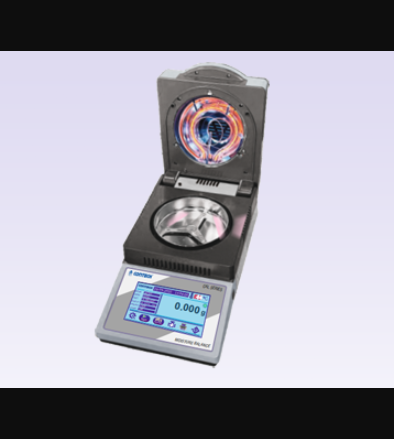 | Moisture Balances Moisture Balances (CAL Series) (0.001 g to 180 g) Moisture Balances (CAL Series) (0.001 g to 180 g) The CONTECH CAL Series Moisture Balances are advanced moisture analyzers designed for fast,... View product → |
How to make moisture measurement defensible over time
A method remains defensible when routine checks, traceable records, and comparison results show that it still measures the intended property. Under ISO/IEC 17025, record the instrument identification, balance verification, temperature verification, method version, sample condition, operator, raw masses, endpoint, calculation, and any deviation.
- Verify the balance with traceable test weights at the working range and investigate results outside the laboratory’s acceptance limit.
- Verify oven or analyzer temperature at the actual setpoint, not only the displayed value.
- Run replicate portions to track repeatability, using control material or a retained sample with an established result.
- Record maintenance, software changes, failed checks, corrective action, and the decision to release or reject data.
- Reconfirm sample mass and layer thickness after changing pans, grinding equipment, temperature, drying time, or endpoint settings.
Use comparison studies to prove that moisture content analysis remains fit for its stated purpose:
| Study | Compare | Evidence to review |
|---|---|---|
| Routine repeatability | Duplicate or triplicate portions | Difference against the laboratory limit |
| Method comparison | Analyzer versus the validated oven method | Bias across low, medium, and high moisture samples |
| Reference comparison | Result versus a traceable reference or proficiency-test value | Agreement with the assigned value |
| Specificity check | Loss on drying versus Karl Fischer under ISO 760 | Difference showing whether volatile compounds affect the result |
For cereals, compare with the complete ISO 712 procedure rather than assuming an analyzer program is equivalent. If the specification concerns water alone, investigate Karl Fischer before defending a loss-on-drying result.
Frequently asked questions
What does moisture content analysis actually measure?
It measures the sample’s mass change after drying. Report it as water concentration only when the method shows that the lost mass represents water rather than solvents or volatile compounds.
How do you prepare a representative sample for moisture testing?
Mix the material, reduce it without changing its moisture, and weigh a defined portion quickly in a covered container. Spread the portion evenly to support consistent drying.
How do you choose drying conditions for each material?
Use the specified standard method when one exists. Otherwise, select a temperature and endpoint that remove water without decomposing the sample, evaporating other components, or forming a dry surface that traps moisture.
Should a laboratory use a moisture balance analyzer or an oven?
Choose an oven when a reference method, larger sample, or confirmatory result matters. Choose a moisture balance analyzer for rapid routine testing when its heating programme and endpoint agree with a validated reference method.
How can a laboratory make moisture measurement defensible over time?
Document the sample identity, mass, temperature, programme, endpoint, operator, and result. Check repeatability with control samples, verify the balance, and compare analyzer results with an oven method during validation.