

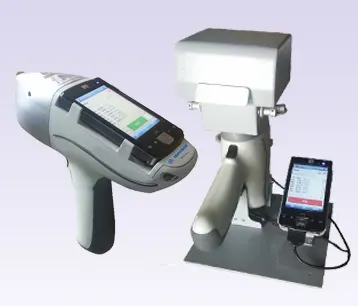
GOLD PURITY CHECKING INSTRUMENTS X-Ray Fluorescence Spectrometer Handheld Detector X-Ray Fluorescence Spectrometer Handheld Detector (Si-PIN / SDD) – CGX-104 The X-Ray Fluorescence (XRF) Spectrometer is designed for the rapid detection and analysis of precious and noble metals used in the jewellery industry. It accurately identifies and measures the composition of metals including Gold (Au), Silver (Ag), Platinum (Pt), Iridium (Ir), Osmium (Os), Palladium (Pd), Rhodium (Rh), Ruthenium (Ru), Copper (Cu), Zinc (Zn), Nickel (Ni), Cadmium (Cd), Iron (Fe), Cobalt (Co), Indium (In), and Tin (Sn). The Energy Dispersive X-Ray Fluorescence (EDXRF) technique uses a high-performance detector and advanced detection circuitry to resolve spectral peaks generated when a primary X-ray beam strikes a metal alloy. Each element emits X-rays with unique energy levels, and the intensity of the emitted spectrum is directly proportional to the concentration of that element. Powerful analysis software processes the spectrum and accurately reports the elemental composition of the sample. The XRF Gold Purity Tester consists of an X-ray tube, high-voltage power supply, X-ray tube filters, X-ray fluorescence detector, processing electronics, system interface, and an external computer. An integrated camera allows users to view the sample directly on the computer screen for precise positioning and analysis. Features • Fast and non-destructive precious metal analysis. • Suitable for jewellery manufacturers, refiners, hallmarking centres, laboratories, and quality control applications. • Detects and analyzes Gold, Silver, Platinum, Palladium, Rhodium, Copper, Zinc, Nickel, Iron, Tin, and other precious metals. • Advanced Energy Dispersive X-Ray Fluorescence (EDXRF) technology. • High-precision elemental composition analysis. • Integrated camera for live sample viewing. • User-friendly software for quick and accurate reporting. • Compact handheld design for easy operation. • High accuracy and repeatability. • Ideal for quality control and metal verification. Specifications X-Ray Tube: Tungsten anode, 40 kV, 100 µA with 5 filter positions Detector Type: Solid-state Si-PIN diode with thermo-electric cooling (Optional SDD) Active Area: 6 mm² Energy Resolution: Less than 165 eV at 5.9 keV (Less than 140 eV for SDD) Display: High-resolution 4-inch color touchscreen Supported Operating Systems: Windows CE / Mobile for PDA Windows XP / Vista / 7 for PC Battery Operating Time: Up to 8 hours Dimensions: 242 mm (L) × 78 mm (W) × 230 mm (H) Weight (with Battery): 1230 g (Standard) 1440 g (Optional Configuration) Calibration XRF is a reference analytical technique; therefore, certified standards are required for quantitative analysis. Known standards are analyzed to generate spectral intensity versus concentration calibration curves. These calibration curves are then used to determine the elemental composition of unknown samples with high accuracy. How to Get the Best Results from the XRF Spectrometer • Proper standardization and calibration of the instrument are essential for accurate and reliable results. • For intricate jewellery designs, perform testing at multiple points to obtain the most representative composition. • Allow adequate warm-up time before testing. • Use the instrument on a sturdy and vibration-free working surface. • Ensure a stable power supply, proper grounding, and a controlled operating environment. • For powder samples, proper grinding minimizes scattering effects and improves accuracy. • For solid samples, surface polishing helps reduce scattering effects. • Flat sample surfaces provide the most accurate measurement results. • Due to differences in melting points, atomic structures, and manufacturing techniques, certain elements may not uniformly alloy with noble metals, which can influence analysis results.
Address
207, 2nd Flr., So Lucky Corner, Opp Chakala Church, Opp. Balmukund Party Hall, Opp. Hindustan Petroleum Pump, Chakala,
Mumbai, India, 400099